
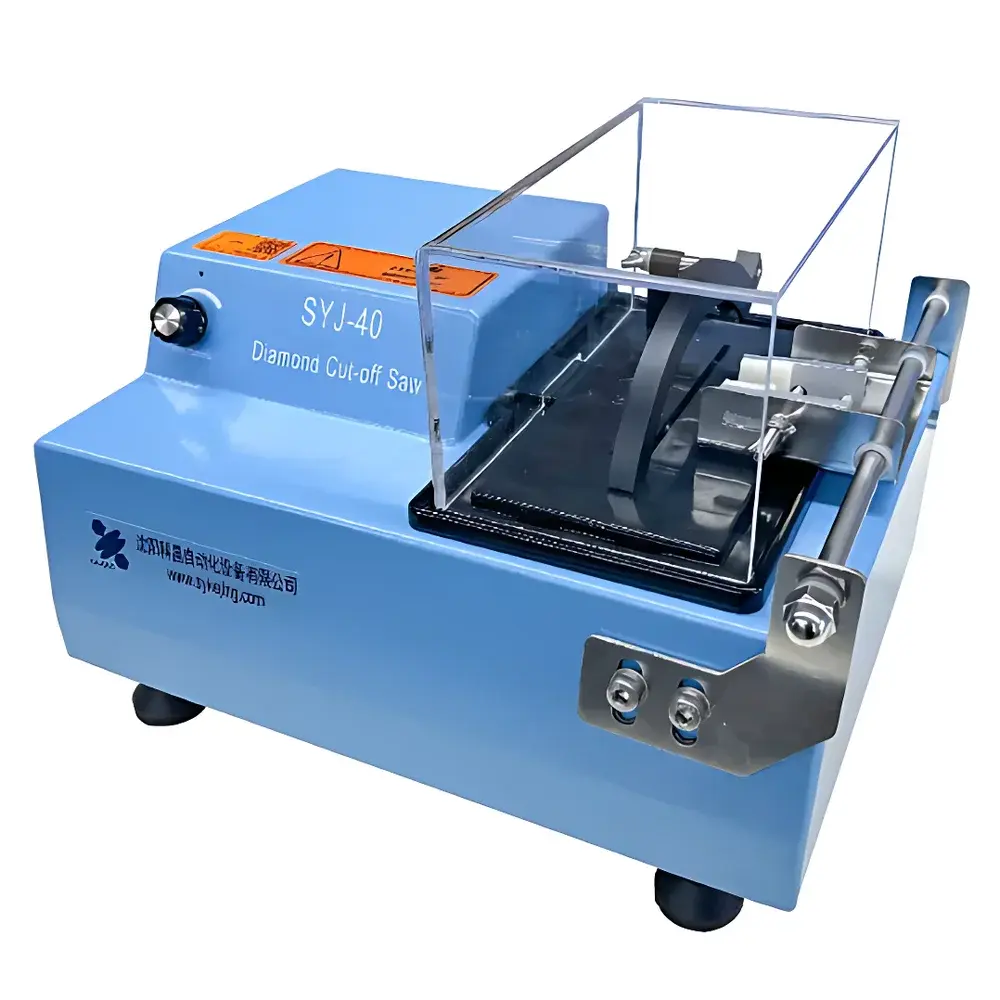
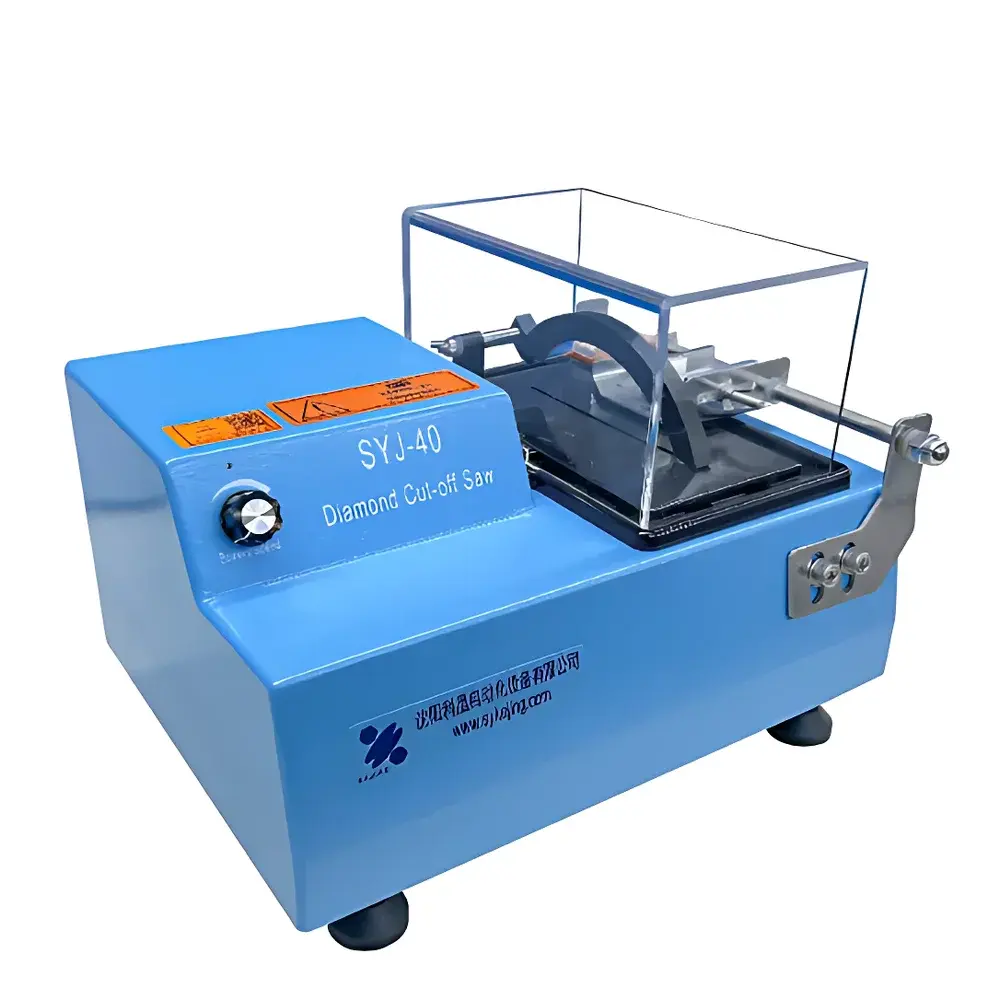
KJ GROUP SYJ-40 Manual Precision Abrasive Cutting Machine
| Brand | KJ GROUP |
|---|---|
| Origin | Liaoning, China |
| Manufacturer Type | Authorized Distributor |
| Country of Origin | China |
| Model | SYJ-40 |
| Instrument Type | Abrasive Wheel Cutting Machine |
| Power Supply | AC 100–240 V, 50/60 Hz, 10 A (with DC24V/11.67A adapter) |
| Total Power Consumption | 100 W |
| Motor | DC24V, 90 W, 5.2 A, max 2500 rpm |
| Effective Spindle Speed Range | 650–2500 rpm |
| Blade Diameter | Ø100 mm |
| Maximum Sample Cross-Section | 25 mm × 40 mm |
| Dimensions (L×W×H) | 390 × 285 × 290 mm |
| Weight | 7 kg |
| Operating Environment | 0–45 °C, 10–85% RH (non-condensing) |
| Safety Compliance | Grounded three-pin AC input required |
Overview
The KJ GROUP SYJ-40 Manual Precision Abrasive Cutting Machine is a compact, benchtop abrasive sectioning system engineered for controlled, low-dust, low-noise coarse sectioning of brittle and hard materials in academic and research laboratory environments. It operates on the principle of mechanical abrasion using rotating bonded abrasive or diamond-impregnated wheels, where material removal occurs via micro-fracture and grain attrition under applied manual feed force and continuous aqueous coolant delivery. Unlike automated or CNC-driven cutters, the SYJ-40 employs direct hand-guided linear advancement—enabling real-time tactile feedback during cutting—making it especially suitable for preliminary sample preparation of heterogeneous or fragile specimens where overcutting or thermal damage must be avoided. Its DC-motor-driven spindle delivers stable rotational torque across a wide speed range (650–2500 rpm), allowing optimization for varying hardness and fracture toughness—e.g., slower speeds for quartz or sapphire, higher speeds for PCB substrates or soft metals. The integrated water reservoir design prevents external leakage, ensuring consistent coolant flow to the cutting interface while minimizing lab floor contamination and conserving water volume.
Key Features
- Manually controlled linear feed mechanism for precise, operator-responsive sectioning with immediate adjustment of cutting rate and pressure
- Infinitely variable spindle speed control (650–2500 rpm) via regulated DC motor drive—optimized for diverse material classes without gear shifting or mechanical transmission loss
- Compact footprint (390 × 285 × 290 mm) and lightweight construction (7 kg) enabling flexible placement on fume hoods, laminar flow benches, or shared prep stations
- Corrosion-resistant chassis and sealed internal coolant reservoir—eliminates external drips and supports long-term operation in humid or chemically exposed lab settings
- Low acoustic emission (<65 dB(A) typical at 1 m distance) and minimal vibration due to balanced rotor assembly and rigid base mounting
- Dual-voltage compatible power architecture: accepts universal AC input (100–240 V, 50/60 Hz) and converts internally to regulated DC24V for motor and control circuitry
Sample Compatibility & Compliance
The SYJ-40 accommodates a broad spectrum of non-ferrous and ceramic-based materials requiring initial gross sectioning prior to polishing or mounting—including single crystals (Si, GaAs, LiNbO₃), technical ceramics (Al₂O₃, ZrO₂), fused silica and borosilicate glass, FR-4 and polyimide PCBs, geological thin-section precursors (granite, basalt, shale), and metallurgical specimens (as-cast alloys, heat-treated steels). All standard blade types—electroplated diamond (Ø100 × 0.4 mm), silicon carbide, and alumina—are ISO 6344-compliant bonded abrasives rated for dry/wet cutting applications. The device meets IEC 61000-6-3 (EMC emission limits) and IEC 61000-6-2 (immunity to electrostatic discharge and conducted RF disturbances). While not certified to UL or CE for standalone medical or industrial production use, its grounded AC interface, thermal cutoff protection, and enclosed wheel guard conform to general laboratory safety practices per ANSI Z9.2 and ISO 15223-1 labeling requirements.
Software & Data Management
The SYJ-40 is a fully manual, analog-operated instrument with no embedded firmware, touchscreen interface, or digital data logging capability. Operational parameters—including spindle speed setting, feed rate, and coolant flow—are monitored and adjusted directly by the user without software mediation. Consequently, no drivers, configuration files, or cybersecurity protocols apply. This architecture ensures deterministic behavior, eliminates firmware update dependencies, and satisfies laboratories operating under strict GLP or ISO/IEC 17025 environments where traceability of manual interventions is documented via procedural logs rather than electronic audit trails. No FDA 21 CFR Part 11 compliance is claimed or required, as the unit generates no electronic records.
Applications
- Preliminary sectioning of mineralogical samples for petrographic thin-section fabrication in geoscience departments
- Rapid isolation of die-level silicon wafers or compound semiconductor substrates prior to cross-sectional SEM analysis
- Controlled truncation of optical crystals (e.g., BBO, KDP) for laser cavity alignment studies
- Dimensional reduction of sintered ceramic compacts before density or porosity measurement (ASTM C20, ISO 5017)
- Pre-mounting segmentation of metallographic coupons from as-received stock, preserving microstructural integrity during hot/cold mounting
- Educational demonstration of abrasive wear mechanics and material-specific cutting response in materials science curricula
FAQ
What types of blades are supported, and how are they secured?
The SYJ-40 accepts standard Ø100 mm arbor-mounted abrasive wheels with 12.7 mm center holes. Blades are clamped using dual stainless-steel flanges and a precision-ground arbor shaft—ensuring runout < 0.05 mm at full speed.
Is coolant flow adjustable?
Yes—the integrated reservoir includes a manually operated needle valve that regulates drip rate; typical output ranges from 15–60 mL/min depending on viscosity and nozzle geometry.
Can the machine be used without water cooling?
No. Continuous aqueous coolant is mandatory to suppress dust generation, prevent thermal cracking in brittle materials, and extend blade service life. Dry operation voids warranty and violates OSHA respirable crystalline silica exposure guidelines.
What maintenance is required?
Monthly inspection of blade flange threads, arbor cleanliness, and reservoir seal integrity; annual lubrication of feed slide rails with silicone-free PTFE grease; replacement of worn coolant tubing every 12 months.
Does KJ GROUP provide application support for unconventional materials?
Yes—technical documentation includes empirically derived speed/feed recommendations for >35 material categories; custom fixture design services (e.g., geological thin-section jigs) are available under NDA upon request.
Related Products



