
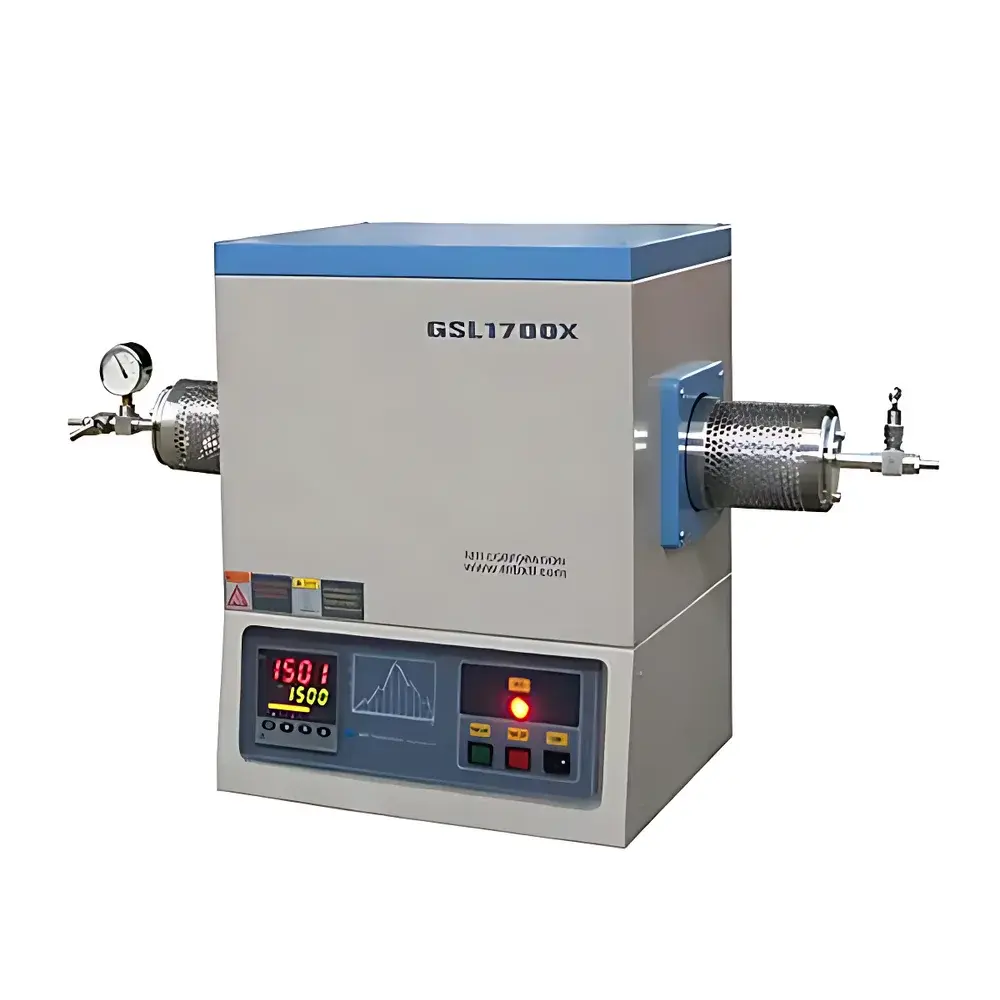
KJ GROUP GSL-1700X High-Temperature Vacuum & Atmosphere Tube Furnace
| Brand | KJ GROUP |
|---|---|
| Origin | Liaoning, China |
| Manufacturer Type | Authorized Distributor |
| Country of Origin | China |
| Model | GSL-1700X |
| Heating Element | 1700°C-rated Molybdenum Disilicide (MoSi₂) Rods |
| Max Temperature | 1700°C (≤2 h), Continuous Operation at 1650°C |
| Heating Zone Length | 457 mm |
| Uniform Zone Length | 150 mm |
| Temperature Control Accuracy | ±1°C |
| Thermocouple Type | Type B (Platinum/Rhodium) |
| Vacuum Level | ≤1×10⁻² Torr (with dual-stage rotary vane pump) |
| Power Supply | AC 220 V, 50/60 Hz, 5.2 kW (30 A circuit breaker required) |
| Alumina Tube Dimensions | Ø60 mm OD / Ø54 mm ID × 1000 mm L or Ø80 mm OD / Ø74 mm ID × 1000 mm L |
| External Dimensions | 590 × 490 × 740 mm |
| Net Weight | 150 kg |
| Cooling | Dual-layer shell with forced-air cooling |
| Insulation | High-purity alumina fiber |
| Temperature Programming | 30-segment PID controller |
| Safety Certification | CE-compliant |
| Surface Temperature | <55°C under full load |
Overview
The KJ GROUP GSL-1700X is a high-precision, programmable tube furnace engineered for controlled thermal processing under vacuum or inert/reducing atmospheres. It utilizes molybdenum disilicide (MoSi₂) heating elements rated to 1700°C, enabling stable operation up to 1650°C continuously and short-term excursions to 1700°C for material synthesis, sintering, annealing, and chemical vapor deposition (CVD) precursor decomposition. The furnace employs a double-walled stainless steel chamber with integrated forced-air cooling and high-purity alumina fiber insulation—optimized to minimize radial thermal gradient and maximize energy efficiency. Its design conforms to fundamental requirements for laboratory-scale high-temperature process reproducibility, including uniform axial temperature distribution across a 150 mm hot zone and precise thermocouple-based feedback control via a 30-segment PID algorithm.
Key Features
- Dual-shell construction with active air-cooling system ensures external surface temperature remains below 55°C during extended operation at maximum temperature.
- High-density alumina fiber insulation provides low thermal conductivity and long service life under repeated thermal cycling.
- 30-step programmable PID temperature controller supports complex ramp-hold-cool profiles, with independent settings for heating rate, dwell time, and cooling rate.
- CE-certified electrical architecture includes over-temperature protection, ground-fault detection, and thermal cut-off switches compliant with IEC 61000-6-2/6-4 immunity and emission standards.
- Standard configuration includes two interchangeable high-purity alumina tubes (Ø60/Ø54 mm and Ø80/Ø74 mm), each 1000 mm in length, compatible with standard KF25 and ISO-KF vacuum flange interfaces.
- Integrated B-type thermocouple with cold-junction compensation delivers measurement accuracy of ±1°C within the operational range (300–1700°C).
Sample Compatibility & Compliance
The GSL-1700X accommodates cylindrical samples up to 52 mm (for Ø60 mm tube) or 72 mm (for Ø80 mm tube) in diameter, with unrestricted length within the 1000 mm tube. It supports crucibles made from alumina, quartz, graphite, or silicon carbide—subject to compatibility with process atmosphere and temperature. When configured with optional corrosion-resistant digital vacuum gauge and stainless-steel double-ferrule compression fittings, the system meets baseline requirements for GLP-aligned CVD process documentation. While not inherently 21 CFR Part 11 compliant, its analog PID controller output can be interfaced with validated data acquisition systems supporting audit trails, electronic signatures, and secure user access control—enabling integration into GMP-regulated R&D workflows upon third-party validation.
Software & Data Management
The base unit operates via front-panel keypad and LCD interface; however, optional PC-based control software enables remote monitoring, real-time graphing, and automated data logging (timestamped temperature, setpoint, and power output). Logged files are exported in CSV format for post-processing in MATLAB, Python (NumPy/Pandas), or statistical analysis platforms. The software supports alarm-triggered email notifications (via SMTP relay), configurable data sampling intervals (1–60 s), and export of calibration reports traceable to NIST-traceable reference thermocouples. All firmware updates are delivered as signed binaries to ensure integrity and version control.
Applications
- Solid-state synthesis of oxides, nitrides, and carbides (e.g., LiCoO₂, SiC, TiN) under Ar/N₂/H₂ atmospheres.
- Controlled oxidation studies of refractory metals and alloys using precisely regulated O₂ partial pressure.
- Thermal annealing of graphene and transition metal dichalcogenide (TMD) monolayers on insulating substrates.
- Preparation of catalyst supports and metal–organic framework (MOF) derivatives via solvent-free pyrolysis.
- Calibration and aging tests of high-temperature sensors and thermoelectric materials per ASTM E230/E220 protocols.
- Low-pressure sintering of nanostructured ceramics where grain growth suppression requires rapid quenching from 1600°C+.
FAQ
What vacuum level can the GSL-1700X achieve with the standard pump configuration?
With the included dual-stage rotary vane pump, the system reaches ≤1×10⁻² Torr after 45 minutes of pumping from atmospheric pressure.
Is the furnace suitable for hydrogen atmosphere processing?
Yes—when equipped with H₂-compatible stainless-steel flanges, leak-tested O-rings, and appropriate gas flow controllers, it supports safe operation at up to 5% H₂ in Ar (per ISO 10156 classification).
Can the temperature profile be logged internally without connecting to a PC?
No—the base controller does not include non-volatile memory for autonomous logging; external data acquisition or optional PC software is required.
What maintenance is recommended for MoSi₂ heating elements?
Elements should be visually inspected before each high-temperature cycle for warping or surface scaling; replacement is advised after ~500 hours cumulative operation above 1500°C.
Does the furnace meet ASTM C1247 or ISO 8501 surface preparation standards?
No—those standards pertain to abrasive blast cleaning of metallic substrates; the GSL-1700X is not a surface preparation tool but a thermal processing instrument.



