
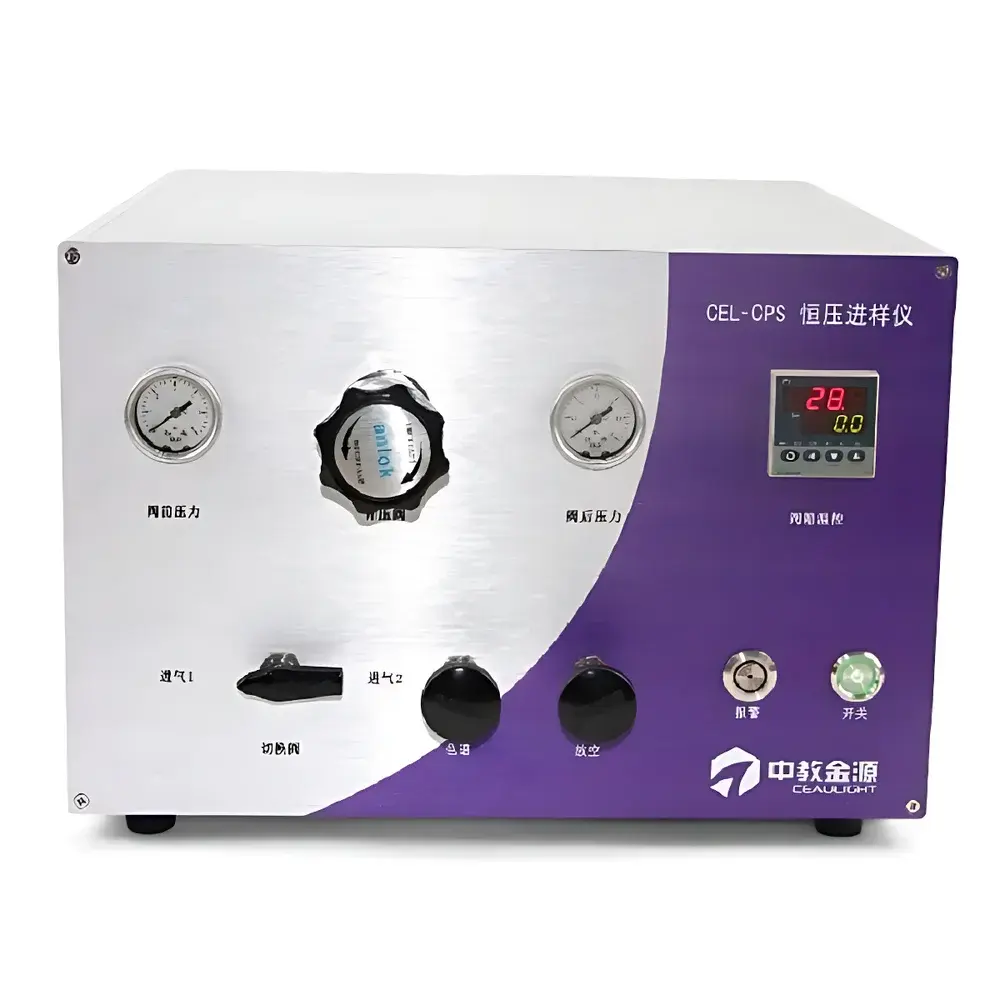
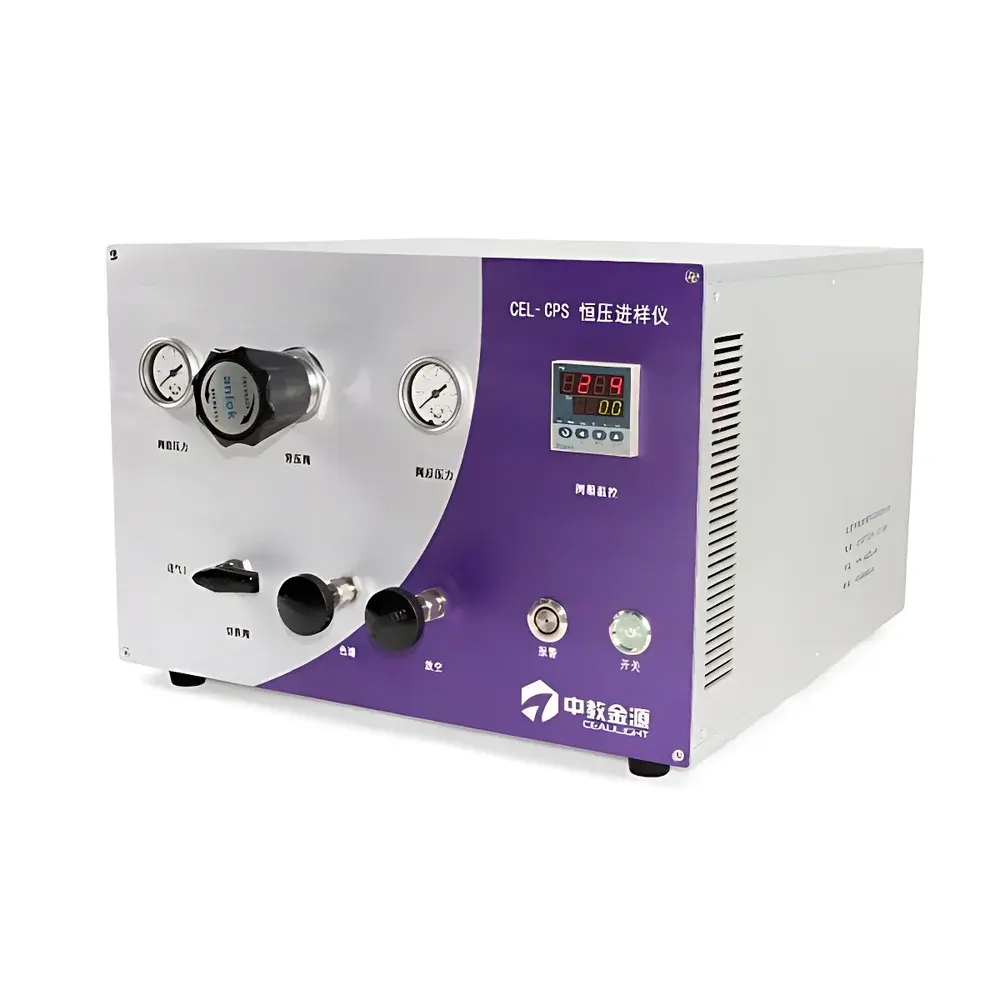
CEL-CPS Constant-Pressure Sample Introduction System
| Brand | CEAULIGHT (Zhongjiao Jinyuan) |
|---|---|
| Origin | Beijing, China |
| Manufacturer Type | OEM Manufacturer |
| Country of Origin | China |
| Model | CEL-CPS |
| Pricing | Upon Request |
| Inlet Pressure | <6 MPa (optional upgrade to 10 MPa) |
| Inlet Ports | 2 independent, electrically actuated for automatic switching |
| Outlet Pressure | <0.6 MPa |
| Outlet Ports | 2 dedicated channels (one for GC coupling, one for high-flow venting) |
| Flow Control | U.S.-sourced Dwyer digital flow meter with ±1% FS accuracy |
| Valves & Fittings | U.S.-imported ANLOK® stainless steel compression fittings and solenoid valves |
| Dimensions (W×H×D) | 300 × 410 × 186 mm |
Overview
The CEL-CPS Constant-Pressure Sample Introduction System is an engineered interface module designed specifically for coupling high-pressure catalytic or thermochemical reaction systems with gas chromatography (GC) analyzers in real-time, online monitoring configurations. It operates on the principle of pressure-regulated sample transfer: maintaining a stable, user-defined upstream pressure while delivering a precisely metered, low-pressure stream to the GC injection port. This enables continuous, representative sampling from reactors operating at pressures up to 6 MPa (with optional 10 MPa-rated configuration), without compromising GC column integrity or detector stability. Unlike passive bleed or manual sampling methods, the CEL-CPS integrates active pressure regulation, dual-path inlet selection, and calibrated mass flow control — ensuring reproducible residence time, minimal dead volume, and quantitative transfer of volatile and semi-volatile species across dynamic reaction conditions.
Key Features
- Two independently controllable high-pressure inlet ports with electrically actuated ANLOK® solenoid valves, enabling automated switching between parallel reactors or feed streams without manual intervention.
- Integrated precision pressure regulation system with dual-stage stainless steel regulators, maintaining outlet pressure ≤0.6 MPa regardless of upstream fluctuations within the rated range.
- Dwyer Series 4000 digital flow meter (U.S.-sourced, NIST-traceable calibration certificate available), providing real-time volumetric flow readout and fine-tuning capability for GC-compatible flow rates (typically 1–50 mL/min, He or N₂ carrier).
- Dedicated dual-outlet architecture: one optimized for direct connection to standard GC split/splitless injectors (1/16″ SS tubing, Swagelok®-compatible), and a second high-capacity vent line with adjustable needle valve for safe, controlled release of excess process gas.
- Compact modular chassis (300 × 410 × 186 mm) constructed entirely from 316 stainless steel with electropolished internal surfaces; fully compatible with laboratory fume hoods and integrated reactor skids.
- Optional pressure transducer outputs (0–10 V or 4–20 mA) and RS485 Modbus RTU interface for integration into SCADA or LabVIEW-based process control environments.
Sample Compatibility & Compliance
The CEL-CPS supports gaseous and vapor-phase samples from heterogeneous catalysis, supercritical fluid reactions, hydrothermal synthesis, and Fischer–Tropsch processes. It is chemically compatible with H₂, CO, CO₂, CH₄, NH₃, light hydrocarbons (C₁–C₆), and inert carriers (Ar, N₂, He). All wetted materials conform to ASTM A269 TP316L specifications. The system meets mechanical safety requirements per ISO 4414 (pneumatic fluid power) and ASME B31.3 (process piping). For regulated laboratories, its optional analog/digital I/O supports audit-trail-capable data logging aligned with FDA 21 CFR Part 11 and GLP/GMP documentation workflows when paired with compliant software platforms.
Software & Data Management
While the CEL-CPS operates as a hardware-integrated subsystem without embedded firmware, it is fully interoperable with third-party control software via its analog and digital interfaces. When used with GC systems equipped with OpenLab CDS, Chromeleon, or Empower, pressure and flow setpoints can be logged synchronously with chromatographic data. Optional Python API drivers (provided upon request) enable script-based sequence control — e.g., triggering inlet port switch upon detection of specific retention time windows or reactor temperature thresholds. All configuration parameters (pressure setpoints, valve timing, flow limits) are stored in non-volatile memory and survive power cycling.
Applications
- Real-time kinetic profiling of CO₂ hydrogenation catalysts under 3–6 MPa H₂ partial pressure.
- In situ monitoring of methane reforming reactions with simultaneous quantification of H₂, CO, CO₂, and C₂₊ hydrocarbons.
- Online analysis of biomass-derived syngas composition during pressurized pyrolysis/gasification trials.
- Dynamic headspace sampling from high-pressure electrochemical cells for product evolution studies.
- Method development for USP and ASTM D1945-compliant gas purity verification in specialty chemical synthesis lines.
FAQ
Can the CEL-CPS be used with capillary GC columns requiring ultra-low flow rates (e.g., <1 mL/min)?
Yes — the Dwyer flow meter and integrated needle valve allow stable operation down to 0.5 mL/min with helium carrier, provided backpressure is managed via GC inlet configuration.
Is explosion-proof certification available for hazardous area installation?
Standard units are rated for Class 1, Division 2 environments; ATEX or IECEx-certified variants (with intrinsically safe solenoids and pressure sensors) are available upon engineering review.
Does the system support automated calibration against certified gas standards?
It does not include built-in calibration functionality, but its analog outputs permit external validation using NIST-traceable pressure and flow calibrators per ISO/IEC 17025 procedures.
What maintenance intervals are recommended for long-term reliability?
ANLOK® fittings require torque verification every 6 months; Dwyer meter recalibration is advised annually; solenoid valves rated for ≥1 million cycles under clean, dry gas conditions.
Can inlet switching be triggered by external TTL signals from a GC autosampler or reactor controller?
Yes — the valve driver accepts 5 V DC TTL logic inputs with configurable debounce and delay settings, enabling synchronized operation with external event triggers.



