
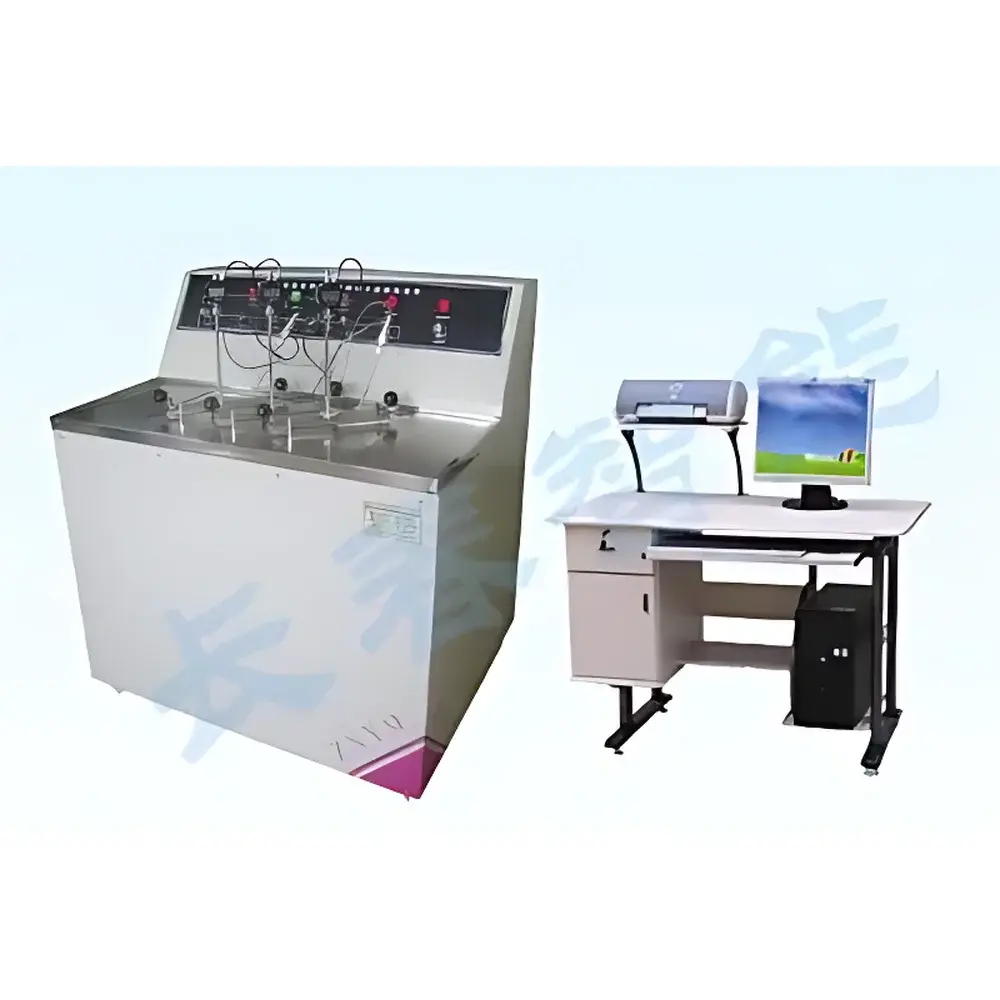
Changchun Intelligent WKW-3 Load Deflection Temperature & Vicat Softening Point Tester
| Brand | Changchun Intelligent |
|---|---|
| Origin | Jilin, China |
| Model | WKW-3 |
| Temperature Range | Ambient to 300 °C |
| Temp. Accuracy | ±0.5 °C |
| Heating Rates | 5 ±0.5 °C/6 min (A) or 12 ±1.0 °C/6 min (B) |
| Deflection Measurement Range | 0–0.5 mm (HDT), 0–1 mm (Vicat) |
| Dial Gauge Resolution | ±0.005 mm |
| Vicat Needle | 3 mm length, 1.000 ±0.015 mm² cross-sectional area |
| HDT Probe Fillet Radius | 3.0 ±0.2 mm |
| Max. HDT Load | 5 kg |
| Vicat Loads | GA = 10 ±0.2 N, GB = 50 ±1 N |
| Max. Heating Power | ≤4000 W |
| Power Supply | 220 V, 50 Hz, 30 A |
| Span Options | 64 mm or 100 mm |
| Heating Medium | Methyl silicone oil (flash point 300 °C, kinematic viscosity 200 cSt) |
| Cooling Modes | Natural convection or water cooling |
| Over-Temperature Protection | Yes |
| Compliance | GB/T 1633–2000, GB/T 1634–2004 |
Overview
The Changchun Intelligent WKW-3 Load Deflection Temperature (HDT) and Vicat Softening Point Tester is a precision thermal-mechanical instrument engineered for standardized determination of the temperature at which thermoplastic and thermosetting polymers undergo defined deformation under specified load conditions. It operates on two internationally recognized test principles: the heat deflection temperature (HDT), measured per ISO 75 and ASTM D648, and the Vicat softening temperature (VST), aligned with ISO 306 and ASTM D1525. Both methods rely on controlled thermal ramping of a specimen immersed in a uniform heating medium—methyl silicone oil—while applying a calibrated axial load via either a flat-ended probe (Vicat) or a cantilevered bar geometry (HDT). The instrument’s microprocessor-controlled heating system ensures strict adherence to standardized ramp rates (5 °C/6 min or 12 °C/6 min), while high-resolution digital displacement sensing captures minute dimensional changes with ±0.005 mm repeatability. Designed for compliance-driven laboratories, the WKW-3 delivers traceable, reproducible results required for material qualification, process validation, and regulatory submissions in polymer R&D, quality control, and third-party testing.
Key Features
- Microprocessor-based closed-loop temperature control with dual ramp rate selection (A: 5 ±0.5 °C/6 min; B: 12 ±1.0 °C/6 min) meeting GB/T 1634–2004 and ISO 75–1 requirements.
- High-stability methyl silicone oil bath (flash point ≥300 °C, kinematic viscosity 200 cSt) ensuring uniform thermal transfer and minimal volatility across the full 20–300 °C operating range.
- Dual-load configuration: configurable 10 N (GA) and 50 N (GB) Vicat loads with certified force tolerance (±0.2 N / ±1 N); 5 kg HDT loading capacity with precision-machined probe (3.0 ±0.2 mm fillet radius).
- Integrated overflow oil recovery system mitigates risks associated with thermal expansion of high-viscosity media, enhancing operational safety and long-term bath integrity.
- Real-time CRT-displayed thermal–displacement curves with automatic endpoint detection based on user-defined deflection thresholds (0.34 mm for Vicat, 0.25 mm for HDT).
- Over-temperature cut-off protection, programmable upper limit setting, and dual cooling options (natural convection or external water circuit) for rapid thermal cycle recovery.
Sample Compatibility & Compliance
The WKW-3 accommodates standard rectangular specimens (e.g., 80 × 10 × 4 mm for HDT; 10 × 10 × ~4–6 mm for Vicat) fabricated from rigid thermoplastics (e.g., ABS, PC, PP), thermosets (e.g., epoxy, phenolic), elastomers, and engineering composites. Specimen mounting supports both 64 mm and 100 mm spans per ISO 75–2. All mechanical components—including the 1.000 ±0.015 mm² Vicat needle and HDT probe—are manufactured to dimensional tolerances specified in ISO 306 Annex A and ISO 75–2 Clause 6. The system satisfies national and international standards including GB/T 1633–2000 (equivalent to ISO 306), GB/T 1634–2004 (equivalent to ISO 75), and supports audit-ready documentation for GLP-compliant environments. While not inherently 21 CFR Part 11 compliant, raw data export (CSV, PDF) and full test logs enable integration into validated LIMS or ELN platforms.
Software & Data Management
The embedded control software provides keyboard-driven test setup, real-time graphical plotting of temperature vs. deflection, and automated calculation of HDT/VST endpoints. Test parameters—including load selection, span, ramp rate, and deflection threshold—are stored with timestamped metadata. Each test generates a comprehensive report containing ambient conditions, calibration verification flags, raw displacement/time points, derivative curves, and pass/fail status against selected standards. Data export supports USB flash drive transfer in CSV (for spreadsheet analysis) and printer-ready PDF formats. Internal memory retains ≥500 full test records with full audit trail (operator ID, start/stop time, parameter modifications). Optional RS-232 or Ethernet interface enables remote monitoring and centralized data aggregation in multi-instrument labs.
Applications
- Quality assurance of incoming polymer resins and compounded pellets prior to extrusion or injection molding.
- Comparative thermal stability evaluation of flame-retardant formulations, plasticized PVC, and biopolymer blends.
- Supporting ISO 10350 and ASTM D4000 classification systems for thermoplastic material datasheets.
- Validation of annealing and post-molding heat treatment protocols for dimensional stability.
- Research into filler–matrix interfacial effects on heat resistance in glass-fiber-reinforced polyamides and carbon-black-loaded EPDM.
- Regulatory dossier preparation for automotive interior components (SAE J2334), electrical insulation (UL 746B), and medical device housings (ISO 10993–12).
FAQ
What heating medium is required, and why is methyl silicone oil specified?
Methyl silicone oil with a flash point ≥300 °C and kinematic viscosity of 200 cSt is mandatory to ensure thermal stability, low volatility, and uniform heat transfer across the full 20–300 °C range without degradation or oxidation byproducts.
Can the WKW-3 perform both HDT and Vicat tests without hardware reconfiguration?
Yes—the instrument includes interchangeable probe assemblies and load weights; switching between HDT and Vicat modes requires only manual replacement of the probe and adjustment of applied load via calibrated weights.
Is calibration traceable to national standards?
Temperature sensors are calibrated using NIST-traceable reference thermometers; displacement transducers are verified with gauge blocks certified to ISO/IEC 17025-accredited laboratories. Full calibration certificates are provided upon request.
What safety features prevent overheating or oil spillage?
Dual redundant safeguards include programmable upper-temperature cutoff, thermal fuse backup, and an integrated overflow recovery reservoir that captures expanded oil during rapid heating cycles.
Does the system support automated reporting for ISO/IEC 17025 accreditation?
While the base unit does not include electronic signature or audit trail encryption, all raw data, timestamps, and operator inputs are logged unalterably and exportable for integration into accredited QA/QC workflows.






