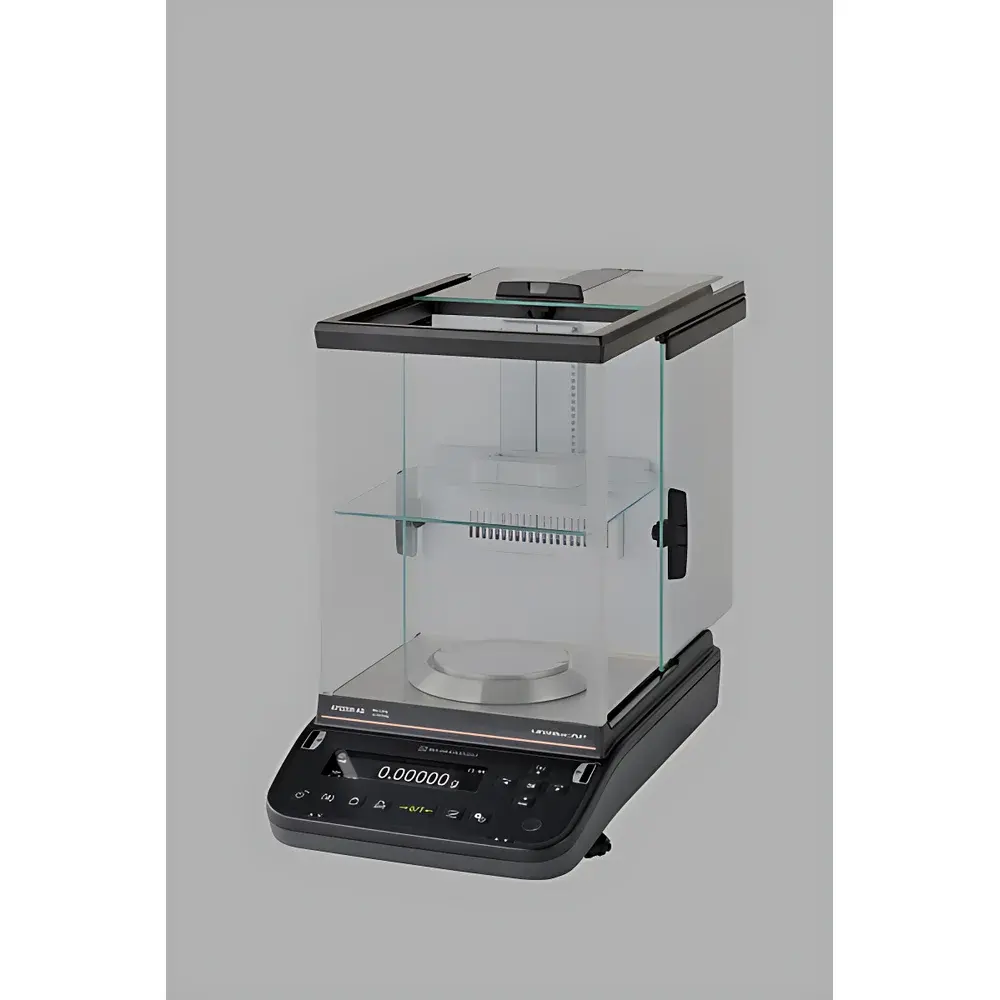
Shimadzu AP225W-AD Advanced Ultra-Micro Balance with Motorized Auto-Door and Non-Contact Operation
| Brand | Shimadzu |
|---|---|
| Origin | Japan |
| Model | AP225W-AD |
| Instrument Type | Ultra-Micro Balance |
| Maximum Capacity | 220 g |
| Readability | 0.01 mg |
| Repeatability | 0.01 mg (at 5 g load), 0.015 mg (at ~20 g), 0.03 mg (at ~100 g) |
| Calibration | Internal motorized auto-calibration with optional external weight support |
| Display | OLED matrix display (±85° viewing angle) |
| Auto-Door | Motorized full-glass door with proximity-sensing activation |
| Non-Contact Control | Dual side-mounted capacitive sensors for function selection |
| Static Elimination | Integrated STABLO™-AP electrostatic neutralizer |
| Operating Environment | 5–40 °C, 20–85 % RH |
| Linearity Error | ±0.1 mg |
| Minimum Weighing Value | 20 mg |
| Sensitivity Temperature Coefficient | ±2 ppm/°C (10–30 °C) |
| Pan Diameter | Ø91 mm |
| Dimensions (W×D×H) | 212 × 411 × 345 mm (incl. power unit) |
| Weight | 9.7 kg |
| Connectivity | RS-232C, USB-A (host), USB-B (device) |
Overview
The Shimadzu AP225W-AD is an advanced ultra-micro balance engineered for laboratories requiring high-resolution mass measurement under stringent environmental and operational constraints. Utilizing Shimadzu’s proprietary UniBloc AP monolithic weighing sensor architecture, the AP225W-AD delivers exceptional stability and rapid response—reducing display stabilization time to just 2 seconds for micro-weighing tasks, a significant improvement over prior-generation instruments. Its core design integrates three critical functional domains: non-contact human-machine interaction, active electrostatic mitigation, and automated environmental isolation. The balance operates on the principle of electromagnetic force compensation (EMFC), where sample mass is determined by the current required to restore equilibrium in a precision load cell system. This method ensures traceable, high-reproducibility measurements compliant with ISO/IEC 17025 metrological requirements. The AP225W-AD is purpose-built for applications demanding contamination control—including GLP/GMP-regulated pharmaceutical QC, toxicology research, reference standard preparation, and nanomaterial formulation—where glove-compatible operation, minimized manual intervention, and ISO 14644-1 Class 5 cleanroom compatibility are essential.
Key Features
- Motorized full-glass auto-door with programmable opening range, eliminating physical contact during sample loading/unloading—critical for biosafety level 2+ workflows and hazardous substance handling.
- Dual non-contact capacitive sensors positioned on left/right flanks enable glove-compatible selection of four preconfigured functions (e.g., tare, print, memory recall, calibration) based on dwell time—no surface touch required.
- Integrated STABLO™-AP active ionizer suppresses electrostatic interference in real time, reducing weighing drift and improving repeatability for low-mass, high-surface-area samples (e.g., powders, lyophilized APIs, catalysts).
- OLED matrix display with ±85° wide-angle visibility ensures legibility from oblique positions—supporting ergonomic benchtop integration and multi-user shared-lab environments.
- Smart stand accessory (standard on AP225W-AD) enables direct volumetric flask or bottle placement on the pan, eliminating transfer steps and associated cross-contamination risks in solution preparation workflows.
- Internal motorized calibration system supports scheduled or event-triggered recalibration; compatible with certified external weights (90 g recommended) for audit-ready traceability per ASTM E898 and USP <41>.
Sample Compatibility & Compliance
The AP225W-AD accommodates a broad spectrum of sample formats—from 5 mg crystalline reference standards to 220 g bulk reagents—while maintaining ≤0.01 mg readability at low loads. Its Ø91 mm stainless-steel pan and removable draft shield accommodate tall containers (e.g., 1-L volumetric flasks) without compromising aerodynamic stability. The balance meets ISO 9001 design assurance criteria and conforms to electromagnetic compatibility (EMC) standards IEC 61326-1 and safety standard IEC 61010-1. For regulated environments, it supports 21 CFR Part 11-compliant data integrity when paired with Shimadzu’s LabSolutions Balance software (audit trail, electronic signatures, user access levels). All performance specifications—including linearity (±0.1 mg), repeatability (0.01 mg at 5 g), and minimum weighing value (20 mg)—are validated per OIML R 76-1 and verified using NIST-traceable weights.
Software & Data Management
Data acquisition and reporting are managed via Shimadzu’s LabSolutions Balance PC software (Windows 10/11), which provides configurable templates for SOP-driven workflows: buffer preparation (pH/molarity calculation), molar conversion, concentration dilution series, and HPLC mobile phase formulation. Raw weighing data—including timestamp, operator ID, environmental conditions (optional external温湿度 sensor input), and calibration logs—are exported in CSV or PDF format with embedded digital signatures. The USB-A port supports direct connection to label printers or flash drives for standalone data archiving; RS-232C enables legacy LIMS integration. Audit trails record all parameter changes, calibration events, and user logins—fully compliant with ALCOA+ principles for FDA inspections.
Applications
- Pharmaceutical QC: Accurate weighing of potent compounds (e.g., cytostatics, hormones) where <0.1% error is mandated per ICH Q5C.
- Reference Material Certification: Preparation of CRM sub-samples under ISO Guide 35, leveraging 0.01 mg resolution and <0.015 mg repeatability at nominal loads.
- Academic Research: Nanoparticle dosing for in vitro toxicity assays, where static charge-induced variability must be suppressed below detection thresholds.
- Environmental Labs: Trace metal standard preparation for ICP-MS analysis, requiring sub-10 µg accuracy and contamination-free handling.
- Food Safety Testing: Mycotoxin reference standard dilution series with documented uncertainty budgets per ISO/IEC 17025 Clause 7.6.
FAQ
What is the minimum sample mass that can be weighed with reliable uncertainty?
The validated minimum weighing value (MWV) is 20 mg, determined per USP <41> using standard deviation-based assessment at k=2 confidence level.
Does the AP225W-AD support GLP-compliant audit trails?
Yes—when used with LabSolutions Balance software, it records all critical events (calibrations, tare operations, user logins) with immutable timestamps and operator attribution.
Can the auto-door be disabled for continuous operation?
Yes—the door operation mode is fully configurable via the instrument menu: automatic, manual, or locked-open states are selectable.
Is external humidity/temperature compensation available?
The balance includes built-in temperature compensation (±2 ppm/°C); optional external温湿度 sensor input enables dynamic air density correction for buoyancy-compensated mass values.
What maintenance is required for the STABLO™-AP ionizer?
No consumables or periodic replacement—STABLO™-AP uses solid-state corona discharge with self-cleaning electrodes; routine cleaning with isopropyl alcohol is recommended every 6 months.