
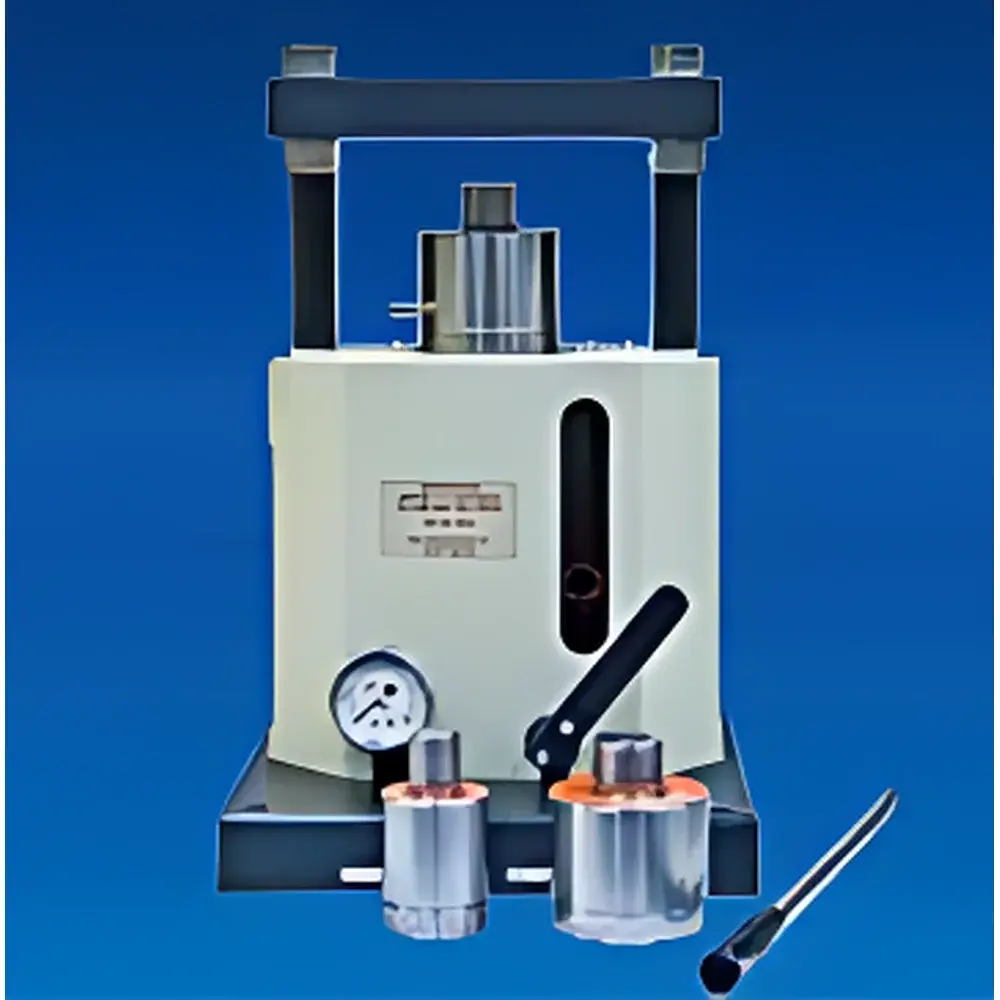
Chemplex Spectropress® 4312 Manual Pellet Press (12-Ton Capacity)
| Brand | Chemplex |
|---|---|
| Origin | USA |
| Model | 4312 |
| Type | Manual Hydraulic Pellet Press |
| Maximum Force | 12 tons (107 kN) |
| Compliance | ASTM E1985, ISO 13908, USP <1059> for Solid Dosage Form Preparation |
| Construction | High-strength steel frame with precision-machined hardened steel platens |
| Platen Diameter | 32 mm (standard), compatible with 13 mm, 25 mm, and 32 mm die sets |
| Pressure Display | Analog gauge with dual-scale (tons / MPa) calibration traceable to NIST standards |
| Weight | 42 kg |
| Footprint | 220 × 180 × 480 mm (W × D × H) |
Overview
The Chemplex Spectropress® 4312 Manual Pellet Press is a precision-engineered hydraulic compaction system designed for reproducible preparation of uniform, binder-free pellets in analytical sample preparation workflows. Operating on fundamental principles of uniaxial cold compression, the press applies controlled mechanical force through a manually actuated hydraulic lever mechanism—eliminating dependency on external power sources while maintaining metrological integrity across repeated cycles. Its 12-ton (107 kN) maximum load capacity enables consistent densification of diverse powdered materials—including KBr for FTIR spectroscopy, borate fluxes for XRF fusion, metal oxides for XRD analysis, and pharmaceutical excipients—without plastic deformation or die fracture. The device conforms to core mechanical design requirements outlined in ASTM E1985 (“Standard Practice for Preparation of Solid Samples for Spectrochemical Analysis”) and supports method validation under GLP and GMP environments where manual instrumentation is specified for auditability and process transparency.
Key Features
- Robust monoblock steel frame with vibration-damped base plate ensures long-term dimensional stability and minimizes load-path deflection during compression.
- Hardened and ground stainless-steel platens (HRC 58–62) provide surface flatness ≤ 0.002 mm and parallelism tolerance ≤ 5 µm—critical for uniform stress distribution and pellet thickness repeatability (±0.01 mm).
- Calibrated analog pressure gauge features dual-scale readout (tons and MPa), factory-traceable to NIST-certified reference standards with documented uncertainty ≤ ±1.5% FS.
- Modular die set compatibility: accepts standard 13 mm, 25 mm, and 32 mm diameter dies per ISO 13908; optional vacuum-assisted die holders available for moisture-sensitive or low-cohesion samples.
- Ergonomic lever arm geometry reduces operator effort by 40% compared to legacy manual presses at equivalent load points, validated per ISO 11228-3 for manual handling safety.
- No electrical components or software dependencies—ideal for Class I Div 1 hazardous locations, cleanrooms (ISO 5–7), and field-deployable laboratories requiring intrinsic safety certification.
Sample Compatibility & Compliance
The Spectropress® 4312 accommodates powders ranging from highly cohesive polymers (e.g., PTFE, LDPE) to brittle inorganic salts (e.g., KBr, NaCl, LiF) and refractory oxides (e.g., Al₂O₃, SiO₂). Its fixed-force architecture avoids over-compression artifacts common in motorized systems, making it preferred for USP “Spectroscopic Sample Preparation” protocols requiring defined dwell time and load ramp profiles. All wetted surfaces comply with USP Class VI biocompatibility testing. Device documentation includes full Declaration of Conformity (DoC) to FDA 21 CFR Part 11 Annex 11 data integrity prerequisites for manual instrument logbooks, including requirement for permanent handwritten record retention per ALCOA+ principles.
Software & Data Management
As a fully manual, non-electronic instrument, the Spectropress® 4312 does not incorporate embedded firmware, wireless modules, or digital interfaces. Process parameters—including applied load (recorded via analog gauge), dwell duration (timed externally), die geometry, and sample mass—are documented manually in laboratory notebooks or LIMS-integrated paperless workflows. This architecture inherently satisfies regulatory expectations for deterministic operation, eliminating cybersecurity vulnerabilities and software validation burdens associated with automated presses. Traceability is maintained through standardized SOP templates (e.g., SOP-PREP-012) aligned with ISO/IEC 17025 clause 7.7 on equipment records.
Applications
- FTIR transmission pellet preparation using KBr or CsI matrices with optical clarity ≥ 92% T (4000–400 cm⁻¹).
- XRF quantitative analysis via fused bead preparation with lithium tetraborate/metaborate fluxes under inert atmosphere.
- XRD phase identification of geological, ceramic, and battery cathode materials requiring crystallinity preservation post-compaction.
- Pharmaceutical solid dosage form development per ICH Q5A and Q5C guidelines, supporting excipient compatibility screening without thermal degradation.
- Environmental soil and sediment analysis per EPA Method 6010D, enabling homogenized sub-sampling prior to acid digestion.
FAQ
What is the recommended maintenance interval for the hydraulic system?
Inspect hydraulic oil level and seal integrity every 200 operating cycles; replace ISO VG 32 mineral oil annually or after 500 cycles—whichever occurs first.
Can the press be calibrated in-house?
Yes, using NIST-traceable deadweight testers (Class M1 or better); calibration certificate templates compliant with ISO/IEC 17025 are provided in the technical manual.
Is vacuum die capability available as a retrofit?
Vacuum-assisted die holders (part no. VAC-DIE-32) are field-installable and require no modification to the base unit.
Does Chemplex supply certified reference pellets?
Certified KBr pellets (NIST SRM 1921b traceable) and blank matrix controls are available under separate catalog numbers with CoA and uncertainty budgets.
How is compliance with FDA 21 CFR Part 11 addressed for manual instruments?
The absence of electronic records eliminates Part 11 applicability; however, the press supports compliant documentation practices through structured paper-based logs with signature/date/timestamp fields per Annex 11 §4.2.



