
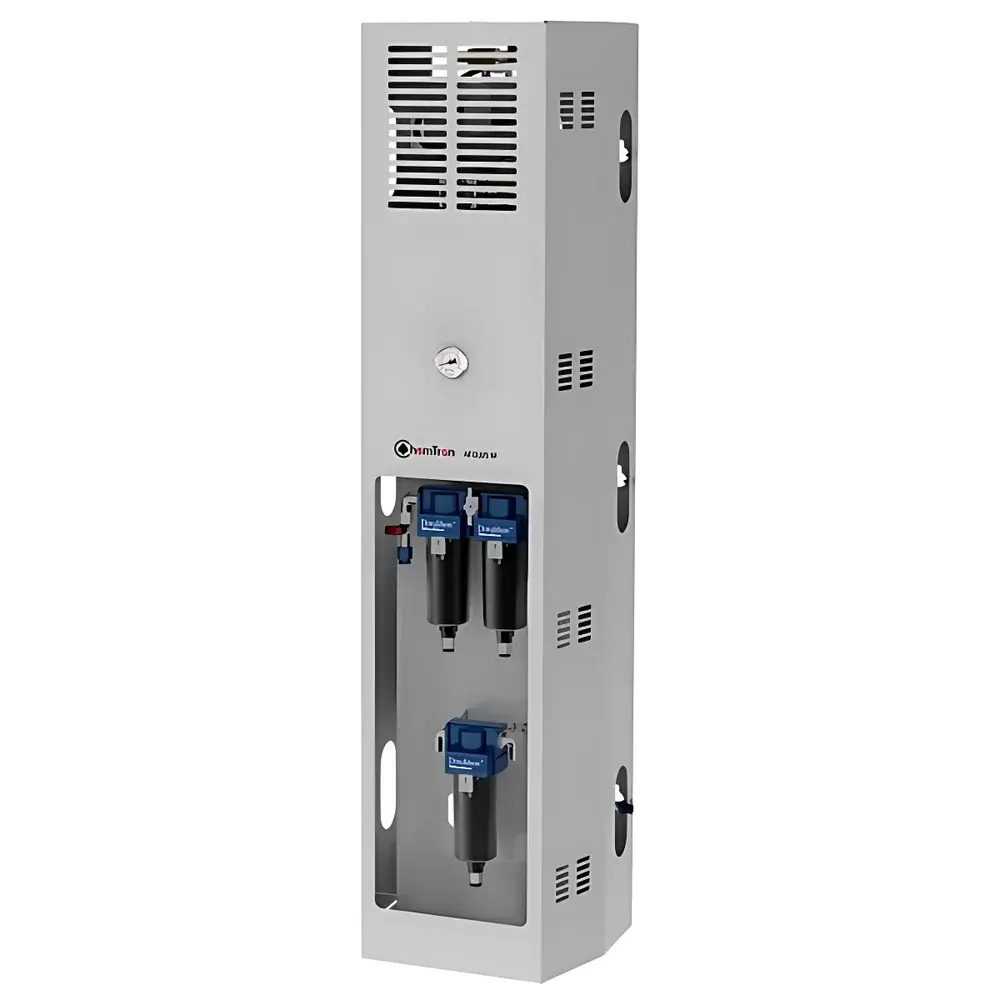
ChemTron AEOLUS Modular Nitrogen Generator
| Brand | ChemTron |
|---|---|
| Model | AEOLUS |
| Type | Membrane-Based Nitrogen Generator Module |
| Output Pressure | 7.6 bar (108 psi) |
| Flow Options | 40 / 80 / 120 L/min (at 95–96% purity) |
| Purity Options | Up to 99% N₂ |
| Compressed Air Inlet | 8.5–10 bar, ISO 8573-1 Class 1.3.1 (oil-free, dew point ≤ –20 °C) |
| Ambient Operating Temperature | 15–35 °C |
| Noise Level | < 58 dB(A) |
| Dimensions (W × D × H) | 324 × 265 × 1204 mm |
| Weight | 25–27 kg |
| Air Inlet | OD 10 mm or G1/4" |
| N₂ Outlet | OD 6 mm or G1/4" |
| Mounting | Benchtop or Wall-Mountable |
Overview
The ChemTron AEOLUS Modular Nitrogen Generator is an engineered solution for on-demand, high-reliability nitrogen supply in analytical laboratories, QC environments, and pilot-scale industrial processes. It operates on the principle of selective gas permeation through hollow-fiber membrane technology—leveraging differential permeability of oxygen, water vapor, and CO₂ relative to nitrogen across polymeric membranes. This physical separation process requires no chemical consumables, catalysts, or electrical power for gas generation itself, ensuring intrinsic operational safety, zero background interference (e.g., no VOCs, ozone, or NOₓ byproducts), and compliance with inert atmosphere requirements for sensitive instrumentation such as GC, LC-MS, ICP-MS, and glovebox purging. Designed for integration into existing compressed air infrastructure, the AEOLUS system delivers consistent nitrogen at regulated pressure (7.6 bar) and adjustable flow rates—making it suitable for both continuous low-flow applications (e.g., detector makeup gas) and intermittent high-demand use (e.g., sample preparation purge, solvent evaporation).
Key Features
- Membrane-based nitrogen generation: No electricity required for gas separation—only clean, dry compressed air input.
- Modular scalability: Three base modules (AEOLUS M, L, XL) support nominal flows of 40, 80, and 120 L/min at ≥95% purity; parallel configuration enables combined outputs up to 400 L/min without external manifold complexity.
- Integrated 3-stage compressed air filtration: Coalescing, particulate, and activated carbon stages ensure ISO 8573-1 Class 1.3.1 air quality—critical for membrane longevity and nitrogen consistency.
- Flexible installation: Compact vertical form factor (1204 mm height) supports benchtop placement or wall mounting, minimizing footprint in space-constrained labs.
- Acoustically optimized design: <58 dB(A) noise emission enables silent operation in open-plan laboratories and near noise-sensitive instruments.
- Dual air inlet compatibility: Configurable for direct connection to large-capacity oil-free compressors or small-footprint compressors with integrated receiver tanks.
- Pressure-stable output: Maintains 7.6 bar ±0.3 bar delivery pressure with ≤1.5 bar pressure drop across full flow range—ensuring stable instrument performance without external regulators.
Sample Compatibility & Compliance
The AEOLUS generator produces nitrogen meeting ASTM D6671 (Standard Specification for Nitrogen for Use in Analytical Instrumentation) and ISO 8573-1:2010 Class 2.2.1 for particulate, water, and oil content when fed compliant compressed air. Its oil-free, catalyst-free architecture eliminates risk of column contamination in GC systems or ion source fouling in mass spectrometry. The absence of electrical heating elements or reactive media ensures full compatibility with explosion-proof zones (ATEX Zone 2 / Class I Div 2 where applicable) and meets GLP/GMP facility requirements for documented, maintenance-light utility gas supply. All wetted materials—including membrane housings, filters, and pneumatic fittings—are FDA-compliant and certified non-leaching per USP .
Software & Data Management
While the AEOLUS module operates autonomously without embedded electronics, optional analog pressure/flow transducers (0–10 V or 4–20 mA outputs) can be integrated into facility SCADA or LabVantage systems for real-time monitoring of inlet air pressure, outlet N₂ pressure, and flow rate. All mechanical components—including filter service intervals, membrane replacement schedules (typically >20,000 operating hours), and pressure decay test logs—support full traceability under 21 CFR Part 11 when recorded via validated electronic lab notebooks (ELN) or CMMS platforms. Calibration certificates for optional sensors are NIST-traceable and include uncertainty budgets per ISO/IEC 17025.
Applications
- Gas chromatography carrier and detector gases (FID, TCD, ECD)
- LC-MS and ICP-MS desolvation and collision gas supply
- Inert blanketing for solvent evaporation systems (e.g., TurboVap®, CentriVap®)
- Glovebox and anaerobic chamber purging
- Sample preparation workflows requiring oxygen-free environments (e.g., lipid oxidation studies, metal-organic framework synthesis)
- Pharmaceutical stability testing chambers (ICH Q1A)
- Electron microscopy sample storage and transfer
FAQ
Does the AEOLUS module require electrical power to generate nitrogen?
No—the core membrane separation process is entirely passive and pressure-driven. Only optional monitoring sensors or solenoid valves require power.
What compressed air quality is mandatory for optimal membrane life?
ISO 8573-1 Class 1.3.1: oil content ≤0.01 mg/m³, particles ≤0.1 µm, dew point ≤–20 °C at atmospheric pressure.
Can multiple AEOLUS modules feed a single distribution manifold?
Yes—modules are pressure-synchronized and designed for parallel operation without cross-flow imbalance or backpressure issues.
Is routine maintenance limited to filter replacement?
Yes—primary maintenance consists of scheduled coalescing and activated carbon filter changes every 6–12 months based on air usage; membranes require no periodic servicing.
How is nitrogen purity verified during qualification?
Via calibrated electrochemical O₂ analyzer (e.g., Michell XZR400) measuring residual oxygen downstream; typical uncertainty ±0.1% O₂ at 99% N₂.



