
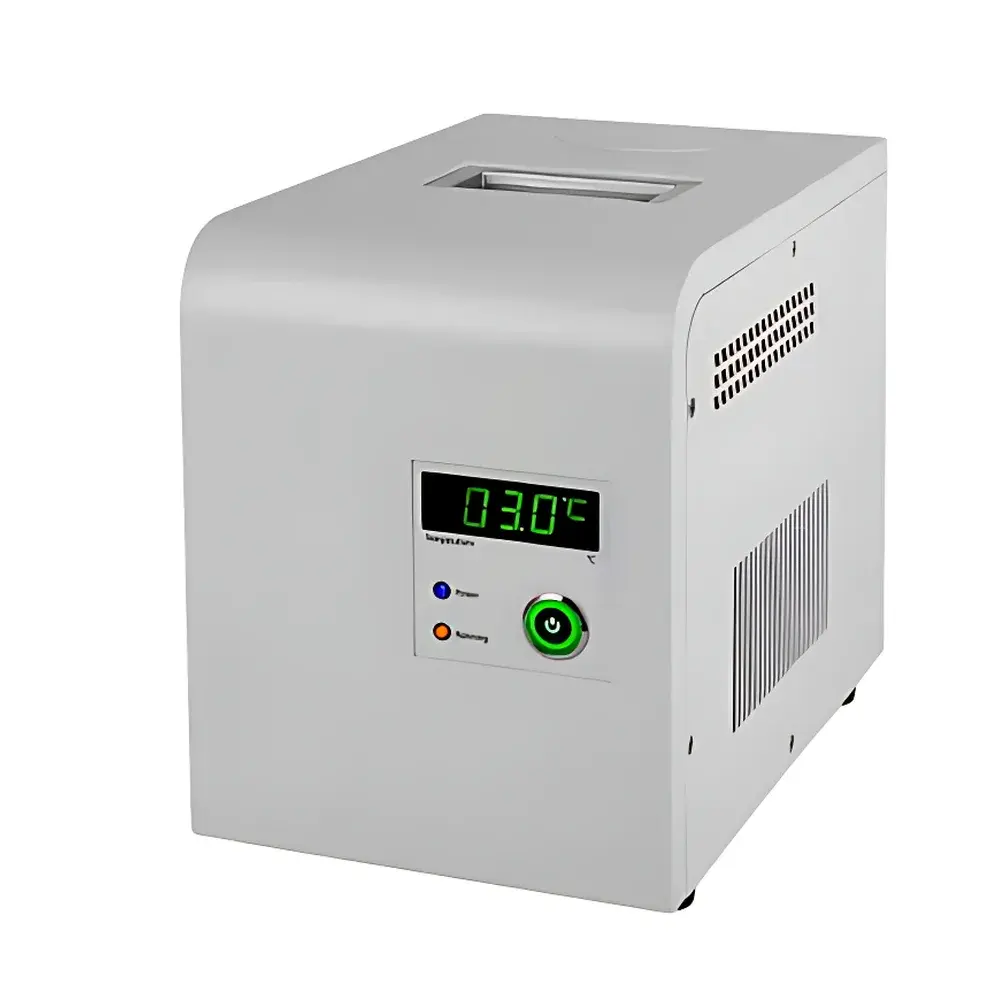
ChemTron B150 Peltier-Cooled Circulating Chiller
| Brand | ChemTron |
|---|---|
| Origin | Germany |
| Model | B150/C150/C300 |
| Instrument Type | Vertical |
| Cooling Principle | Peltier (Thermoelectric) |
| Temperature Range (B150) | 3.0 °C to ambient |
| Temperature Range (C150/C300) | 3–60 °C |
| Refrigeration Capacity | 150 W (B150, C150), 300 W (C300) |
| Heating Power | 550 W |
| Pump Type | Centrifugal |
| Flow Rate | 9 L/min |
| Max. Pressure | 0.5 bar |
| Reservoir Volume | 300 mL (B150), 750 mL (C150/C300) |
| IP Rating | IP21 |
| Dimensions (W×D×H) | 190×336×250 mm (B150), 185×369×358 mm (C150), 393×185×381 mm (C300) |
| Display | High-Resolution LED |
Overview
The ChemTron B150 is a compact, vertical-format Peltier-cooled circulating chiller engineered for precise temperature control in analytical laboratory applications where mechanical compressor-based systems are impractical or undesirable. Unlike vapor-compression chillers, the B150 leverages the solid-state Peltier effect—thermoelectric heat transfer across junctions of dissimilar semiconductors under direct current—to deliver cooling without refrigerants, moving parts, or oil-lubricated compressors. This architecture enables silent operation, rapid thermal response, and exceptional long-term stability at low maintenance overhead. Designed specifically for integration with optical and thermal analytical instruments—including UV-Vis spectrophotometers, FTIR systems, polarimeters, refractometers, density meters, and viscometers—the B150 maintains fluid temperatures as low as 3.0 °C above ambient (with no active heating), supporting critical thermal conditioning of sample cells, flow cells, detectors, and optical path components. Its sealed, closed-loop circulation ensures consistent thermal transfer while minimizing evaporation, contamination, and air ingress risks.
Key Features
- High-resolution LED display with intuitive menu navigation for real-time monitoring of setpoint, actual bath temperature, pump status, and system diagnostics
- Plug-and-play operation: powered on and ready for external thermal regulation within seconds—no precooling or warm-up delays
- Ultra-low acoustic signature (<45 dB(A)) due to brushless centrifugal pump and absence of compressor vibration
- Space-efficient vertical footprint optimized for benchtop deployment alongside sensitive instrumentation
- Integrated thermoelectric cooling module with passive heatsink and forced-air thermal management for sustained 150 W cooling capacity at ΔT = 20 °C
- Robust, corrosion-resistant stainless-steel reservoir and fluid pathways compatible with water, water/glycol mixtures, and non-aggressive aqueous coolants
- Ergonomic integrated carry handle and non-slip rubber feet for safe repositioning and stable operation
- Energy-efficient design compliant with EU ErP Directive (2009/125/EC) and RoHS 2011/65/EU
Sample Compatibility & Compliance
The B150 supports continuous circulation of coolant through external devices with standard 6–10 mm ID tubing connections. It is validated for use with analyzers requiring stable thermal environments per ASTM E2931 (standard practice for temperature calibration of spectrophotometers), ISO 17025-accredited laboratories, and GLP-compliant workflows. While the unit itself does not include data logging or audit trail functionality, its stable thermal output facilitates adherence to USP (Spectrophotometric Absorbance Measurements) and ICH Q2(R2) guidelines for instrument qualification. The IP21 enclosure rating provides protection against vertically falling drips and solid objects >12.5 mm—suitable for general laboratory environments but not wet or splash-prone areas. All materials in contact with coolant meet FDA 21 CFR 177.2600 (indirect food additives: polymeric substances) requirements.
Software & Data Management
The B150 operates via standalone hardware controls; it does not feature digital connectivity (USB, Ethernet, RS-232) or embedded software. Temperature setpoints and operational states are managed exclusively through the front-panel interface. For laboratories requiring electronic recordkeeping or remote monitoring, third-party integration is achievable using optional analog 0–10 V or 4–20 mA process signals (available on C150/C300 variants). No proprietary drivers, firmware updates, or cloud services are required—ensuring compatibility with legacy and modern lab infrastructure alike. All configuration parameters remain persistent after power cycling, eliminating need for reinitialization.
Applications
- Thermal stabilization of cuvette holders and flow cells in UV-Vis and NIR spectrophotometers
- Cooling of detector housings and optical benches in FTIR and Raman systems to reduce thermal noise
- Temperature-controlled solvent delivery in micro-distillation and fractional crystallization setups
- Active cooling of high-intensity LED light sources used in fluorescence and absorbance detection modules
- Thermal conditioning of viscometer baths and density gradient columns per ASTM D445 and ISO 3104
- Supporting differential scanning calorimetry (DSC) auxiliary cooling stages when paired with compatible controllers
FAQ
Does the B150 support both cooling and heating functions?
No—the B150 is a cooling-only unit with a minimum operating temperature of 3.0 °C above ambient. For combined heating/cooling capability, consider the C150 or C300 models, which integrate resistive heating elements (550 W) alongside Peltier cooling.
What is the maximum allowable coolant viscosity for reliable pump performance?
The centrifugal pump is rated for aqueous solutions and glycol/water mixtures up to 50% v/v (viscosity ≤ 3.5 mPa·s at 20 °C). Higher-viscosity fluids may reduce flow rate and impair thermal uniformity.
Can the B150 be used in a cleanroom environment?
Yes—its oil-free, refrigerant-free operation and lack of particulate-emitting components make it suitable for ISO Class 5–7 cleanrooms, provided ambient temperature remains within 15–30 °C and relative humidity stays below 70% RH.
Is the reservoir volume sufficient for extended unattended operation?
With a 300 mL capacity and typical flow rates of 6–9 L/min, the B150 is intended for short-to-medium duration thermal conditioning (≤8 hours) in closed-loop configurations. For prolonged operation, periodic level checks and top-up with deionized water are recommended.
How often does the unit require preventive maintenance?
Under normal laboratory conditions, only annual visual inspection of tubing integrity, pump inlet filter (if installed externally), and heatsink cleanliness is advised. No scheduled lubrication, refrigerant recharge, or compressor servicing is required.



