
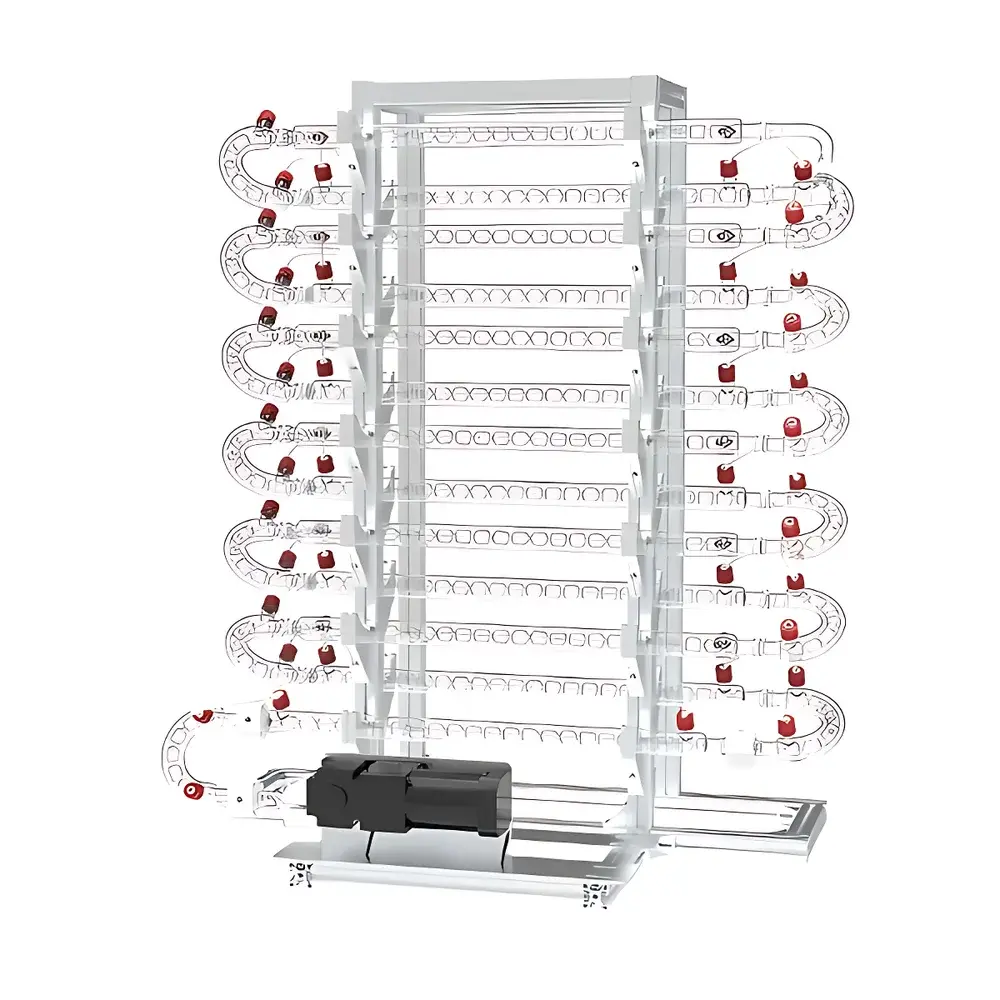
ChemTron CC15 Lite Continuous Oscillatory Baffled Crystallizer (COBC)
| Brand | ChemTron |
|---|---|
| Origin | Germany |
| Model | CC15 Lite |
| Reactor Volume | 1.25 L |
| Total Length | 7 m |
| Nominal Flow Rate | 40 mL/min |
| Typical Residence Time | 30 min |
| Dimensions (W×D×H) | 1110 × 800 × 1010 mm |
| Tube Diameter | DN15 |
| Temperature Control | External Sleeve/Optional Jacketed Bend |
| Compliance | Designed for GLP-compliant lab-scale process development |
| Sample Compatibility | Solid–liquid–gas multiphase systems |
| Interface Options | Integrated ports for PAT tools (e.g., inline Raman, ATR-FTIR, FBRM), multi-point sampling, and auxiliary feed modules |
Overview
The ChemTron CC15 Lite is a laboratory-scale continuous oscillatory baffled crystallizer (COBC), engineered for precise control of nucleation, crystal growth, and agglomeration kinetics under steady-state hydrodynamic conditions. Unlike conventional batch crystallizers, the CC15 Lite operates on the principle of controlled laminar flow with periodic mechanical oscillation—induced by a programmable linear actuator—across a series of equally spaced, perforated baffles housed within a borosilicate glass tube. This configuration generates localized plug-flow-like residence time distribution (RTD) while maintaining high radial mixing and low axial dispersion—key prerequisites for reproducible crystal size distribution (CSD) and consistent crystal habit. The device functions as both a continuous reactor and a crystallization platform, supporting thermally sensitive, polymorphic, or metastable systems where temperature gradient management and residence time fidelity are critical. Its modular DN15 glass architecture allows seamless integration into existing lab infrastructure and enables direct visual observation of crystal formation, fouling behavior, and phase separation dynamics.
Key Features
- Continuous oscillatory baffled design ensures near-plug-flow residence time distribution with tunable Péclet numbers (Pe < 10), minimizing back-mixing and enabling accurate kinetic modeling.
- Borosilicate glass construction (DIN 28120/ISO 3585 compliant) provides full optical access, chemical resistance to organic solvents, acids, and bases, and compatibility with sterilization protocols.
- Integrated thermal management: straight section equipped with an external heating/cooling sleeve; optional upgrade to fully jacketed bends for precise axial temperature profiling across multiple reaction zones.
- Modular interface architecture: standardized 1/4″ Swagelok® or M6 threaded ports at defined axial positions support real-time in situ process analytical technology (PAT) integration—including inline Raman spectroscopy, ATR-FTIR, focused beam reflectance measurement (FBRM), and particle vision and measurement (PVM).
- Programmable oscillation parameters: frequency (0.1–3 Hz) and stroke amplitude (±1–10 mm) independently adjustable via industrial-grade motion controller, enabling systematic study of mixing intensity vs. crystal morphology.
- Scalable geometric fidelity: all CC15 variants (Lite, Standard, Plus, Compact) share identical baffle spacing, orifice geometry, and tube diameter—ensuring linear scale-up correlation from lab to pilot scale.
Sample Compatibility & Compliance
The CC15 Lite accommodates heterogeneous multiphase systems including suspensions (e.g., seed crystals in supersaturated solutions), gas-liquid reactions (e.g., CO₂ absorption during pH-shift crystallization), and solid-liquid slurries (e.g., antisolvent addition with particulate feed). It complies with ISO 17025 requirements for method validation in regulated environments and supports audit-ready operation when paired with 21 CFR Part 11–compliant data acquisition software. All wetted parts meet USP Class VI biocompatibility standards. The system is routinely deployed in pharmaceutical crystallization development (per ICH Q5A/Q5D), fine chemical synthesis, and bio-based platform molecule purification—fully aligned with ASTM E2969 (Standard Guide for Continuous Crystallization Process Development) and EU GMP Annex 15 principles for process validation.
Software & Data Management
Control and monitoring are executed via ChemTron’s proprietary COBC Studio v3.2—a Windows-based application supporting synchronized actuator control, PID-regulated thermal loops, and timestamped acquisition from up to eight analog/digital inputs (e.g., temperature, pressure, conductivity, PAT signals). Raw data streams are logged in HDF5 format with embedded metadata (operator ID, SOP version, calibration timestamps), ensuring traceability per ALCOA+ principles. Export options include CSV, MATLAB .mat, and ISA-88–structured XML for integration with LIMS or MES platforms. Audit trails record all parameter changes, user logins, and system events with immutable digital signatures—fully compliant with FDA 21 CFR Part 11 and EU Annex 11 requirements.
Applications
- Polymorph screening and selective crystallization of APIs under controlled supersaturation profiles.
- Continuous antisolvent crystallization of peptides and biologics intermediates with narrow CSD targets (e.g., D90/D10 < 2.5).
- Kinetic studies of cooling- and reactive crystallization pathways, including secondary nucleation rate quantification.
- Crystallization-driven purification of organic acids (e.g., citric, tartaric) and chiral compounds in food and nutraceutical manufacturing.
- Integration with downstream continuous filtration and drying units for end-to-end integrated continuous manufacturing (ICM) workflows.
- Process intensification of enzymatic reactions coupled with in situ product removal (ISPR) via crystallization.
FAQ
What distinguishes oscillatory baffled crystallization from traditional tubular reactors?
Oscillatory flow decouples residence time from linear velocity—enabling long residence times (e.g., 30–90 min) at low Reynolds numbers (< 200), thereby avoiding turbulent shear that disrupts fragile crystals or amorphous precipitates.
Can the CC15 Lite be used for reactive crystallization involving gas-phase reagents?
Yes—the DN15 glass tube supports co-current or counter-current gas sparging via integrated side-arm inlets; mass transfer limitations are mitigated by oscillation-induced interfacial renewal.
Is retrofitting to a fully jacketed configuration possible post-purchase?
Yes—ChemTron offers field-installable jacketed bend kits with calibrated glycol circulation manifolds and RTD sensor arrays for axial thermal mapping.
How is crystal size distribution monitored in real time?
Via optional FBRM probe mounted at axial position #3 or #5, delivering chord length distribution (CLD) data updated every 2 seconds with automated CSD back-calculation using established transformation models.
Does the system support automated seeding protocols?
Yes—through integration with ChemTron’s AutoSeed Module (ASM), which triggers precise slurry injection upon detection of supersaturation threshold crossing via inline UV-Vis or conductivity feedback.



