
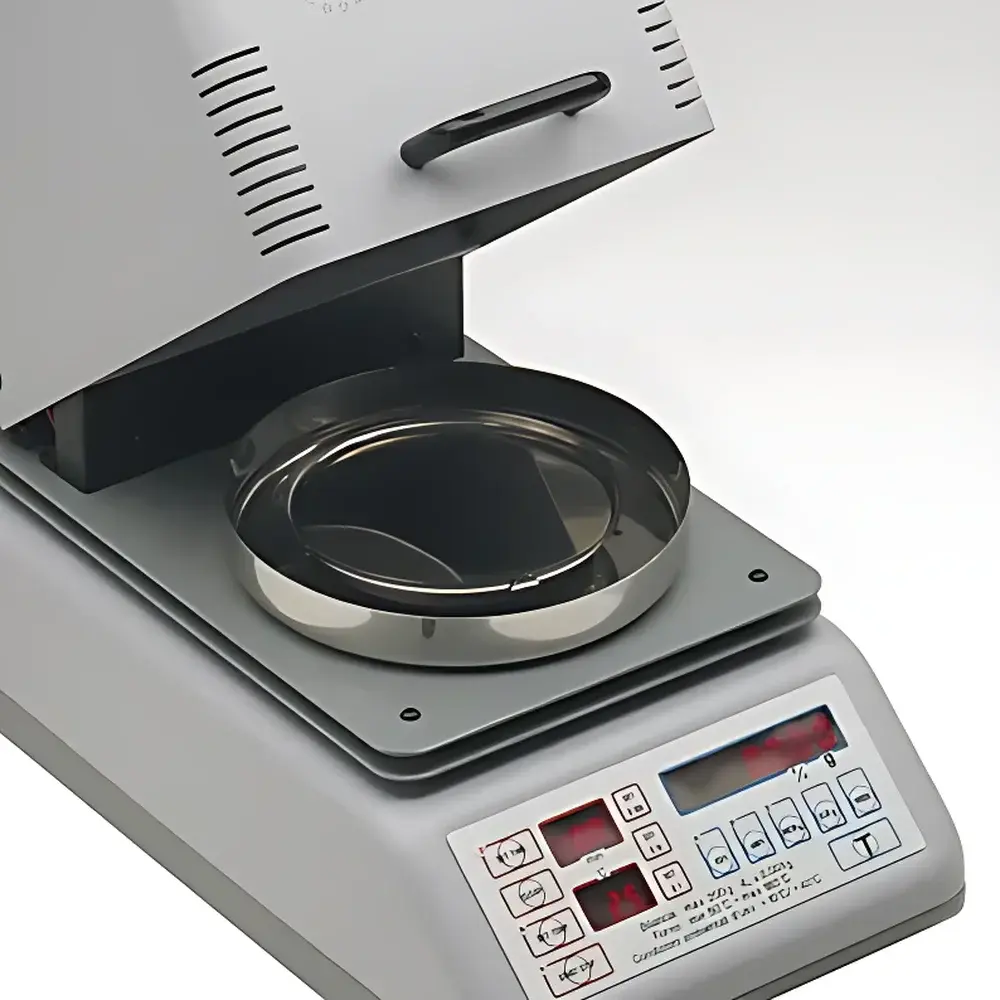
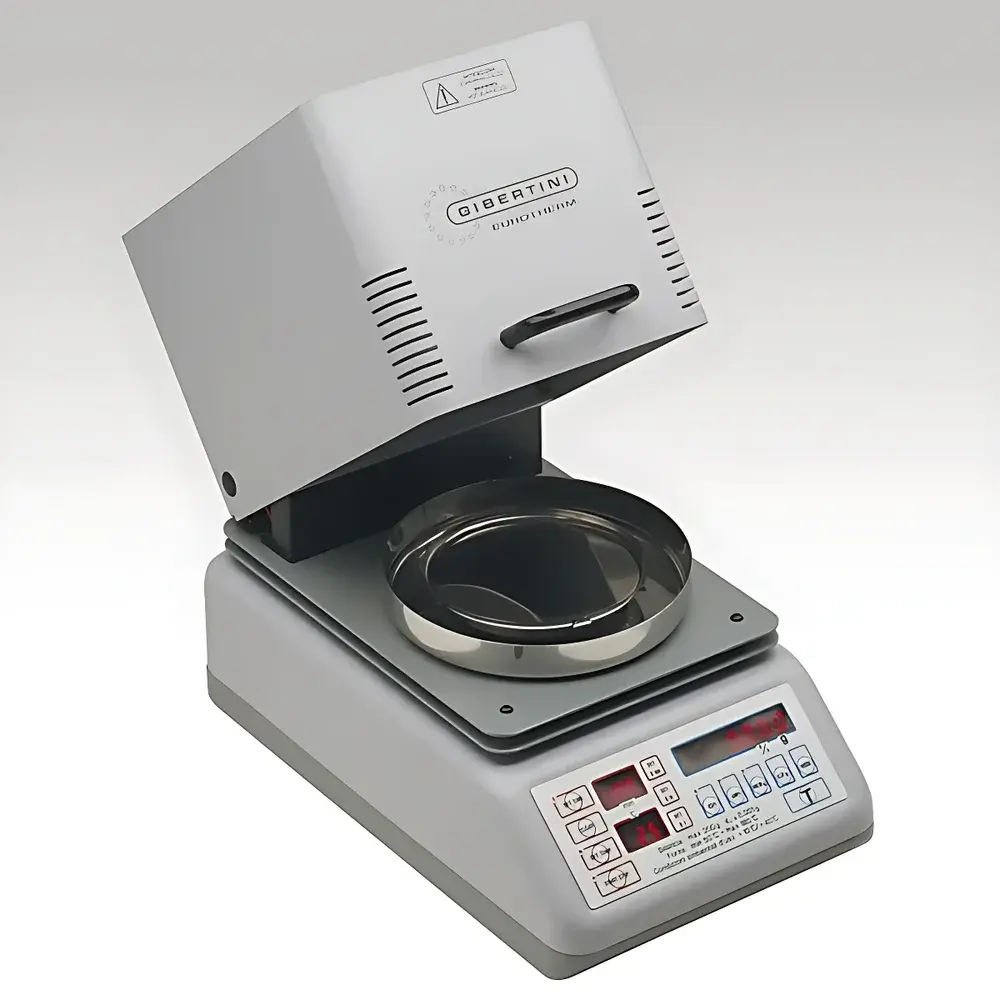
ChemTron EUT Infrared Moisture Analyzer
| Brand | ChemTron |
|---|---|
| Origin | Germany |
| Model | EUT |
| Heating Method | Infrared |
| Weighing Range | 200 g |
| Readability | 0.001 g |
| Repeatability | ±0.001 g |
| Linearity | ±0.002 g |
| Pan Diameter | Φ120 mm |
| Dimensions (W×D×H) | 210×355×300 mm |
| Weight | 9 kg |
| Minimum Sample Mass | 140 mg |
| Maximum Sample Mass | 200 g |
| Moisture Accuracy | ±0.01% |
| Moisture Resolution | 0.01% |
| Timer Range | 1–999 min |
| Heating Temperature Range | 50–180 °C |
| Max Heating Power | 350 W |
| Operating Ambient Temperature | 10–40 °C |
| Calibration | External |
| Interface | RS232 |
Overview
The ChemTron EUT Infrared Moisture Analyzer is a precision laboratory instrument engineered for rapid, gravimetric determination of moisture content in solid and semi-solid samples via infrared drying coupled with high-resolution analytical weighing. Based on the loss-on-drying (LOD) principle, the system applies controlled infrared radiation to uniformly heat the sample while continuously monitoring mass loss in real time using a high-stability electromagnetic force compensation sensor—identical in architecture to those used in analytical balances meeting OIML R76 Class I specifications. The integrated design eliminates thermal lag and mechanical coupling errors common in separate oven-balance configurations, delivering improved reproducibility and measurement traceability. Designed and assembled in Germany, the EUT complies with fundamental metrological requirements outlined in ISO 12099:2017 (Animal feeding stuffs — Determination of moisture content) and supports method validation in accordance with USP , ASTM D4457, and AOAC 952.07.
Key Features
- Annular infrared heating source with gold-coated reflector ensures uniform thermal distribution across the entire sample surface, minimizing edge effects and localized overheating.
- High-precision electromagnetic force compensation transducer with 0.001 g readability and ±0.001 g repeatability, factory-calibrated and verified per internal self-diagnostic routines.
- Integrated calibration and verification protocols for both weighing unit and heating module—accessible via front-panel keypad without external tools.
- Programmable drying parameters: temperature (50–180 °C), duration (1–999 min), and termination criteria (time-based, auto-stop at constant mass, or user-defined mass loss threshold).
- Onboard data storage for up to five independent test methods, each retaining full parameter sets—including initial mass, final mass, dry mass, calculated moisture %, and timestamped drying curve metadata.
- Acoustic end-of-test alert and RS232 serial interface compliant with standard ASCII command protocol for bidirectional communication with LIMS or custom lab software.
Sample Compatibility & Compliance
The EUT accommodates a broad spectrum of industrial and research-grade materials, including pharmaceutical excipients (e.g., lactose monohydrate, microcrystalline cellulose), food powders (flour, starch, dairy blends), polymers (PET, PA6, PBT), catalysts, ceramics precursors, and agricultural commodities. Its Φ120 mm stainless-steel weighing pan provides sufficient surface area for representative sampling while maintaining thermal homogeneity. The instrument meets essential safety and EMC requirements per EN 61010-1:2019 and EN 61326-1:2013. While not certified for GMP production environments out-of-the-box, its deterministic LOD workflow, audit-ready parameter logging, and external calibration capability make it suitable for GLP-compliant quality control labs conducting routine moisture testing under FDA 21 CFR Part 11–aligned documentation practices.
Software & Data Management
Data output is delivered as plain-text ASCII via RS232, enabling seamless integration with third-party data acquisition systems, Excel-based reporting templates, or enterprise laboratory information management systems (LIMS). Each measurement record includes sample ID (user-defined), start/end timestamps, setpoint temperature, actual heating profile summary, initial/final/dry mass values, moisture content (% w/w), and instrument serial number. Internal memory retains method configurations even after power cycling. No proprietary software is required; configuration and operation are fully keyboard-driven, reducing dependency on PC infrastructure and enhancing operational robustness in regulated environments.
Applications
- Pharmaceutical QC: Verification of residual solvent levels in lyophilized APIs and moisture specification compliance for tablet granulations prior to compression.
- Food & Feed Testing: Rapid assessment of moisture in raw ingredients and finished products per Codex Alimentarius standards.
- Polymer Processing: Monitoring hygroscopicity of engineering thermoplastics before extrusion or injection molding to prevent hydrolytic degradation.
- Research Laboratories: Method development for novel drying kinetics studies, especially where conventional halogen or quartz-tube ovens introduce excessive thermal inertia.
- Contract Testing Labs: High-throughput batch analysis with consistent inter-operator performance due to fixed hardware calibration and intuitive parameter recall.
FAQ
Does the EUT support automatic calibration with internal weights?
No—the EUT requires external calibration using certified mass standards. It does not include motorized or internal weight mechanisms.
Can the drying temperature be ramped programmatically (e.g., multi-step profiles)?
No—the EUT operates at a single user-defined temperature throughout the drying cycle. It does not support gradient or segmented heating programs.
Is the RS232 interface compatible with modern Windows OS versions without legacy drivers?
Yes—standard COM port emulation via USB-to-serial adapters (e.g., FTDI or CP2102 chipsets) enables plug-and-play connectivity on Windows 10/11 and Linux systems.
What maintenance is required for long-term accuracy stability?
Routine cleaning of the infrared reflector and weighing pan with lint-free ethanol wipes; annual verification of sensor linearity and temperature uniformity using NIST-traceable reference materials is recommended.
Is the instrument suitable for volatile organic compound (VOC) analysis?
No—the EUT measures total volatile loss interpreted as moisture. It cannot distinguish water from other volatiles; for speciated analysis, coupling with FTIR or GC-MS is required.





