
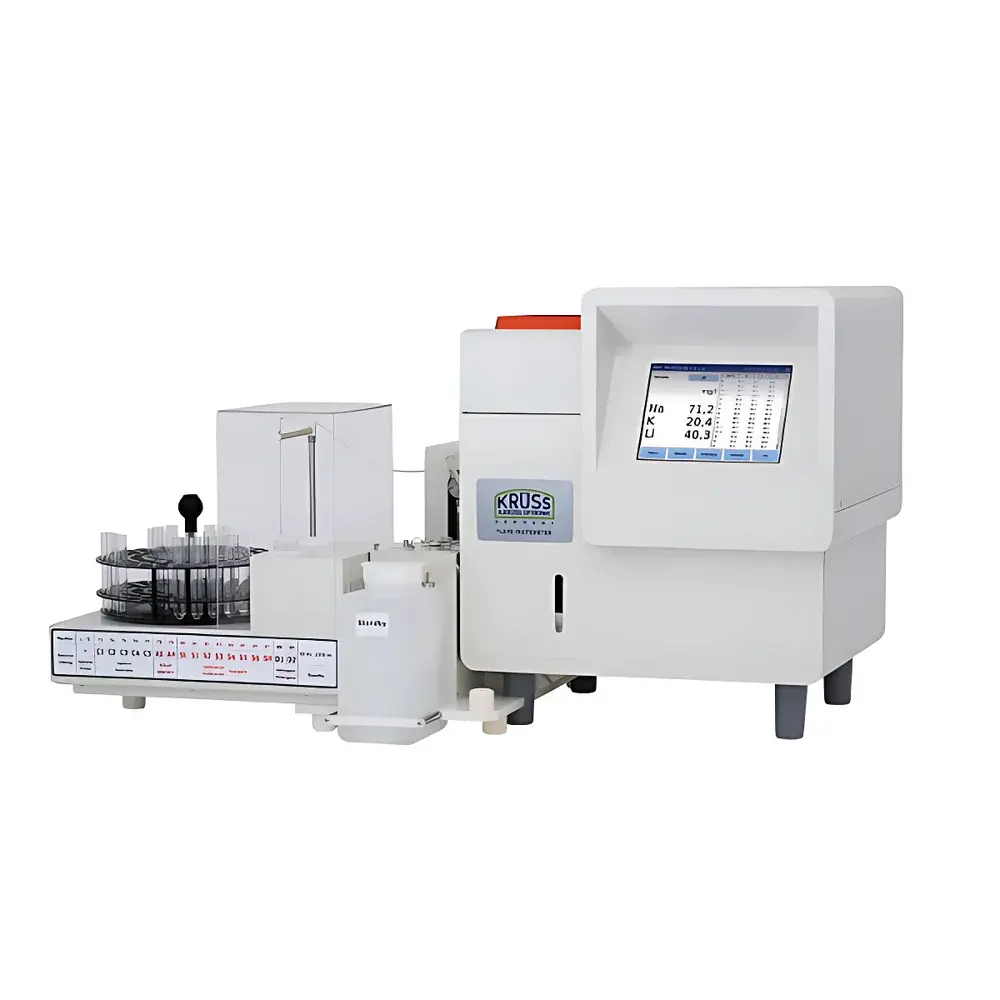
ChemTron FP8400 Flame Photometer
| Brand | ChemTron |
|---|---|
| Origin | Germany |
| Model | FP8400 |
| Type | Manual Flame Photometer |
| Detection Range | Na: 0.01–4500 mg/L (0.0004–200 mmol/L) |
| K | 0.02–4500 mg/L (0.0005–110 mmol/L) |
| Li | 0.02–3000 mg/L (0.0028–420 mmol/L) |
| Ca | 0.30–3000 mg/L (0.0075–75 mmol/L) |
| Measurement Channels | 5 independent configurable channels |
| Throughput | up to 300 samples/hour |
| Data Storage | 999 measurement records with traceable metadata |
| Compliance | GLP, GMP, FDA 21 CFR Part 11 (audit trail enabled) |
| Display | TFT high-brightness touchscreen |
| User Management | Dual-level authentication (admin/operator) |
| Interfaces | RS-232, USB, Ethernet |
Overview
The ChemTron FP8400 Flame Photometer is a precision optical instrument engineered for quantitative elemental analysis of alkali and alkaline earth metals—specifically sodium (Na), potassium (K), lithium (Li), and calcium (Ca)—in aqueous solutions. Based on the principle of atomic emission spectroscopy, the FP8400 atomizes liquid samples into a stable premixed air-propane flame, where metal ions are thermally excited and emit characteristic wavelengths of visible light. Integrated interference-filtered photodetectors measure the intensity of these emissions at discrete spectral bands (e.g., 589 nm for Na, 766 nm for K), enabling direct concentration determination via calibrated calibration curves. Designed and manufactured in Germany, the FP8400 delivers high reproducibility (RSD < 1.5% at mid-range concentrations) and long-term stability under routine laboratory or quality control conditions. Its robust mechanical architecture, thermally stabilized optical path, and flame monitoring circuitry ensure consistent excitation efficiency across extended operation cycles—critical for compliance-driven environments such as pharmaceutical QC labs or food safety testing facilities.
Key Features
- Five independently configurable measurement channels—each assignable to Na, K, Li, Ca, or blank/reference—supporting simultaneous multi-element analysis without hardware reconfiguration.
- TFT high-brightness capacitive touchscreen interface with intuitive icon-based navigation, optimized for glove-compatible operation and ambient-lit lab environments.
- Integrated flame safety system including automatic gas shutoff, flame-out detection, and real-time pressure monitoring—certified to EN ISO 13849-1 PL d (Performance Level d) for functional safety.
- Dual-tier user access control: administrator-level configuration lockout and operator-level measurement execution, with full audit trail logging per FDA 21 CFR Part 11 requirements.
- Onboard data storage for 999 measurement records, each timestamped and tagged with operator ID, calibration status, and instrument-specific parameters (e.g., flame temperature, gas flow rate).
- Multi-protocol connectivity: native support for RS-232 serial output, USB mass storage mode, and Ethernet TCP/IP for LIMS integration or remote diagnostics.
Sample Compatibility & Compliance
The FP8400 accepts standard 12–16 mm outer diameter sample tubes (e.g., 13 × 100 mm borosilicate glass or polypropylene) and operates with aqueous matrices having total dissolved solids (TDS) ≤ 0.5%. It accommodates direct analysis of un-diluted samples within its specified linear dynamic range and supports manual dilution workflows for high-concentration specimens. The instrument complies with ISO 6955:2000 (Flame photometric determination of alkali and alkaline earth metals), ASTM D1293 (electrical conductivity and pH of water), and relevant sections of USP and EP 2.2.27 for elemental impurity screening. Full GLP/GMP traceability is maintained through electronic signature support, calibration verification logs, and immutable data export (CSV/Excel-compatible format with embedded metadata).
Software & Data Management
No proprietary PC software is required for basic operation—the FP8400 functions autonomously with onboard firmware v3.2+. However, optional ChemTron DataLink™ desktop application (Windows 10/11 compatible) enables advanced report generation, method template deployment, and batch calibration curve management. All exported datasets include ISO/IEC 17025-compliant metadata: instrument serial number, firmware revision, calibration date, analyst ID, environmental temperature/humidity (if external sensor connected), and uncertainty estimates derived from calibration standard uncertainties and repeatability measurements. Audit trails record all parameter changes, calibration events, and user logins with tamper-proof timestamps.
Applications
- Pharmaceutical quality control: quantification of residual Na⁺/K⁺ in active pharmaceutical ingredients (APIs) and excipients per ICH Q5D and USP .
- Food & beverage testing: Na/K ratio analysis in dairy products, sports drinks, and infant formula; Ca monitoring in fortified beverages.
- Clinical research laboratories: serum/plasma electrolyte profiling (Na, K, Li) in therapeutic drug monitoring protocols.
- Environmental water analysis: hardness assessment (Ca²⁺/Mg²⁺ surrogate via Ca-only mode) and wastewater effluent compliance reporting.
- Industrial process support: online-ready configurations (FP8500+ valve module) enable integration into continuous feed streams for real-time brine or boiler water monitoring.
FAQ
What regulatory standards does the FP8400 meet for GxP environments?
The FP8400 supports full 21 CFR Part 11 compliance—including electronic signatures, audit trail activation, and role-based access control—when configured with firmware v3.2+ and paired with validated network infrastructure.
Can the FP8400 measure magnesium or other elements beyond Na, K, Li, and Ca?
No. The optical filter set and flame optimization are specifically engineered for the four listed elements. Mg emits weakly in air-propane flames and requires nitrous oxide-acetylene combustion, which is not supported by this platform.
Is automatic sample dilution available on the FP8400 model?
The base FP8400 is a manual-feed instrument. Automatic dilution is only available on FP8600 (with integrated autosampler) and FP8700 (with dilution/mixing module); retrofitting is not supported.
How often must the instrument be recalibrated?
Initial calibration is performed using NIST-traceable standards. Recalibration frequency depends on usage intensity and regulatory requirements—typically every 8–24 hours in high-throughput QC labs, or per batch in GLP studies.
Does the FP8400 require annual factory service?
While not mandatory, ChemTron recommends annual performance verification (PV) by an authorized service engineer, including burner alignment, photodetector linearity check, and gas flow calibration—documentation provided for internal QA records.





