
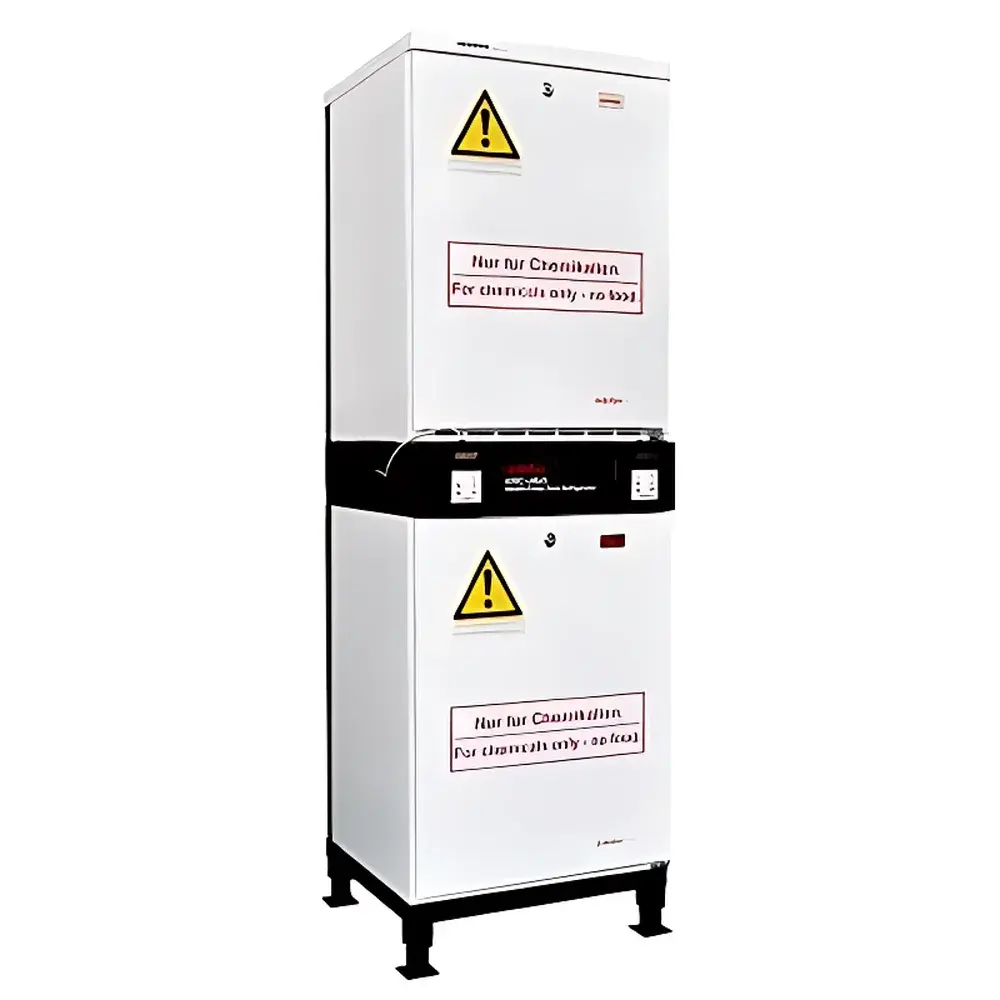
ChemTron KRC540 Explosion-Proof Laboratory Refrigerator
| Brand | ChemTron |
|---|---|
| Origin | Germany |
| Model | KRC540 |
| Instrument Type | Upright |
| Capacity | 540 L |
| Operating Temperature Range | −2 °C to +12 °C |
| Temperature Stability | ±1 °C |
| Display Resolution | 0.1 °C |
| Refrigeration System | Compressor-based |
| Refrigerant | R134a |
| Control Type | Digital LED Controller |
| External Dimensions (W×L×H) | 92 × 71 × 153 cm |
| Internal Dimensions (W×L×H) | 70 × 60 × 135 cm |
| Safety Features | Intrinsically Safe Internal Cavity, Externally Mounted Control Circuitry, Door Lock, Overload-Protected Compressor, Self-Test Function for Alarm Verification |
| Optional Accessories | ATEX-certified compact bottle-top dispenser, explosion-proof digital probe thermometer with data logging capability |
Overview
The ChemTron KRC540 Explosion-Proof Laboratory Refrigerator is an intrinsically safe, upright cold storage unit engineered specifically for the secure containment of flammable, volatile, and reactive chemical substances in regulated laboratory, pharmaceutical, and industrial research environments. Designed in accordance with IEC 60079-0 and IEC 60079-15 standards for equipment protection by type of protection “nA” (non-sparking) and “nC” (encapsulated), the KRC540 eliminates ignition risks through rigorous electrical isolation: no wiring, switches, or electronic components reside within the storage chamber. Instead, all control circuitry—including temperature sensors, relays, and display modules—is fully externalized and housed in a certified explosion-protected enclosure. This architecture ensures full compliance with ATEX Directive 2014/34/EU and meets requirements for Zone 2/22 hazardous locations where explosive atmospheres are unlikely but possible under abnormal conditions.
Key Features
- Intrinsically safe internal cavity: No internal electrical components—zero risk of spark generation during door opening, sample handling, or routine maintenance.
- Digital LED controller with 0.1 °C resolution and ±1 °C temperature stability across the full operating range (−2 °C to +12 °C), enabling precise thermal management for sensitive reagents.
- Externally mounted, self-contained control module with configurable cable length options for remote operation—ideal for placement behind safety barriers or within adjacent non-hazardous rooms.
- Compressor-based refrigeration system using R134a refrigerant, selected for its zero ozone depletion potential (ODP = 0) and low global warming potential (GWP = 1430), supporting institutional sustainability objectives.
- Integrated safety verification function: Users can initiate a full-system alarm self-test without interrupting operational continuity—critical for GLP/GMP audit readiness.
- Reversible door hinge assembly allows left- or right-handed swing configuration to accommodate spatial constraints and workflow ergonomics in ISO-certified laboratories.
- Robust mechanical door lock with keyed access control prevents unauthorized entry, aligning with ISO/IEC 17025 clause 6.4.10 on secure sample custody.
- Anti-static interior lining and grounded chassis minimize electrostatic discharge (ESD) hazards when handling low-flashpoint solvents such as ether, acetone, or ethyl acetate.
Sample Compatibility & Compliance
The KRC540 accommodates standard laboratory containers—including glass bottles, HDPE carboys, stainless steel cans, and UN-certified safety cans—within its 540 L single-zone chamber. Its uniform airflow design minimizes thermal gradients, ensuring consistent storage conditions across all shelf levels. The unit conforms to EN 14460:2021 (safety requirements for explosion-protected refrigerated appliances), DIN VDE 0165 Part 1 (electrical equipment for explosive atmospheres), and supports adherence to OSHA 1910.106 and NFPA 45 standards for chemical storage. It is validated for continuous operation under ambient temperatures up to 32 °C and relative humidity ≤80% non-condensing.
Software & Data Management
While the base KRC540 operates via standalone digital control, optional accessories enable enhanced traceability: the explosion-proof digital probe thermometer (model KRT-EP) provides continuous internal temperature logging compliant with FDA 21 CFR Part 11 requirements—including user authentication, electronic signatures, and immutable audit trails. Data export is supported via USB or RS-485 interface, facilitating integration into LIMS or ELN platforms. All firmware updates undergo functional safety review per IEC 61508 SIL 2 principles.
Applications
- Secure long-term storage of Class I flammable liquids (flash point < 60 °C) per NFPA 30.
- Cold-chain preservation of unstable intermediates in synthetic organic chemistry workflows.
- Controlled-temperature staging of solvents prior to GC or HPLC analysis to ensure injection consistency.
- Storage of peroxide-forming compounds (e.g., diethyl ether, tetrahydrofuran) at sub-ambient temperatures to suppress autoxidation kinetics.
- Compliance-driven archiving of reference standards in pharmaceutical QC labs subject to USP and ICH Q5C guidelines.
FAQ
Is the KRC540 certified for use in Zone 1 hazardous areas?
No—the KRC540 is certified for Zone 2 (gas) and Zone 22 (dust) only. Its “nA” and “nC” protection methods are not rated for continuous presence of explosive atmospheres.
Can the internal temperature be logged continuously without external hardware?
Not by default; real-time logging requires the optional KRT-EP probe thermometer with integrated memory and timestamped output.
Does the unit support validation protocols such as IQ/OQ/PQ?
Yes—ChemTron provides factory-issued calibration certificates traceable to NIST standards and supports third-party qualification with documented test scripts aligned with ASTM E2500 and EU Annex 15.
What maintenance intervals are recommended for the compressor and condenser?
Annual inspection of condenser coil cleanliness and refrigerant pressure verification is advised; service logs must be retained per ISO/IEC 17025 clause 7.7.
Is the door seal material compatible with aggressive solvents like chloroform or benzene?
Yes—the gasket uses EPDM elastomer with fluorocarbon resistance, validated per ASTM D471 for immersion testing up to 72 hours.



