
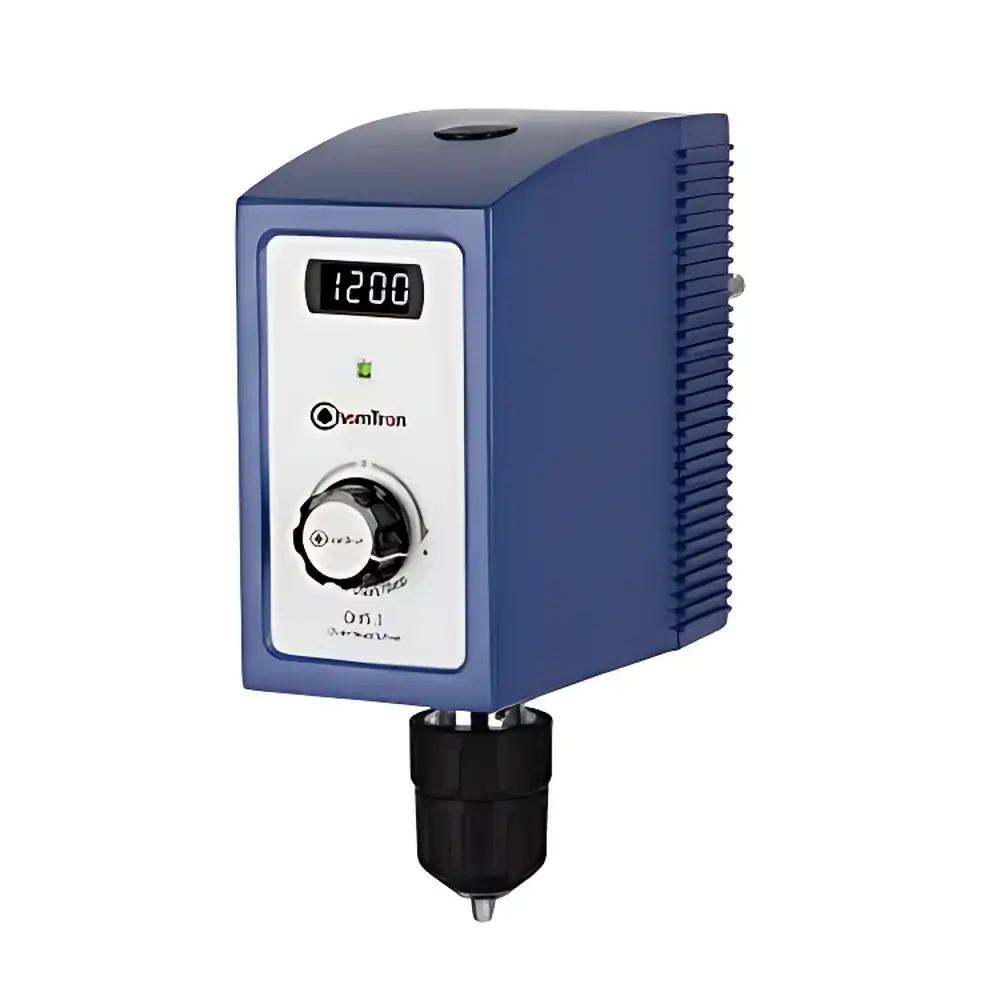
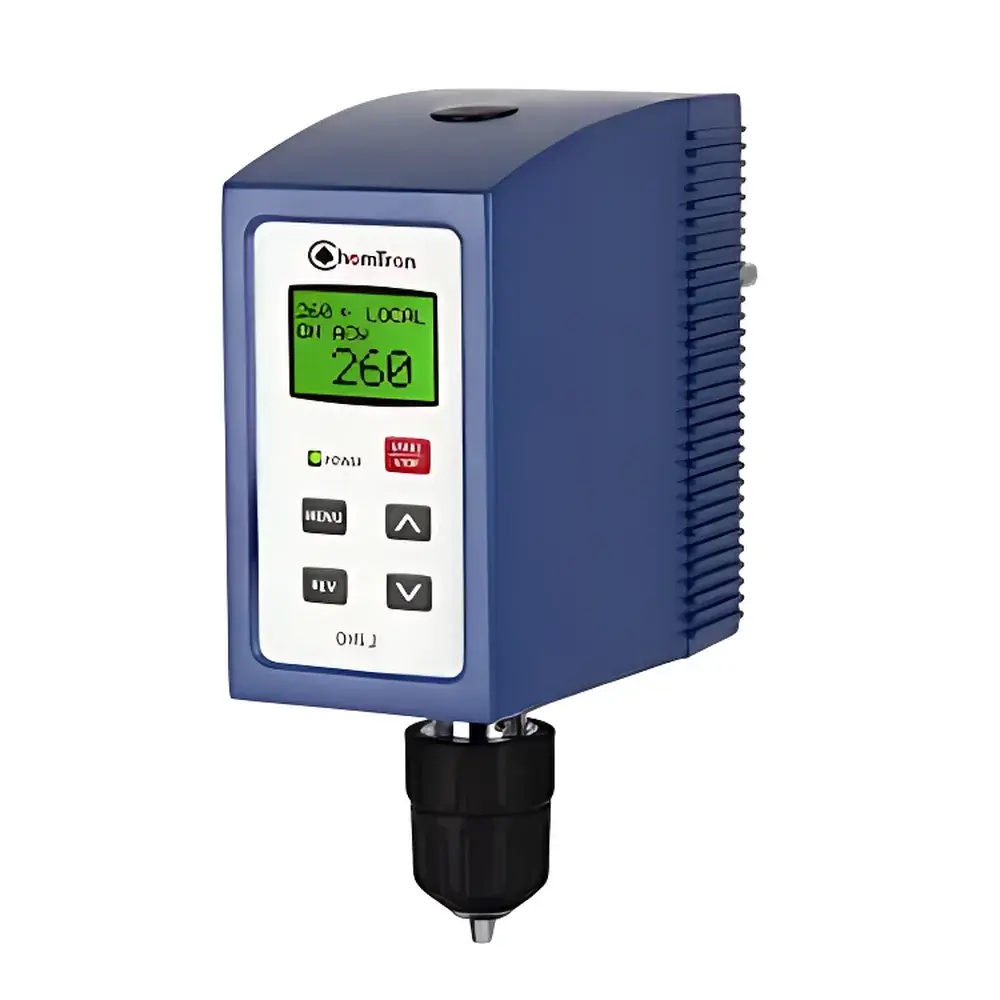
ChemTron OHS Series Overhead Stirrers
| Brand | ChemTron |
|---|---|
| Origin | USA |
| Model | OHS.1 / OHS.2 |
| Stirrer Type | Electric Overhead Stirrer |
| Max. Stirring Volume | 50 L (OHS.1), 100 L (OHS.2) |
| Speed Range | 20–2000 rpm (OHS.2), 40–2000 rpm (OHS.1) |
| Speed Accuracy | ±1 rpm |
| Max. Torque | 70 N·cm |
| Max. Viscosity | 20,000 cP |
| Motor | Brushless DC |
| Display & Control | LED + Knob (OHS.1) |
| Dimensions (W×D×H) | 105 × 160 × 185 mm |
| Power Input/Output | 70 W / 50 W |
| Shaft Clamping Diameter | 10 mm |
| Reversibility | Not supported (OHS.1), Supported (OHS.2) |
Overview
The ChemTron OHS Series Overhead Stirrers are precision-engineered laboratory instruments designed for reliable, high-duty-cycle mixing in demanding R&D, quality control, and pilot-scale synthesis environments. Based on the Couette flow principle—where torque is transmitted from a rotating shaft into a fluid medium via viscous drag—the OHS system delivers consistent shear input across variable viscosities and volumes. Unlike magnetic stirrers limited by heat sensitivity and low-torque capability, overhead stirrers provide direct mechanical coupling, enabling reproducible agitation of heterogeneous suspensions, viscous polymer solutions, emulsions, and high-density slurries up to 100 L (OHS.2). The brushless DC motor architecture eliminates carbon brush wear, ensuring stable speed output over extended operation without performance drift or scheduled maintenance—a critical requirement for GLP-compliant long-duration experiments and automated reaction monitoring.
Key Features
- Brushless DC motor with microprocessor-based closed-loop speed feedback, maintaining ±1 rpm accuracy across the full range (20–2000 rpm for OHS.2; 40–2000 rpm for OHS.1)
- Integrated thermal and current overload protection: automatically limits torque and reduces speed under excessive load to prevent motor stall or sample splashing
- Low-noise, sealed gearhead design with vibration-damped housing—meets ISO 10816-3 vibration severity standards for laboratory equipment
- Top-entry shaft passage allows uninterrupted vertical adjustment of impeller depth without repositioning the entire unit—ideal for jacketed reactors, multi-neck flasks, and custom reactor assemblies
- OHS.1: LED digital display with large ergonomic knob control—fully operable with lab gloves; real-time speed readout with tactile confirmation
- OHS.2: Full digital interface with LCD screen, RS-232 serial port, 0–20 mA analog input (for external PID signal integration), 0–10 V analog input (for potentiometer or PLC control), 0–5 V analog output (for torque/speed monitoring), and foot switch trigger—enabling synchronized operation within automated synthesis platforms
- Reversible rotation (OHS.2 only) supports controlled deagglomeration, bidirectional suspension homogenization, and compatibility with specialized impeller geometries requiring alternating shear direction
Sample Compatibility & Compliance
The OHS Series accommodates a broad spectrum of sample types—from low-viscosity aqueous buffers (≥1 cP) to non-Newtonian gels and thixotropic pastes (up to 20,000 cP). Its 70 N·cm maximum torque ensures stable operation with anchor, paddle, and turbine impellers across vessel diameters from 50 mm to 300 mm. All units comply with IEC 61010-1:2010 safety requirements for electrical equipment used in laboratory settings, including protection against electric shock, mechanical hazards, and abnormal temperature rise. The corrosion-resistant anodized aluminum housing meets ASTM B117 salt-spray resistance specifications (>96 h), making it suitable for routine use in fume hoods handling organic solvents, acids, and bases. Units ship with CE marking and are validated for use in environments adhering to ISO/IEC 17025 and FDA 21 CFR Part 11 when integrated with compliant data acquisition systems.
Software & Data Management
OHS.2 supports ASCII protocol over RS-232 for bidirectional communication with third-party software (e.g., LabVIEW, MATLAB, or custom Python scripts). Command sets include real-time speed query, setpoint update, direction toggle, start/stop control, and status polling (e.g., “IS_RUNNING”, “OVERLOAD_ACTIVE”). Analog I/O channels enable hardware-level integration into process control loops: 0–20 mA input accepts signals from external temperature or pH controllers to modulate stirring speed dynamically; 0–5 V output provides proportional voltage corresponding to actual rotational speed for archival in SCADA or ELN systems. Audit trails—including timestamped speed changes, error codes, and runtime logs—can be exported for regulatory review during GMP audits or method validation protocols.
Applications
- Controlled addition and dispersion in API crystallization processes (USP <701> compliance support)
- High-solids slurry mixing for battery electrode slurry preparation (NMC, LFP formulations)
- Emulsion polymerization under inert atmosphere (Schlenk line integration via top-entry shaft)
- Viscosity-dependent dissolution testing per USP <711>
- Long-term stability studies of colloidal nanosuspensions (e.g., lipid nanoparticles, PLGA microparticles)
- Multi-step catalytic hydrogenation where sequential reagent addition requires precise agitation timing and torque consistency
FAQ
What is the difference between OHS.1 and OHS.2 in terms of control architecture?
OHS.1 uses open-loop analog control with digital LED feedback; OHS.2 implements full digital closed-loop control with RS-232, analog I/O, and programmable logic interfaces.
Can the OHS stirrer be mounted on a universal stand or reactor frame?
Yes—the base features standardized M6 threaded holes compatible with common lab clamps and modular mounting brackets (e.g., ChemTron STB series or equivalent).
Is calibration traceable to NIST standards?
Speed calibration is performed using a Class 1 optical tachometer traceable to NIST; certificate of conformance is provided with each unit.
What impeller shaft diameters are supported?
The collet accepts round stainless-steel shafts with diameters of 6–10 mm; optional quick-release chucks (sold separately) support D-shaft and hex-key configurations.
Does the unit support continuous operation at maximum torque?
Yes—rated for indefinite duty cycle at ≤70 N·cm and ≤2000 rpm, provided ambient temperature remains below 35 °C and ventilation is unobstructed.



