
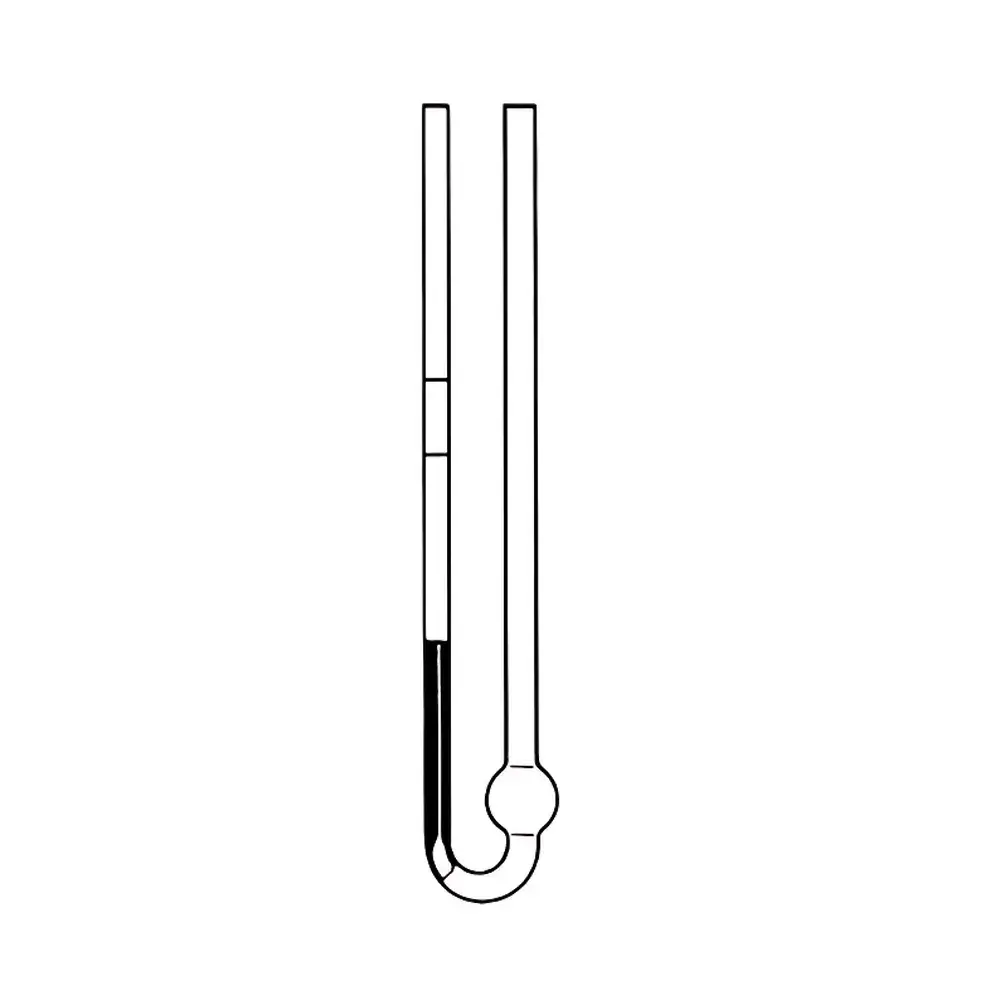

ChemTron Ostwald Viscometers (Models 51610 & 50903)
| Brand | ChemTron |
|---|---|
| Origin | Germany |
| Model Numbers | 51610, 50903 |
| Instrument Type | Capillary Viscometer (Ostwald-type) |
| Portability | Portable |
| Operating Environment | Ambient Temperature |
| Kinematic Viscosity Range | 0.4 – 800 mm²/s |
| Calibration | Pre-calibrated with certified capillary constants (K-values) |
| Fill Volume | 2–3 mL |
| Total Length | 220–290 mm |
| Compliance | Designed for ASTM D445, ISO 3104, and IP 71 standard test methods |
Overview
ChemTron Ostwald Viscometers (Models 51610 and 50903) are precision-engineered glass capillary viscometers based on the classical Ostwald (or U-tube) principle. These instruments determine kinematic viscosity by measuring the efflux time of a fixed volume of liquid under gravity through a calibrated capillary tube. The measurement relies on Poiseuille’s law, where kinematic viscosity (ν, in mm²/s) is calculated as ν = K × t, with K being the instrument-specific capillary constant (determined via calibration with traceable reference fluids) and t the efflux time in seconds. Designed for laboratory and quality control environments, these viscometers deliver high reproducibility for transparent, Newtonian, and low-shear-rate fluids—particularly mineral oils, solvents, polymer solutions, and lubricants—under ambient conditions without external temperature control.
Key Features
- Pre-calibrated capillary constants (K-values) certified per ISO/IEC 17025-accredited procedures; each unit includes a unique K-value label affixed to the stem.
- Two distinct series: Standard Ostwald (Model 509xx) with fill volume ~3 mL and total length ~220 mm; Miniature Ostwald (Model 516xx/517xx) optimized for limited sample availability (~2 mL fill) and foam-prone liquids, with extended length (~290 mm) for improved flow stability.
- Capillary geometry engineered for laminar, fully developed flow—ensuring compliance with ASTM D445 requirements for capillary diameter tolerance and bulb volume ratios.
- Chemically resistant borosilicate glass (Duran® or equivalent), annealed to minimize thermal stress and dimensional drift during repeated use.
- Integrated timing marks (upper and lower meniscus lines) etched with micron-level precision for unambiguous efflux time determination.
- Compatible with universal viscometer stands (e.g., ChemTron 5397 and 6499 series), enabling vertical alignment within ±0.05°—critical for gravitational consistency and measurement repeatability.
Sample Compatibility & Compliance
These viscometers are validated for use with Newtonian liquids exhibiting low volatility and minimal particulate content. Non-Newtonian or shear-thinning samples require caution and should be assessed for applicability per ISO 2555. The 50903 model (K = 0.325 mm²/s²) covers low-viscosity ranges (0.4–5 mm²/s), ideal for hydrocarbons and light solvents. The 51610/51710 series (K = 0.43 mm²/s²) extends into medium-range applications (0.4–65 mm²/s), while the 51630/51730 III-grade (K = 1.36 mm²/s²) supports high-viscosity oils up to 800 mm²/s. All models conform to the dimensional and functional specifications outlined in ASTM D445 Annex A1, ISO 3104 Clause 6, and IP 71 Section 4. They are routinely employed in GLP-compliant QC labs where method traceability, operator independence, and manual measurement audit trails are required.
Software & Data Management
As analog, gravity-driven instruments, ChemTron Ostwald Viscometers operate without embedded electronics or firmware. However, they integrate seamlessly into digital QA workflows: efflux times are recorded manually or via stopwatch interfaces compliant with FDA 21 CFR Part 11 when paired with validated electronic lab notebooks (ELNs) or LIMS platforms. Calibration certificates include uncertainty budgets (k=2) aligned with EURAMET cg-12 guidelines. For automated data capture, users may employ vision-based timer systems (e.g., high-speed camera + edge-detection software) synchronized to meniscus crossing events—enabling timestamped, operator-agnostic records suitable for internal audits and regulatory submissions.
Applications
- Quality assurance of base oils, transformer oils, and hydraulic fluids per ASTM D975 and IEC 60296.
- Batch release testing of pharmaceutical excipients (e.g., propylene glycol, PEG 400) under USP viscosity monographs.
- Research-grade characterization of polymer dilute solutions (e.g., polystyrene in toluene) using relative viscosity protocols.
- Educational laboratories demonstrating fundamental rheological principles—including Hagen-Poiseuille flow, Reynolds number estimation, and Newtonian fluid behavior.
- In-process monitoring of solvent recovery streams in fine chemical manufacturing where rapid, low-cost viscosity screening is critical.
FAQ
Are these viscometers supplied with calibration certificates?
Yes—each unit ships with a manufacturer-issued calibration certificate listing its certified K-value, reference fluid(s) used (e.g., NIST-traceable silicone oils), and expanded uncertainty (k=2) at 25 °C.
Can I use these for non-Newtonian fluids?
Not without validation. Ostwald viscometers assume Newtonian behavior and constant shear rate. Yield-stress or time-dependent fluids (e.g., gels, suspensions) will yield non-reproducible results and are outside the scope of ASTM D445.
What temperature control is required?
Testing must be conducted in a thermostatically stabilized bath (±0.02 °C) per ASTM D445 Section 7. While the viscometer itself is ambient-rated, viscosity is highly temperature-sensitive; bath immersion depth and equilibration time must follow standard protocol.
How often should recalibration be performed?
Recalibration is recommended every 12 months or after mechanical impact, cleaning with aggressive solvents, or observed deviation from historical control chart limits—per ISO/IEC 17025 clause 6.5.



