
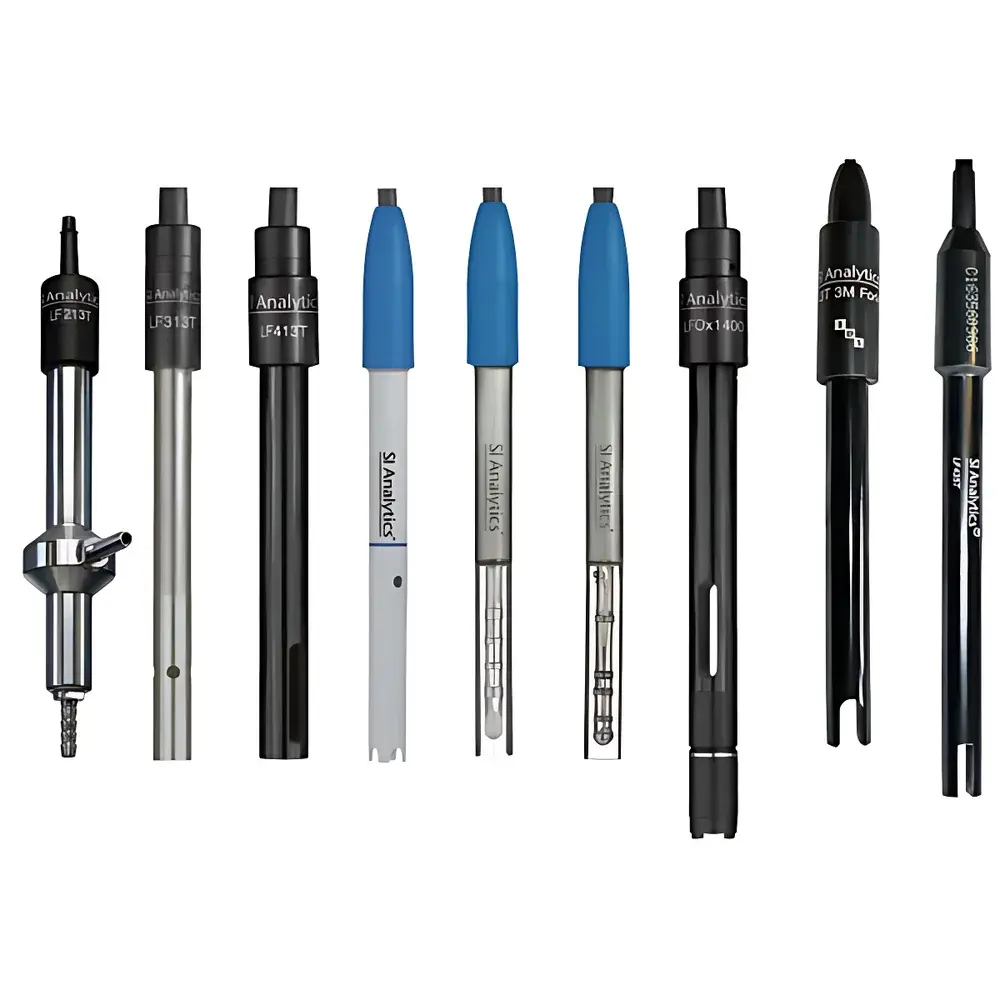
ChemTron ScienceLine LF 213 T Trace Conductivity Electrode with Flow-Through Cell
| Brand | ChemTron |
|---|---|
| Origin | Germany |
| Model | ScienceLine LF 213 T |
| Cell Constant | 0.01 cm⁻¹ |
| Electrode Material | Stainless Steel Ring |
| Temperature Sensor | NTC 30 kΩ |
| Operating Temp. Range | 0–100 °C |
| Conductivity Range | 0.03–1000 µS/cm |
| Electrode Body Diameter | 12 mm |
| Cable Length | 1.5 m |
| Housing | Stainless Steel |
| Compliance | ASTM D1125, ISO 7888, USP <645>, EN 27888 |
| Features | Integrated Flow-Through Cell, Fixed Connector |
Overview
The ChemTron ScienceLine LF 213 T is a high-precision trace conductivity electrode engineered for ultra-low-conductivity measurements in ultrapure water systems, pharmaceutical water loops (PW, WFI, PWFI), and semiconductor process rinse monitoring. It operates on the principle of two-electrode AC conductometry at a fixed frequency (typically 1–10 kHz), minimizing polarization effects and enabling stable, drift-free readings in sub-1 µS/cm environments. Its 0.01 cm⁻¹ cell constant is optimized for maximum sensitivity and resolution in the 0.03–1000 µS/cm range—critical for meeting stringent pharmacopeial requirements such as USP and EP 2.2.39. The integrated stainless steel flow-through cell ensures laminar, bubble-free sample presentation while maintaining thermal equilibrium and minimizing residence time artifacts. Designed and manufactured in Germany, the LF 213 T adheres to ISO 9001-certified production protocols and conforms to electromagnetic compatibility standards per IEC 61326-1 for laboratory and industrial cleanroom integration.
Key Features
- Stainless steel dual-ring sensing element with precisely calibrated 0.01 cm⁻¹ cell constant for trace-level accuracy
- Integrated flow-through cell with standardized ¼” NPT or Swagelok-compatible inlet/outlet ports for seamless inline installation
- NTC 30 kΩ temperature sensor embedded adjacent to the measuring cell for real-time, co-located thermal compensation (±0.1 °C typical accuracy)
- Robust 316L stainless steel housing rated IP67, resistant to aggressive cleaning agents (e.g., hydrogen peroxide, ozone, sodium hydroxide) used in GMP validation
- 1.5 m shielded, low-noise cable with fixed 8-pin DIN connector compatible with ChemTron CDM 210/310, Mettler Toledo InPro 7250i, and other industry-standard conductivity transmitters
- Optional ID recognition (LF 213 T ID variant) supporting automatic sensor parameter recall and audit-ready configuration logging per FDA 21 CFR Part 11 requirements
Sample Compatibility & Compliance
The LF 213 T is validated for continuous operation in Type I ultrapure water (ASTM D5127), purified water (USP ), and water for injection (WFI) systems. Its surface finish (Ra ≤ 0.4 µm) and electropolished stainless steel construction prevent leaching and biofilm nucleation. The electrode meets ISO 7888 for electrical conductivity measurement of water and ASTM D1125 for conductivity testing of water samples. It supports GLP/GMP workflows through full traceability: each unit carries a unique serial number, calibration certificate (NIST-traceable reference standards), and optional factory calibration at 0.1 µS/cm and 10 µS/cm points. All materials comply with EU Regulation EC 1935/2004 for food contact and USP Class VI biocompatibility testing.
Software & Data Management
When paired with ChemTron’s CDM 310 transmitter or third-party controllers supporting Modbus RTU or HART 7, the LF 213 T enables full digital data integrity. The ID-enabled variant logs sensor type, calibration date, cell constant, and firmware revision directly into the host system—eliminating manual entry errors. Audit trails include timestamped conductivity and temperature values, sensor status flags (e.g., “flow detected”, “temperature out-of-range”), and calibration event records. Data export complies with CSV and XML formats suitable for LIMS integration. For regulated environments, the system supports electronic signatures, role-based access control, and 21 CFR Part 11-compliant electronic records when deployed with validated software platforms.
Applications
- Real-time monitoring of UPW distribution loops in semiconductor fabs (SEMI F57-0218 compliance)
- In-line verification of WFI quality during still and loop circulation in pharmaceutical manufacturing (Annex 1, EU GMP)
- Validation of deionized water systems in biotech clean utilities
- Leak detection in heat exchangers and condensate return lines via conductivity spike analysis
- Calibration verification of online TOC analyzers using conductivity correlation protocols
- Research-grade low-conductivity studies in electrochemistry and membrane characterization labs
FAQ
What is the recommended flow rate for optimal performance with the integrated flow-through cell?
A minimum linear flow velocity of 0.3 m/s is advised to ensure complete cell flushing and eliminate boundary layer effects; maximum recommended pressure is 6 bar at 20 °C.
Can the LF 213 T be autoclaved?
No—autoclaving exceeds the NTC sensor’s thermal limit and may compromise cable insulation integrity. Sterilization is achieved via SIP (steam-in-place) at ≤121 °C for ≤30 min only when installed in validated sanitary manifolds with external temperature control.
Is a separate temperature probe required?
No—the integrated NTC 30 kΩ sensor provides direct, co-located temperature measurement; no external RTD or thermistor is needed for standard applications.
How often should the electrode be recalibrated?
Per USP , daily system suitability testing is required; full recalibration is recommended every 7–14 days in continuous operation or after any maintenance event affecting flow path integrity.
Does the LF 213 T support conductivity compensation for non-aqueous solvents?
It is validated exclusively for aqueous systems per ISO 7888; use in organic solvents or high-viscosity media is not supported and may damage the sensor.




