
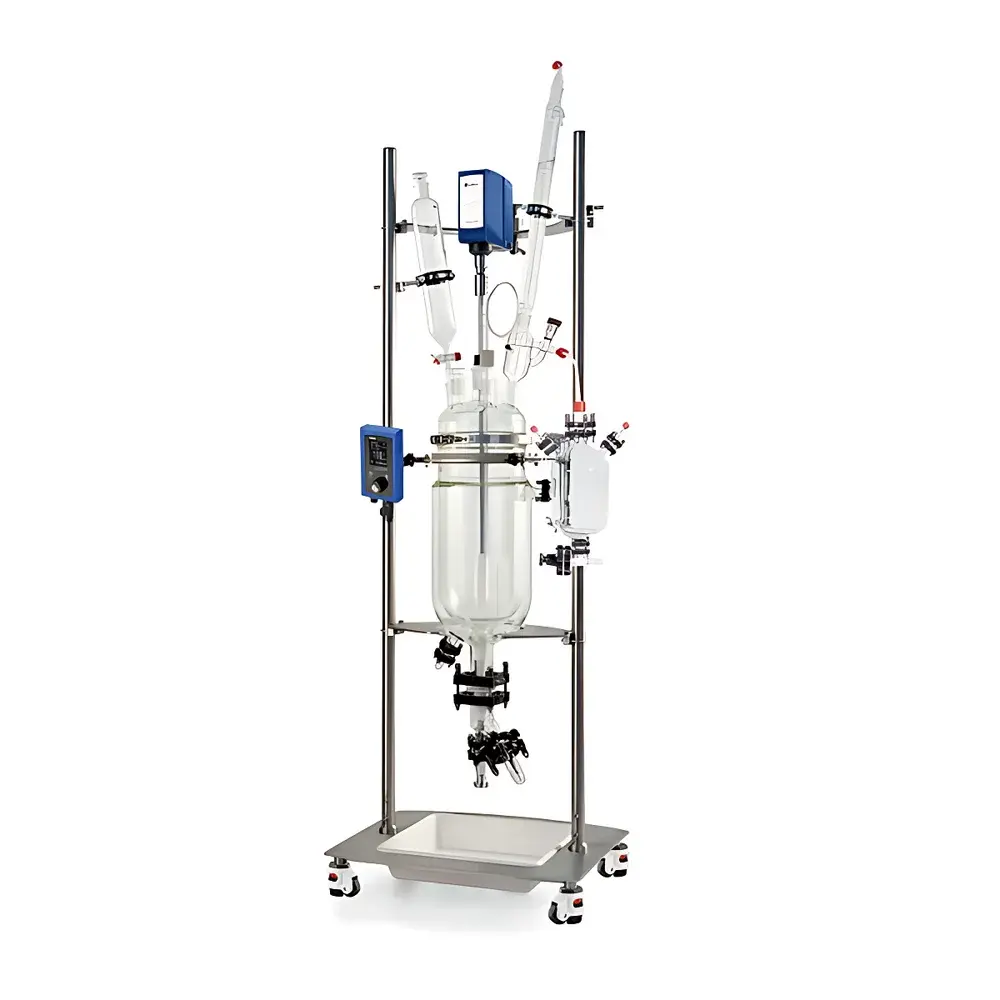
ChemTron SPG Pilot-Scale Glass Reactor
| Brand | ChemTron |
|---|---|
| Origin | Germany |
| Model | SPG |
| Capacity | 12–200 L |
| Vessel Material | Borosilicate Glass 3.3 (DIN ISO 3585) |
| Maximum Operating Pressure | Up to 6 bar (g) |
| Vacuum Rating | Down to -0.9 bar (absolute) |
| Jacket Type | Double-walled glass jacket for heating/cooling media |
| Standard Flange Interface | ISO-KF / DIN 28178 (ground-glass joints: 45/50, 24/40, DN200/DN300/DN400) |
| Stirring Options | Digital-controlled high-torque drive (up to 120 N·cm) or AC motor drive |
| Optional Thermal Management | Multi-channel oil circulation unit with independent temperature control per port |
| Structural Frame | Modular stainless steel support frame with leveling feet and integrated utility routing |
Overview
The ChemTron SPG Pilot-Scale Glass Reactor is an engineered platform for scalable chemical synthesis, process development, and reaction optimization under controlled thermal, pressure, and mixing conditions. Designed in accordance with ISO 9001-certified German manufacturing standards, the SPG series employs borosilicate glass 3.3 (DIN ISO 3585) for full process visibility, chemical inertness, and resistance to thermal shock—enabling safe operation across a wide temperature range (–50 °C to +200 °C) when paired with compatible heat transfer fluids. Its double-jacketed glass vessel architecture supports precise temperature regulation via external circulators, while the modular flange system—featuring standardized ground-glass joints (45/50, 24/40) and ISO-KF-compatible ports—ensures seamless integration of distillation columns, condensers, gas inlets, solid feeders, and inline sensors. Unlike benchtop reactors, the SPG is purpose-built for pilot-scale continuity: its pressure-rated design (up to 6 bar gauge), vacuum capability (down to –0.9 bar absolute), and mechanically robust stirring systems enable direct translation of lab protocols to kilo-lab or pre-GMP environments.
Key Features
- Modular configuration: Select from five base capacities (12 L, 20 L, 30 L, 50 L, 100 L, and 200 L) with corresponding DN200, DN300, or DN400 glass vessels—each validated for mechanical integrity under static and dynamic load conditions.
- Two interchangeable drive systems: A digitally regulated high-torque stirrer (CR3091.02FOHS.4DF) delivering up to 120 N·cm at speeds from 0–250 rpm, or a rugged AC motor variant optimized for long-duration, low-shear applications.
- Multi-port reactor head: Standard 200 mm (8″) or 300/400 mm flanged lids include central 45/50 opening, three to five auxiliary 45/50 ports, and a dedicated 60–100 mm solid-charge port sealed with PTFE-coated glass covers and quick-clamp fixtures.
- Integrated thermal management: Optional multi-channel oil circulation unit (JRS-1503-M / JRS-1504-M configurations) enables independent temperature control of jacket, reflux condenser, and bottom coil—critical for exothermic reactions and staged crystallization.
- Full-system compatibility: All components—including PTFE-sealed valves (JRS-6472-245), glass impellers (anchor, 45° pitched-blade), temperature probes (stainless steel/PTFE-coated, 600 × 6 mm), and insulated metal tubing (–50 °C to +200 °C)—are traceable to DIN/ISO specifications and supplied with material certification.
Sample Compatibility & Compliance
The SPG reactor accommodates heterogeneous, viscous, and gas-evolving reaction mixtures—including catalytic hydrogenations, Grignard formations, polymerizations, and crystallization studies—without risk of metal contamination or surface adsorption. Its all-glass wetted path complies with USP , EP 3.1.1, and FDA 21 CFR Part 11 requirements for data integrity when used with validated software interfaces. Pressure and vacuum ratings conform to PED 2014/68/EU (Category II) and ASME BPVC Section VIII Div. 1 (when equipped with certified pressure relief devices). All O-rings, gaskets, and bearings are FDA-compliant PTFE or FKM; no silicone-based lubricants are used in factory assembly. The system supports GLP/GMP documentation workflows through configurable audit trails and electronic signature-capable controllers (optional upgrade).
Software & Data Management
While the base SPG operates as a hardware-integrated platform, optional digital modules enable full process data capture and remote supervision. The ChemTron ControlHub™ interface (sold separately) provides real-time logging of torque, temperature, pressure, and stir speed with timestamped CSV export. It supports 21 CFR Part 11 compliance via role-based access control, electronic signatures, and immutable audit logs. Integration with LabArchives ELN, DeltaV DCS, or Siemens Desigo CC is achieved via Modbus TCP or OPC UA protocols. All firmware updates are digitally signed and verified prior to installation—ensuring cybersecurity alignment with IEC 62443-3-3 SL2 requirements.
Applications
- Pharmaceutical process validation: Scale-up of API syntheses from 100 mL to 200 L while maintaining identical mixing regimes and thermal profiles.
- Agrochemical formulation development: Controlled addition of hazardous reagents under inert atmosphere with real-time pH and conductivity monitoring.
- Specialty polymer synthesis: Step-growth polycondensation requiring precise vacuum ramping and continuous water removal via Dean-Stark traps.
- Electrolyte screening for battery R&D: Anhydrous handling of LiPF₆ solutions under argon with moisture-level monitoring (<10 ppm) at port connections.
- Biocatalysis under mild conditions: Immobilized enzyme reactions at 30–45 °C with shear-sensitive substrates—enabled by low-RPM anchor impellers and non-metallic wetted surfaces.
FAQ
What pressure and vacuum ratings apply to the SPG reactor?
The SPG is rated for continuous operation up to 6 bar gauge pressure and down to –0.9 bar absolute vacuum. Burst pressure exceeds 12 bar for all standard vessel sizes.
Can the SPG be used for hydrogenation reactions?
Yes—when equipped with H₂-rated pressure seals, explosion-proof motor options, and certified gas mass flow controllers, the SPG meets ATEX Zone 1 requirements for catalytic hydrogenation.
Is custom engineering support available for GMP-compliant installations?
ChemTron offers IQ/OQ protocol development, FAT/SAT execution, and 3Q documentation packages aligned with Annex 15 and ASTM E2500-13.
How is temperature uniformity maintained across large-volume vessels?
Through optimized jacket geometry, calibrated flow distribution manifolds, and optional IR thermography validation reports confirming ΔT ≤ ±1.5 °C across the vessel wall surface.
Are spare parts and technical documentation provided with each system?
Every SPG shipment includes a complete spares kit (O-rings, clamps, PTFE bearings), bilingual (EN/DE) operation manuals, material certificates, and 3D STEP files for CAD integration.



