
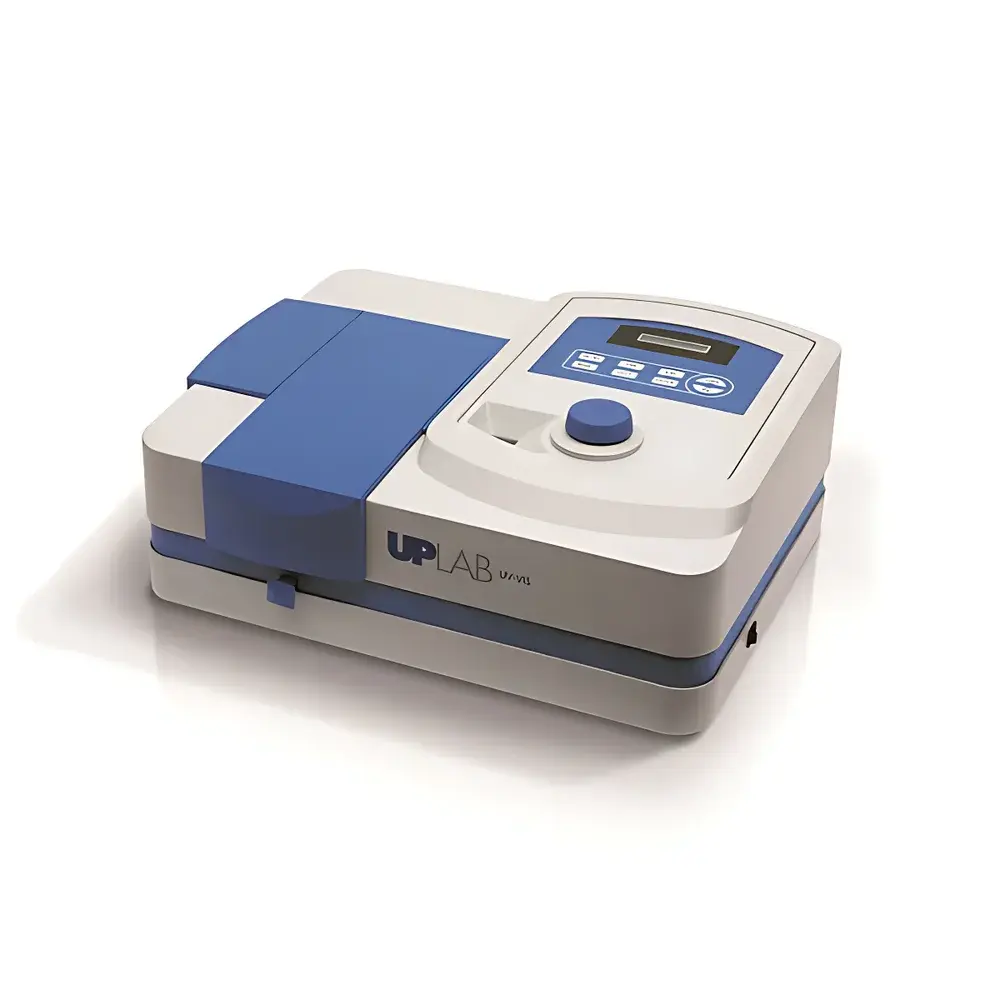
ChemTron UPLAB UV-Vis Spectrophotometer
| Brand | ChemTron |
|---|---|
| Origin | Germany |
| Model | UPLAB |
| Wavelength Range | 320–1100 nm (VIS), 190–1100 nm (UV-VIS & UV-VIS AUTO) |
| Wavelength Accuracy | ±2.0 nm (VIS/UV-VIS), ±0.5 nm (UV-VIS AUTO) |
| Wavelength Repeatability | 1 nm (VIS/UV-VIS), 0.2 nm (UV-VIS AUTO) |
| Spectral Bandwidth | 2 nm (1, 4, 5 nm optional) |
| Photometric Accuracy | ±0.5% T (0–100% T), ±0.002 A (0–0.5 A), ±0.004 A (0.5–1 A) |
| Photometric Repeatability | 0.3% T (VIS/UV-VIS), 0.2% T (UV-VIS AUTO) |
| Stray Light | ≤0.1% T (NaI at 220 nm |
| 0% T Stability | 0.2% T / 30 min |
| 100% T Stability | 0.001 A / 30 min (at 500 nm, post thermal equilibration) |
| Detector | Silicon photodiode |
| Light Sources | Tungsten halogen lamp (VIS), Deuterium lamp (UV-VIS & UV-VIS AUTO) |
| Display | 16×2 LCD (VIS/UV-VIS), 6-inch high-brightness blue-backlit LCD (UV-VIS AUTO) |
| Operating Modes | Transmittance (T), Absorbance (A), Concentration (C), Kinetics (E) |
| Data Output | USB interface, printer support, PC export via UPSoft software |
| Dimensions | 530 × 410 × 210 mm |
| Weight | 15–18 kg (model-dependent) |
| Power Supply | 220–230 V AC, 50 Hz |
| Power Consumption | 100–140 W |
Overview
The ChemTron UPLAB UV-Vis Spectrophotometer is a precision optical instrument engineered for quantitative and qualitative analysis across research laboratories, quality control environments, and routine analytical workflows in food & beverage, pharmaceutical, environmental, and chemical industries. Based on the principle of Beer-Lambert law absorption spectroscopy, the UPLAB series employs double-beam or single-beam optical architecture (model-dependent) with high-stability tungsten-halogen and deuterium light sources to deliver reliable absorbance and transmittance measurements across the ultraviolet, visible, and near-infrared spectral regions. The VIS model covers 320–1100 nm, while the UV-VIS and UV-VIS AUTO variants extend coverage down to 190 nm—enabling detection of aromatic compounds, nucleic acids, proteins, and low-concentration analytes requiring deep-UV sensitivity. Its monochromator design ensures consistent spectral resolution, and the instrument’s optical path is optimized for minimal stray light (<0.1% T), critical for accurate low-transmittance measurements at demanding wavelengths such as 220 nm (NaI) or 340 nm (NaNO₂).
Key Features
- Three configurable models: UPLAB-VIS (320–1100 nm), UPLAB-UV-VIS (190–1100 nm), and UPLAB-UV-VIS AUTO (190–1100 nm with automated wavelength scanning and programmable method execution)
- High-precision wavelength calibration: ±0.5 nm accuracy and 0.2 nm repeatability on UV-VIS AUTO variant—suitable for regulatory-compliant method validation per ISO 8577, ASTM E275, and USP
- Selectable spectral bandwidth (1, 2, 4, or 5 nm) allows optimization between resolution and signal-to-noise ratio depending on sample matrix complexity
- Dual-light-source configuration (tungsten halogen + deuterium lamp) ensures seamless spectral continuity without manual lamp switching or intensity discontinuity
- Thermally stabilized optical bench and low-drift electronics guarantee long-term photometric stability: ≤0.001 A drift over 30 minutes at 500 nm after thermal equilibrium
- Integrated 6-inch high-brightness blue-backlit LCD on UV-VIS AUTO model supports real-time spectrum preview, kinetic plot visualization, and multi-curve overlay
- Robust mechanical construction (15–18 kg mass, steel-reinforced chassis) minimizes vibration-induced noise and enhances operational reliability in shared lab environments
Sample Compatibility & Compliance
The UPLAB platform accommodates standard 10 mm pathlength cuvettes (quartz for UV, glass or plastic for VIS), as well as microvolume adapters and flow cells for specialized applications. It is routinely deployed in wine, juice, dairy, and fermentation analytics—validated for use with over 40 CE-marked enzymatic and colorimetric assay kits (e.g., L-malic acid, total SO₂, glycerol, polyphenols, ammoniacal nitrogen). All assay protocols are aligned with OIV, AOAC, and EN methods where applicable. The system meets IEC 61010-1 safety requirements for laboratory electrical equipment and complies with electromagnetic compatibility standards (EN 61326-1). When operated with UPSoft software under defined user access controls and audit-trail-enabled configurations, the UPLAB-UV-VIS AUTO supports GLP and GMP data integrity requirements—including full traceability of measurement parameters, calibration history, and operator logs.
Software & Data Management
UPSoft is a dedicated Windows-based application designed exclusively for the UPLAB family. It provides full instrument control, method development, spectral acquisition, kinetic profiling, and quantitative analysis using user-defined calibration curves (linear, quadratic, or cubic). Data files are saved in native .ups format and exportable to CSV, TXT, or PDF for integration into LIMS or ELN systems. UPSoft supports FDA 21 CFR Part 11 compliance when deployed with electronic signatures, role-based permissions, and immutable audit trails—ensuring data integrity during regulatory inspections. Batch processing, report templating, and customizable pass/fail criteria further streamline QC workflows. Raw spectral data can be exported for advanced chemometric analysis in third-party tools such as MATLAB or Unscrambler.
Applications
The UPLAB spectrophotometer serves diverse analytical needs including but not limited to: quantification of organic acids (L-malic, D-lactic, citric) in must and wine; determination of residual sugar (glucose/fructose/sucrose) via enzymatic assays; measurement of total and free sulfur dioxide in beverages; assessment of phenolic content (total polyphenols, anthocyanins, catechins); enzymatic detection of glycerol, acetaldehyde, and α-amino nitrogen in fermentation monitoring; metal ion analysis (iron, copper, calcium, magnesium) using colorimetric reagents; and verification of enzyme activity and reagent stability through kinetic absorbance tracking. Its versatility extends to water quality testing (chlorides, nitrates, ammonia), pharmaceutical excipient verification, and educational laboratory instruction in analytical chemistry.
FAQ
What is the difference between the UPLAB-UV-VIS and UPLAB-UV-VIS AUTO models?
The UV-VIS AUTO model includes motorized wavelength scanning, programmable method sequences, enhanced display functionality, and tighter wavelength accuracy (±0.5 nm) and repeatability (0.2 nm)—making it suitable for validated, high-throughput QC environments.
Can the UPLAB be used with non-ChemTron assay kits?
Yes—provided the assay follows standard colorimetric or enzymatic reaction kinetics and falls within the instrument’s absorbance range (–0.3 to 3.0 A) and wavelength capability. Users must validate method performance independently.
Is UPSoft compatible with Windows 11 and 64-bit systems?
Yes—UPSoft v4.2 and later fully support Windows 10 and Windows 11 (64-bit), including TLS 1.2 encryption for secure network communication.
Does the instrument support GLP-compliant electronic signatures?
When configured with UPSoft’s security module and connected to an authenticated domain environment, electronic signatures, audit trails, and user-level permissions meet GLP and 21 CFR Part 11 requirements.
What maintenance is required for long-term optical performance?
Annual verification of wavelength accuracy and photometric linearity using NIST-traceable standards (e.g., holmium oxide filter, neutral density filters) is recommended. Lamp replacement intervals are ~2000 hours for D₂ and ~5000 hours for tungsten halogen sources.






