
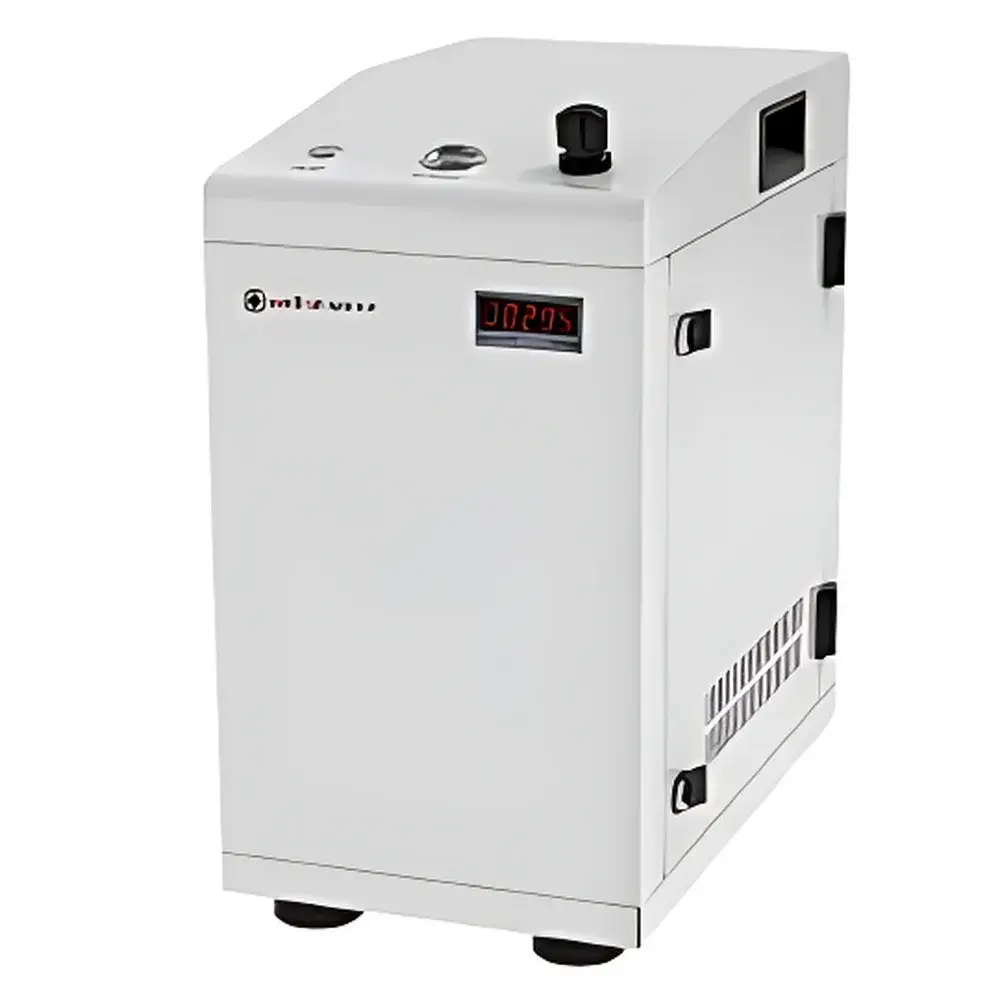
ChemTron WIND ELSD Dedicated Nitrogen Generator for Evaporative Light Scattering Detectors
| Brand | ChemTron |
|---|---|
| Origin | Germany |
| Model | WIND ELSD |
| Output Flow | 20 L/min @ 5.5 bar |
| Output Pressure | 5.5 bar |
| Nitrogen Dew Point | < −40 °C |
| Ambient Temperature Range | 10–35 °C |
| Ambient Humidity | 0–80 % RH (non-condensing) |
| Power Supply | 220–240 V / 50 Hz |
| Noise Level | 58 dB(A) |
| Dimensions (W×L×H) | 300 × 550 × 560 mm |
| Weight | 40 kg |
| Internal Storage Tank | 5 L stainless steel |
| Filtration | Integrated Type I triple-stage coalescing filter (particulate removal down to 0.01 µm) |
Overview
The ChemTron WIND ELSD Dedicated Nitrogen Generator is an engineered solution designed exclusively to supply high-purity, pressure-stable nitrogen gas to evaporative light scattering detectors (ELSD) used in HPLC and UHPLC systems. Unlike generic nitrogen generators, the WIND ELSD employs vacuum-driven hollow-fiber membrane separation technology—optimized for the precise flow, pressure, and purity requirements of ELSD nebulization and drying stages. It integrates a built-in oil-free diaphragm air compressor, multi-stage air purification, and temperature-controlled membrane modules to deliver consistent nitrogen with dew point < −40 °C and particulate content < 0.01 µm—meeting the stringent gas quality demands of trace-level quantitative analysis. Its compact footprint, low acoustic signature (58 dB[A]), and ambient-temperature operation eliminate the need for external cooling or high-pressure gas cylinders, supporting compliance with laboratory safety protocols and reducing operational overhead.
Key Features
- Vacuum-assisted hollow-fiber membrane nitrogen generation ensures stable output at 20 L/min @ 5.5 bar, with purity inversely proportional to flow—optimized for ELSD’s typical 10–18 L/min operational range.
- Integrated oil-free air compressor (1450 rpm, 800 W) with thermal overload protection, anti-vibration mounting, and auto-decompression startup to extend service life and ensure safe cold starts.
- Three-stage pre-filtration system: includes coalescing, activated carbon, and ultrafine particulate filters—reducing airborne contaminants to ≤0.01 µm and eliminating hydrocarbons, moisture, and oil vapors prior to membrane separation.
- Internal air-cooled heat exchanger rapidly condenses compressed air, removing bulk moisture before membrane exposure—enhancing membrane longevity and improving long-term separation stability.
- 5 L electropolished stainless-steel buffer tank resists corrosion from ambient humidity and residual chlorine, preventing rust-induced microbial growth and maintaining gas sterility over time.
- Digital electronic pressure switch enables on-site adjustment of compressor cut-in/cut-out pressures and differential settings—supporting dynamic load matching and energy-efficient duty cycling.
- Front-access quick-release side panels, auto-drain valve, runtime hour counter, and integrated maintenance checklist simplify routine servicing and GLP-aligned recordkeeping.
Sample Compatibility & Compliance
The WIND ELSD is validated for continuous operation with all major ELSD platforms—including those from Thermo Fisher Scientific (e.g., Corona Veo), Agilent (e.g., 1260 Infinity II ELSD), and Waters (e.g., 2424 ELSD). Its nitrogen output meets ASTM D6304 and ISO 8573-1:2010 Class 2:2:2 specifications for compressed air quality (post-filtration), and its dew point performance (< −40 °C) satisfies USP requirements for purified compressed gases used in analytical instrumentation. The unit complies with IEC 61000-6-3 (EMC emissions) and IEC 61000-6-2 (immunity), carries CE marking per EU Machinery Directive 2006/42/EC, and incorporates design elements aligned with FDA 21 CFR Part 11 data integrity principles—particularly through its non-volatile runtime logging and tamper-resistant pressure calibration interface.
Software & Data Management
While the WIND ELSD operates as a standalone hardware system without proprietary software, it supports audit-ready documentation via its embedded digital pressure controller, which logs cumulative runtime hours and records compressor cycle counts. These values are displayed on the front-panel LED and can be manually transcribed into laboratory logbooks or LIMS-integrated maintenance schedules. Optional RS-485 serial output (available upon request) enables integration with building management systems (BMS) or centralized gas monitoring platforms for real-time pressure and operational status telemetry—facilitating preventive maintenance planning and regulatory traceability under ISO/IEC 17025 or GLP frameworks.
Applications
- HPLC/UHPLC-based ELSD detection in pharmaceutical QC labs for excipient quantification, lipid profiling, and carbohydrate analysis where solvent volatility precludes UV detection.
- Natural product research requiring non-destructive, universal detection of non-chromophoric compounds such as saponins, terpenoids, and glycosides.
- Food and beverage testing for emulsifiers, surfactants, and polysaccharides under AOAC or IDF method guidelines.
- Environmental analysis of surfactants and alkylphenol ethoxylates using ELSD-coupled LC methods compliant with EPA Method 1694.
- Academic and contract research laboratories seeking cylinder-free, low-maintenance nitrogen supply with documented gas quality history for method validation reports.
FAQ
What nitrogen purity does the WIND ELSD deliver at rated flow?
At 20 L/min output, nitrogen purity exceeds 99.5 % (v/v); purity increases to >99.9 % when operated at ≤15 L/min—aligning with ELSD manufacturer recommendations for optimal baseline stability.
Is external cooling or ventilation required?
No. The unit features passive convection cooling and an internal air-to-air heat exchanger; it operates safely within ambient temperatures of 10–35 °C without auxiliary HVAC support.
How often must the filtration cartridges be replaced?
Under typical lab conditions (8 h/day, 5 days/week), the Type I triple-stage filter set requires replacement every 6,000 operating hours or annually—whichever occurs first—as documented in the included maintenance log template.
Can the WIND ELSD be integrated with existing ELSD models not listed in the manual?
Yes. Provided the target ELSD accepts nitrogen at 5.5 bar and ≤20 L/min, mechanical compatibility is confirmed via standard 1/4″ NPT or Swagelok® fittings; electrical isolation and grounding must follow local lab safety codes.
Does the unit support 21 CFR Part 11 compliance?
While the base model lacks electronic signature capability, its runtime counter and pressure event logging provide foundational data integrity features; full Part 11 alignment is achievable via third-party LIMS integration or optional firmware upgrade (contact ChemTron Technical Support for qualification package details).



