
Chroma Sputter-Coated High-Precision Optical & Photonic Filters
| Brand | Chroma |
|---|---|
| Origin | USA |
| Manufacturer Type | Authorized Distributor |
| Origin Category | Imported |
| Model | Chroma Sputter-Coated Optical Filters |
| Price | Upon Request |
Overview
Chroma sputter-coated optical filters are precision thin-film interference devices engineered for demanding fluorescence microscopy, spectroscopy, and laser-based analytical systems. Fabricated via magnetron sputtering—a high-vacuum physical vapor deposition (PVD) process—these filters deliver exceptional spectral fidelity through tightly controlled layer thicknesses, stoichiometric stability, and atomic-level interface uniformity. Unlike conventional thermal or electron-beam evaporation coatings, magnetron sputtering yields films with superior mechanical durability, environmental stability, and negligible spectral shift under temperature or humidity variation. The filters operate across an extended spectral range from 200 nm (deep UV) to 3500 nm (short-wave infrared), supporting both broadband and narrowband applications including widefield epifluorescence, confocal imaging, total internal reflection fluorescence (TIRF), Raman spectroscopy, and multiplexed live-cell assays.
Key Features
- Ultra-High Transmission: ≥95% peak transmission in passbands, achieved through optimized quarter-wave stack design and low-absorption dielectric materials (e.g., Ta₂O₅, SiO₂).
- Deep Blocking Performance: Optical density (OD) ≥6 across specified rejection bands—critical for suppressing autofluorescence, excitation bleed-through, and Raman laser scatter.
- Steep Edge Slopes: Transition widths as narrow as <1% of center wavelength (CWL), enabling precise spectral separation in multicolor experiments with overlapping fluorophore emission spectra.
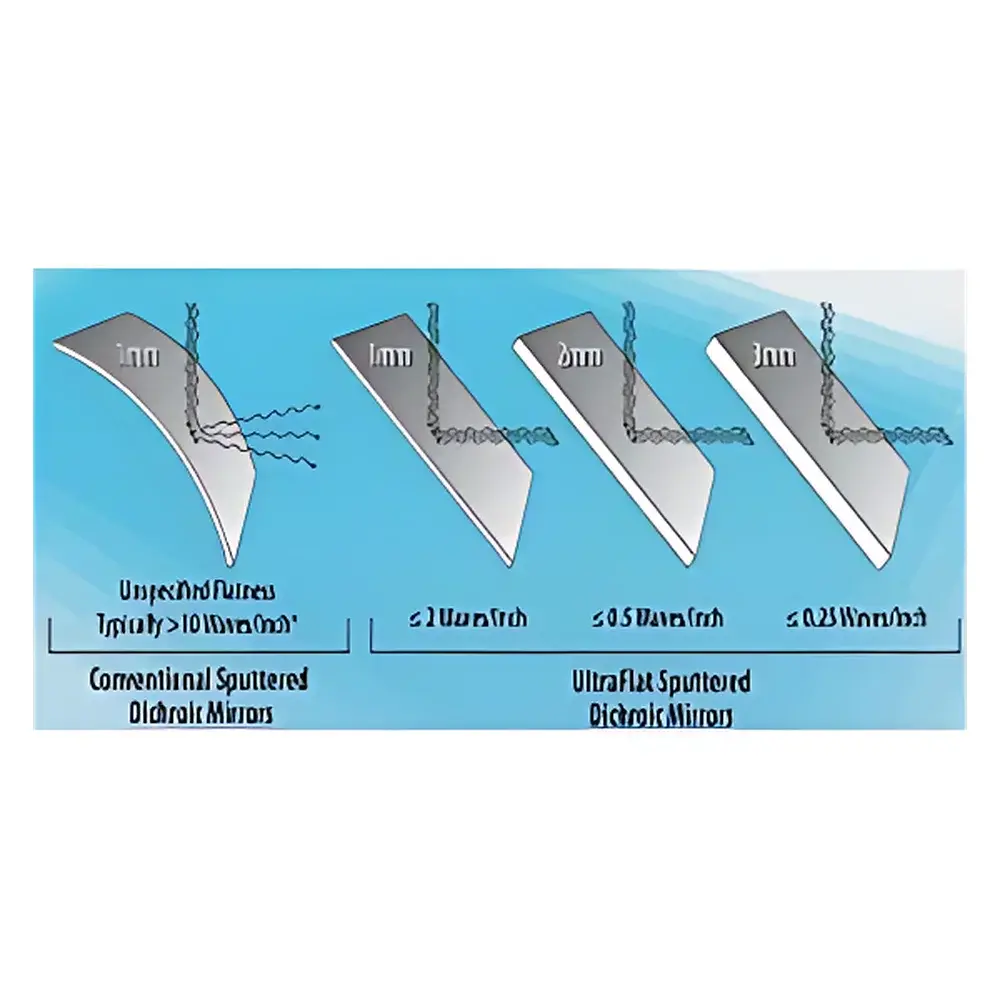
- UltraFlat™ Dichroic Mirrors: Surface flatness ≤0.5 waves/inch (for ≥2 mm substrates); ≤0.25 waves/inch (for ≥3 mm), minimizing wavefront distortion in high-NA laser paths and ensuring accurate TIRF evanescent field generation.
- Custom Geometry Support: Available in circular (Ø2–200 mm), square, rectangular, and irregular shapes—including custom-cut filter mounts compatible with standard cube housings (e.g., Nikon, Olympus, Zeiss).
- Low Fluorescence Substrates: Fused silica and BK7 substrates selected and tested for minimal intrinsic background emission under UV/visible excitation.
Sample Compatibility & Compliance
Chroma filters are compatible with all major commercial microscope platforms (including Nikon Eclipse, Olympus IX/XVII, Zeiss Axio series) and modular optical systems integrating CCD, sCMOS, EMCCD, and scientific CMOS cameras. All sputtered filters comply with ISO 9022-3 (optical component environmental testing), ISO 10110-7 (surface quality specifications), and MIL-C-48497A (coating adhesion and abrasion resistance). For regulated environments, Chroma’s manufacturing traceability supports GLP/GMP documentation requirements; filter lot numbers correspond to full spectral certification reports (including transmission, reflection, and angle-of-incidence characterization at 0°, 45°, and 56°). While not inherently FDA-cleared devices, Chroma filters are routinely deployed in IVD instrument OEM designs validated under 21 CFR Part 820 and ISO 13485.
Software & Data Management
Chroma provides comprehensive spectral data files (.csv, .txt, .spc) for every filter lot, accessible via the Chroma Filter Selector Tool—a web-based application that enables spectral overlay, multi-filter combination simulation, and compatibility checking against common light sources (e.g., LED, arc lamps, diode lasers). Integration with third-party acquisition software (e.g., Micro-Manager, NIS-Elements, ZEN Blue) is supported through standardized metadata tagging (EXIF-compliant filter descriptors). Audit-trail functionality is available when used with Chroma’s certified TRF filter cubes and motorized filter wheels compliant with IEC 62304 Class B safety standards.
Applications
- Fluorescence In Situ Hybridization (FISH): Optimized bandpass sets for DAPI/FITC/TRITC/Cy5/Cy7 with matched dichroics and emission filters to maximize signal-to-noise ratio and chromatic registration accuracy.
- TIRF Microscopy: Ultraflat dichroics (e.g., T405/488/561/640rpc) combined with high-OD emission filters (e.g., ET600/50m) ensure evanescent field confinement and eliminate out-of-focus excitation.
- Raman Spectroscopy: Notch and edge filters (e.g., NF532-1, LP02-532RS) with steep cut-on/cut-off slopes (<0.5 nm/nm) enable detection down to 110 cm⁻¹ with minimal laser line contamination.
- Multiplexed Live-Cell Imaging: Multi-band dichroics and quad-band emission filters support simultaneous acquisition of four fluorophores without hardware reconfiguration.
- Laser Combining & Separation: High-LIDT (>5 J/cm² @ 10 ns, 10 Hz, 1064 nm) sputtered mirrors serve as beam combiners in super-resolution systems (STED, PALM, STORM).
FAQ
What distinguishes magnetron sputtered filters from evaporated ones?
Magnetron sputtering produces denser, more stable thin-film stacks with lower columnar microstructure, resulting in reduced water absorption, higher laser-induced damage threshold (LIDT), and negligible spectral drift over time or environmental cycling.
Can Chroma filters be customized for non-standard wavelengths or bandwidths?
Yes—Chroma offers full custom design services including non-standard CWLs, asymmetric bandpasses, ultra-narrow bandwidths (<1 nm FWHM), and complex multi-notch configurations, subject to minimum order quantities and lead-time planning.
Do Chroma sputtered filters require special mounting considerations?
Due to their sensitivity to angle-of-incidence shifts, sputtered filters must be mounted with mechanical alignment tolerances ≤0.1° for optimal performance; Chroma recommends kinematic mounts or precision-machined filter cubes with integrated reference surfaces.
Are spectral certification reports provided with each shipment?
Yes—every filter lot includes a NIST-traceable spectral scan report covering transmission, reflection, and blocking performance across the full 200–3500 nm range, measured on a calibrated Cary 5000 or equivalent spectrophotometer.
How does Chroma ensure batch-to-batch reproducibility?
Each production run undergoes in-process monitoring using real-time quartz crystal microbalance (QCM) thickness control and post-deposition spectral verification; long-term stability is validated via accelerated aging tests per ISO 9022-10.





