
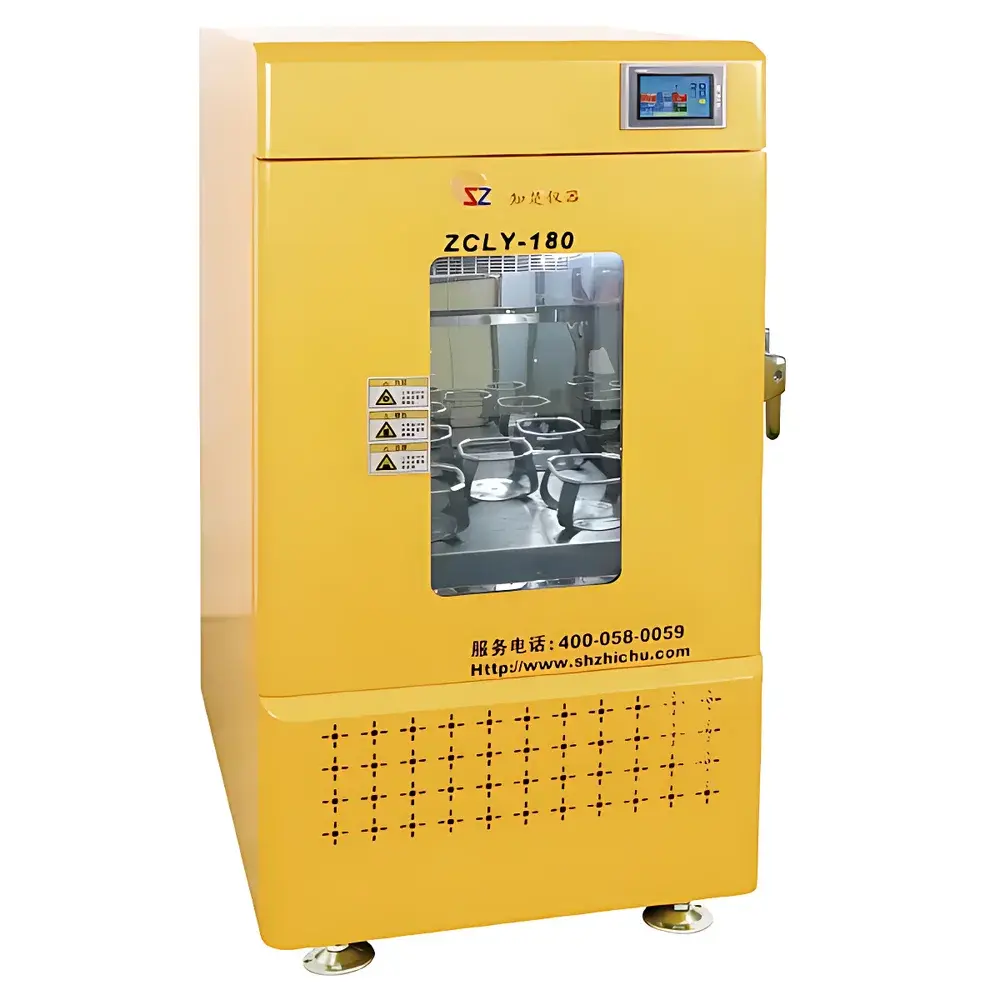
Zhilu ZCLY-180 CO₂ Incubator Shaker
| Brand | Zhilu |
|---|---|
| Model | ZCLY-180 |
| Instrument Type | CO₂-controlled incubator shaker |
| Timing Range | 0–999.9 h |
| Oscillation Frequency | 10–300 rpm (±1 rpm) |
| Amplitude | Ø26 mm |
| Temperature Range | 4–60 °C (at ambient 23–25 °C) |
| Temperature Uniformity | ±0.8 °C (at 37 °C) |
| Temperature Resolution | ±0.1 °C |
| CO₂ Range | 0–20% |
| CO₂ Control Accuracy | ±0.1% |
| Number of Shaking Platforms | 3 |
| Platform Size (L×W) | 485 × 485 mm |
| Max Capacity per Shelf | 250 mL × 25 / 500 mL × 16 / 1000 mL × 9 |
| Internal Chamber | R-cornered 304 stainless steel, seamless welded |
| Display | LCD touchscreen with real-time multi-parameter overlay |
| Data Logging | 1-min interval, up to 3 months’ storage |
| Connectivity | USB export |
| Power Supply | AC 220 V ±10%, 50–60 Hz |
| Dimensions (W×D×H) | 760 × 680 × 1280 mm |
| Net Weight | ~183 kg |
| Noise Level | <55 dB(A) |
Overview
The Zhilu ZCLY-180 CO₂ Incubator Shaker is an integrated life science platform engineered for simultaneous temperature-controlled, CO₂-regulated, and orbital shaking environments—optimized for mammalian cell culture, suspension bioreactor development, microbial fermentation, and recombinant protein expression workflows. It operates on a dual-control architecture: a PID-driven microcomputer system governs thermal stability and CO₂ concentration independently, while a high-torque servo motor ensures precise, low-vibration orbital motion across three independently accessible shelves. The unit employs non-dispersive infrared (NDIR) CO₂ sensing technology for continuous, drift-compensated gas monitoring and closed-loop feedback control—enabling stable CO₂ setpoints from 0% to 20% with ±0.1% accuracy. Its refrigeration subsystem utilizes a high-efficiency, fluorine-free compressor and optimized evaporator design, supporting uninterrupted operation at temperatures as low as 4 °C—even under sustained load and ambient conditions up to 30 °C.
Key Features
- Triple-shelf orbital shaker with independent access and uniform airflow distribution via forced convection
- Three-dimensional eccentric triple-cam drive mechanism for smooth, low-noise oscillation (<55 dB[A]) and extended mechanical longevity
- R-cornered, seamless-welded 304 stainless-steel interior chamber with antimicrobial surface finish (≥99% bacterial inhibition per ISO 22196)
- Dual heating zones: heated glass door + internal chamber wall heating to prevent condensation during low-temperature or high-humidity operation
- Programmable defrost cycle: duration adjustable from 1–250 s; interval configurable between 30–600 min—preventing evaporator icing during prolonged sub-20 °C runs
- LCD touchscreen interface with encrypted parameter locking, real-time overlay of temperature, RPM, CO₂ %, remaining time, and trend curves
- Comprehensive data logging: timestamped records (temperature, CO₂, speed) captured every 60 seconds; local storage supports ≥90 days; exportable via USB to CSV-compatible formats
- UV-C germicidal lamp (254 nm) integrated into the chamber ceiling for routine decontamination cycles
- Power-fail recovery mode with auto-resume functionality and non-volatile memory retention
- Ergonomic safety features: door-open pause, emergency power cutoff, over-temperature alarm with audible/visual alert
Sample Compatibility & Compliance
The ZCLY-180 accommodates standard laboratory vessels—including Erlenmeyer flasks (250–1000 mL), roller bottles, and deep-well plates—via interchangeable universal plastic or stainless-steel clamping fixtures. Its R-cornered chamber geometry and removable shelf assemblies enable complete wash-down capability without disassembly. All wetted surfaces comply with USP Class VI biocompatibility requirements. The system supports GLP/GMP-aligned operation through audit-trail-capable data logging, user-access-level controls, and timestamped event records. While not pre-certified to FDA 21 CFR Part 11, its data export architecture and parameter lockout functions facilitate validation under ISO/IEC 17025, ASTM E2500, and EU Annex 11 frameworks when deployed in regulated QC/QA environments.
Software & Data Management
No proprietary software installation is required. All operational parameters and logged datasets are managed locally via the embedded Linux-based controller. The touchscreen UI provides intuitive navigation across setup, monitoring, and history views. Data export occurs via standard USB mass-storage protocol—generating time-stamped .csv files containing columns for datetime, chamber temperature, setpoint temperature, CO₂ concentration, target RPM, actual RPM, and elapsed runtime. Optional remote monitoring is available through a secure, TLS-enabled mobile application (iOS/Android), enabling real-time status alerts and parameter adjustment within authenticated corporate networks—subject to local IT security policy approval.
Applications
- Mammalian cell expansion in CO₂-buffered media (e.g., DMEM/F12 with 5% CO₂)
- Suspension-adapted CHO or HEK293 culture under controlled shear and gas exchange
- Microbial growth kinetics studies requiring precise O₂/CO₂ interplay (e.g., E. coli, S. cerevisiae)
- Enzyme production and biocatalyst screening under variable temperature and agitation profiles
- Stability testing of biologics in shaken liquid formulations
- Algal photobioreactor pre-cultivation (when equipped with optional LED illumination module)
FAQ
What is the minimum operating temperature with CO₂ enabled?
The unit maintains CO₂ control stability down to 10 °C; below this, condensation risk increases and CO₂ sensor response may slow—consult application notes for low-temperature validation protocols.
Can the shaker run without CO₂ gas supply?
Yes—the CO₂ control loop disables automatically if no gas line is connected; all thermal and agitation functions remain fully operational.
Is the data log compliant with 21 CFR Part 11?
The native log format lacks electronic signature and audit-trail encryption; however, exported .csv files may be imported into validated LIMS or ELN systems meeting Part 11 requirements.
How often should the NDIR CO₂ sensor be calibrated?
Factory calibration is traceable to NIST standards; field recalibration is recommended annually or after exposure to >80% RH for >48 hours—using certified zero-air and 5% CO₂ span gas.
Does the unit support humidity control?
Humidity regulation is not built-in, but optional external humidification modules (sold separately) integrate via analog I/O ports and can be scheduled alongside temperature/CO₂ programs.
Related Products



