
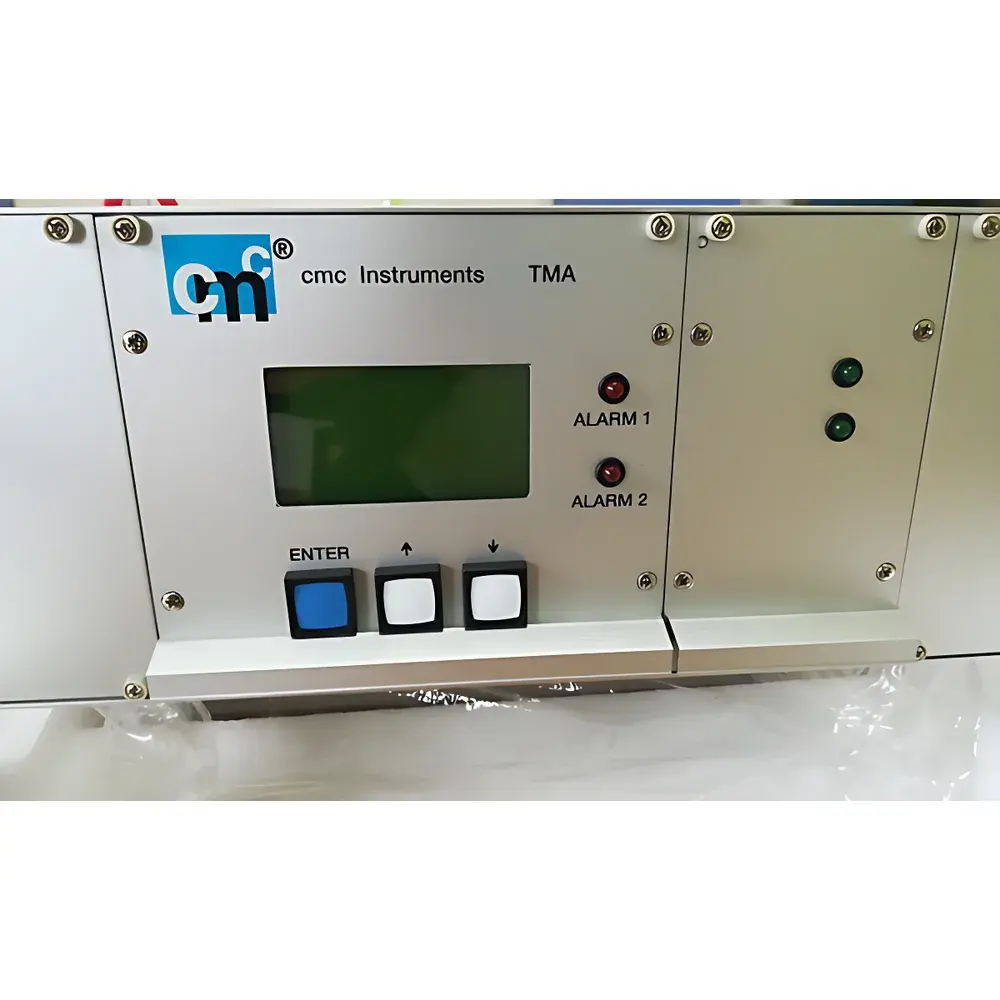
CMC TMA-202-ZB Portable Electrolytic Trace Moisture Analyzer
| Origin | Germany |
|---|---|
| Manufacturer Type | Authorized Distributor |
| Origin Category | Imported Instrument |
| Model | TMA-202-ZB |
| Product Type | Portable Dew Point Analyzer |
| Operating Principle | Phosphorus Pentoxide (P₂O₅) Electrolytic Method |
| Operating Temperature Range | -20 °C to +50 °C |
| Accuracy | ±1 ppm |
| Repeatability | ±0.1 ppm |
| Measurement Ranges | 0–10 ppm / 0–100 ppm / 0–1000 ppm / 0–2500 ppm (Auto-ranging) |
| Full-Scale Accuracy | ±1% of reading |
| Sensitivity | ±0.1% of full scale |
| Display | Backlit LCD |
| Alarm Output | 1 relay (SPDT) |
| Analog Output | 4–20 mA or 0–10 V (user-configurable) |
| Power Supply | Internal rechargeable lead-acid battery or 80–230 VAC, 50–60 Hz |
| Power Consumption | 8 W |
| Enclosure Rating | IP20 |
| Dimensions (W×H×D) | 363 × 115 × 377 mm |
| Weight | ~6 kg |
Overview
The CMC TMA-202-ZB is a portable, microprocessor-controlled trace moisture analyzer engineered for high-precision measurement of water vapor concentration in industrial and ultra-high-purity process gases. It operates on the well-established phosphorus pentoxide (P₂O₅) electrolytic principle: moisture in the sample gas is absorbed by a thin, hygroscopic phosphoric acid (H₃PO₄) film coated between two parallel electrodes—typically fabricated from platinum or rhodium—and subsequently electrolyzed into hydrogen and oxygen. The resulting P₂O₅ continuously regenerates the active sensing layer, enabling stable, drift-free operation without routine recalibration. This electrochemical equilibrium yields a linear current proportional to water content, which is digitized, temperature-compensated, and presented as ppmv (parts per million by volume). Designed for demanding environments—including semiconductor gas delivery, specialty chemical synthesis, and high-purity inert gas qualification—the TMA-202-ZB delivers reliable, real-time quantification where conventional chilled-mirror or tunable diode laser methods face interference or instability.
Key Features
- True portable architecture with integrated rechargeable battery and rugged field-ready housing (IP20-rated)
- Auto-ranging measurement across four dynamic spans: 0–10, 0–100, 0–1000, and 0–2500 ppmv, eliminating manual range selection errors
- Electrolytic P₂O₅ sensor with rapid response (<5 s to 90% of final value) and exceptional long-term stability (calibration interval ≥ 6 months under controlled conditions)
- Full self-diagnostics at power-on: electrode continuity check, membrane integrity verification, and amplifier zero/span validation
- NAMUR-compliant electrical interface (NE 43 standard), supporting seamless integration into distributed control systems (DCS) and programmable logic controllers (PLC)
- Configurable analog output (4–20 mA or 0–10 V) with user-defined scaling and alarm relay with SPDT contact rated for 250 VAC / 3 A
Sample Compatibility & Compliance
The TMA-202-ZB is validated for continuous monitoring of moisture in non-reactive and moderately corrosive gases including helium (He), argon (Ar), nitrogen (N₂), hydrogen (H₂), oxygen (O₂), xenon (Xe), krypton (Kr), deuterium (D₂), sulfur hexafluoride (SF₆), carbon dioxide (CO₂), methane (CH₄), natural gas, and refrigerants (e.g., Freon variants). Its robust sensor design also accommodates aggressive media such as chlorine (Cl₂), hydrogen chloride (HCl), sulfur dioxide (SO₂), and hydrogen sulfide (H₂S)—provided gas streams are free of particulates, aerosols, and condensable organics that could foul the electrolytic cell. While not intended for use with strongly oxidizing or reducing agents that react stoichiometrically with H₃PO₄ (e.g., fluorine, ozone), the instrument complies with relevant safety directives including IEC 61000-6-2 (EMC immunity) and IEC 61000-6-3 (EMC emissions). All firmware and hardware configurations support audit-trail-capable data logging aligned with GLP and GMP documentation requirements.
Software & Data Management
Operation is managed via an intuitive, menu-driven interface accessible through the backlit LCD display. No external PC is required for configuration, calibration, or diagnostic review. Internal memory stores up to 10,000 timestamped readings (date/time, ppmv, temperature, status flags) with optional export via RS-232 serial port (optional USB-to-serial adapter). Firmware supports user-defined alarm thresholds, hysteresis settings, and output scaling parameters—all retained during power loss. For regulated environments, the system meets FDA 21 CFR Part 11 readiness when paired with validated third-party data acquisition software, enabling electronic signatures, role-based access control, and immutable audit trails. Calibration history, sensor regeneration logs, and error codes are time-stamped and retrievable directly from the device.
Applications
- Monitoring moisture in bulk and cylinder-delivered specialty gases for semiconductor fabrication (e.g., Ar for sputtering, N₂ for purge lines)
- Quality assurance of high-purity acid gases (Cl₂, HCl) in chlor-alkali and pharmaceutical intermediate synthesis
- In-line verification of desiccant dryer performance in compressed air and instrument air systems
- Leak detection and integrity testing of vacuum chambers and gloveboxes using tracer gas humidity profiling
- Process validation and release testing of medical-grade gases (USP <823>, ISO 8573-1 Class 1–2 compliance)
- Research applications involving reactive gas chemistry where water impurity must remain below 1 ppmv to prevent catalyst poisoning or side reactions
FAQ
Does the TMA-202-ZB require periodic sensor regeneration?
Yes—while the P₂O₅ sensor exhibits low drift, exposure to high-moisture or contaminated streams may necessitate electrochemical regeneration. This is performed automatically via the built-in regeneration mode, typically restoring baseline sensitivity within 15–30 minutes.
Can it measure dew point directly?
No—it reports water concentration in ppmv. However, dew point can be calculated offline using known gas composition, pressure, and temperature per ISO 8573-1 Annex B or ASTM D6304 methodologies.
Is the instrument suitable for hazardous area installation?
The base unit is rated for general-purpose use (non-explosion-proof). For Zone 1/2 installations, it must be housed in an approved pressurized or purged enclosure meeting ATEX/IECEx standards.
What maintenance intervals are recommended?
Routine checks include inlet filter replacement every 3 months (or per usage), annual verification of analog output linearity, and biannual review of calibration certificate traceability to NIST or PTB standards.






