
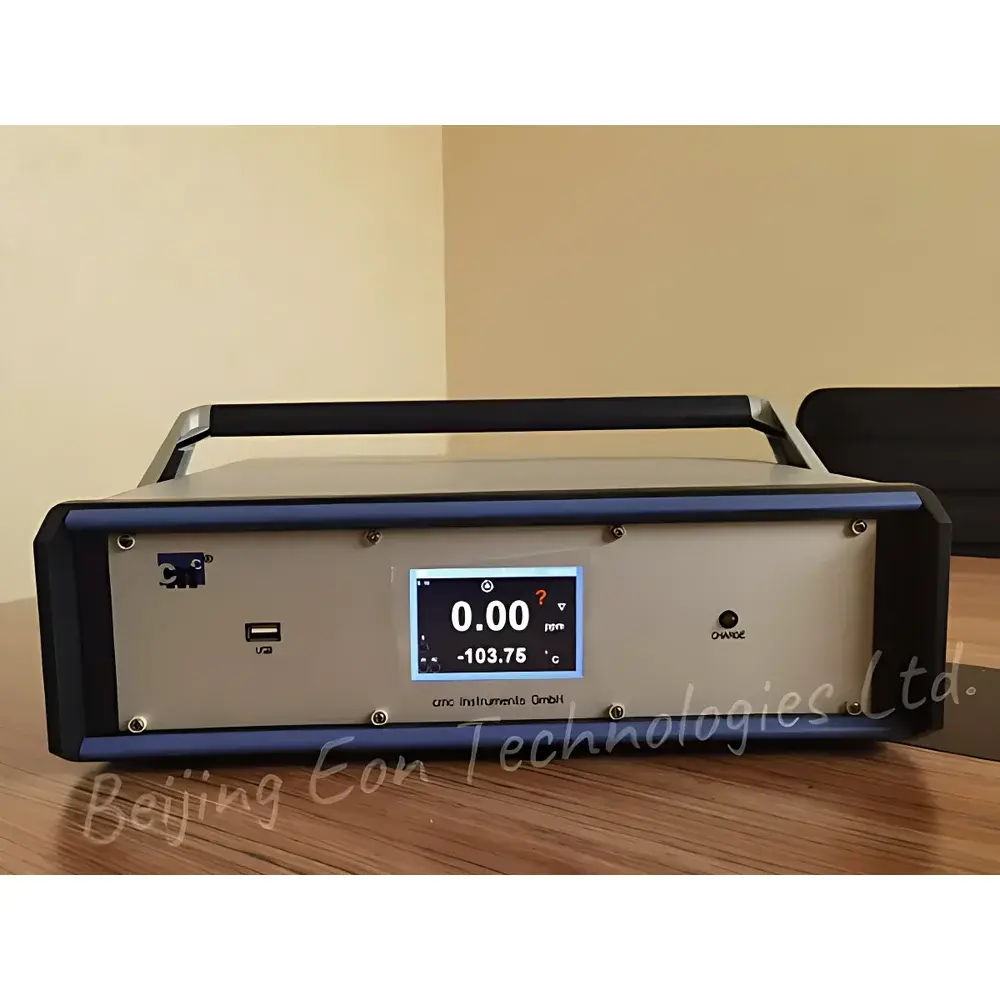
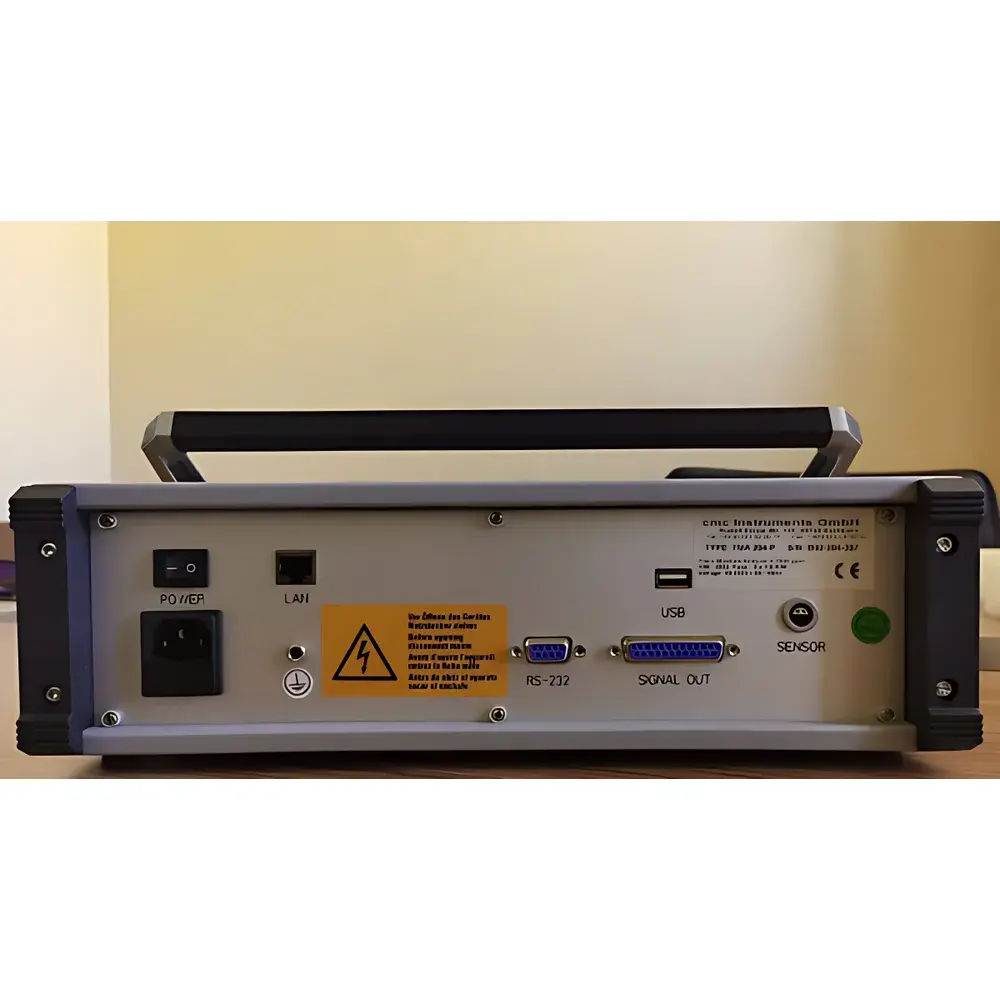
CMC TMA-204-P-Ex Portable Electrolytic Dew Point Analyzer
| Brand | CMC (Himsi) |
|---|---|
| Origin | Germany |
| Model | TMA-204-P-Ex |
| Type | Portable Dew Point Analyzer |
| Principle | Phosphorus Pentoxide (P₂O₅) Electrolytic Method |
| Operating Temperature | 5–50 °C |
| Accuracy | ±1% of full scale |
| Repeatability | ±0.1% of full scale |
| Range | 0–10 / 100 / 1,000 / 2,500 ppm (auto/manual switching) |
| Response Time (T₉₀) | <1 s |
| T₅₀ Response | <8 s |
| Sample Flow Rate | 20 NL/h |
| Recommended Sample Pressure | 0.1–0.5 barg |
| Display | Touchscreen with multilingual support (including Chinese) |
| Output | 0/4–20 mA (configurable) |
| Alarms | High/Low limit (user-definable) |
| Intrinsic Safety | Integrated Zener barrier (Ex ia IIC T4 Ga) |
| Power | Rechargeable Li-ion battery or 80–230 VAC, 50–60 Hz |
| Dimensions | 363 × 115 × 377 mm |
| Weight | ~6 kg |
Overview
The CMC TMA-204-P-Ex is a certified intrinsically safe, portable electrolytic dew point analyzer engineered for trace moisture measurement in aggressive and flammable process gases. It employs the well-established phosphorus pentoxide (P₂O₅) electrolytic principle — a primary, absolute measurement method traceable to fundamental electrochemical stoichiometry. Unlike optical or capacitive techniques, this method directly quantifies water molecules via controlled electrolysis: moisture in the sample gas is absorbed by a thin hygroscopic phosphoric acid (H₃PO₄) film deposited between two parallel electrodes (typically Pt or Rh), then electrolyzed into H₂ and O₂. The resulting P₂O₅ continuously regenerates the film’s affinity for water, establishing a dynamic equilibrium where the measured electrolysis current is linearly proportional to the water vapor concentration. This enables true zero-drift operation without periodic recalibration under stable operating conditions — a critical advantage for long-term unattended monitoring in high-purity or hazardous environments.
Key Features
- Intrinsically safe design certified to ATEX/IECEx Ex ia IIC T4 Ga, suitable for Zone 0/20 installations without external barriers
- True absolute measurement: no reliance on calibration standards; traceable to Faraday’s law of electrolysis
- Ultra-fast response: T₉₀ < 1 second, T₅₀ < 8 seconds — optimized for real-time process control and purge verification
- Four auto-switching measurement ranges (0–10 / 100 / 1,000 / 2,500 ppm) with seamless transitions and full-scale accuracy of ±1%
- High reproducibility: ±0.1% full-scale repeatability ensures statistical confidence in low-concentration trending
- Robust P₂O₅ sensor architecture: glass-bodied cylindrical cell with chemically inert electrode materials compatible with corrosive media
- Integrated Zener safety barrier, touchscreen HMI with configurable language support (including Chinese), and embedded self-diagnostics at power-on
- Dual power mode: field-deployable with rechargeable Li-ion battery or continuous operation via universal AC input (80–230 VAC)
Sample Compatibility & Compliance
The TMA-204-P-Ex is validated for use with ultra-high-purity carrier gases (He, Ar, Ne, Kr, Xe, N₂, H₂, O₂, D₂) and reactive industrial gases including Cl₂, HCl, SO₂, H₂S, F₂, PH₃, SF₆, and halogenated refrigerants (e.g., Freon series). Its sensor chemistry avoids catalytic decomposition or side reactions common with metal-oxide sensors, making it uniquely suited for acidic and oxidizing streams where alternative technologies fail. The instrument complies with IEC 60079-0/-11 (explosive atmospheres), NAMUR NE 21 (analog signal behavior), and supports audit-ready operation per ISO/IEC 17025 and GLP requirements. Optional data logging meets FDA 21 CFR Part 11 expectations when paired with compliant software.
Software & Data Management
The analyzer features an embedded microprocessor with non-volatile memory for storing calibration history, alarm logs, and operational timestamps. Analog output (4–20 mA) is fully configurable for any range segment and includes HART-compatible digital overlay. Optional PC interface (RS-485/Modbus RTU or USB-C) enables integration into SCADA or LIMS platforms. Firmware supports remote parameter configuration and firmware updates via secure signed packages. All measurement events — including sensor regeneration cycles, alarm triggers, and power transitions — are time-stamped and stored with millisecond resolution, supporting root-cause analysis and regulatory review.
Applications
- Moisture verification during high-purity gas cylinder certification (ISO 8573-3 Class 1–4)
- In-line monitoring of semiconductor process gases (e.g., Cl₂ etch lines, HCl deposition)
- Purge gas validation in pharmaceutical nitrogen blanketing systems (USP , EP 2.2.43)
- SF₆ moisture tracking in high-voltage switchgear per IEC 60480 and IEEE C37.122.1
- Field verification of cryogenic air separation unit (ASU) product purity
- Leak detection support in vacuum systems via residual moisture profiling
- Quality assurance of specialty chemical feedstocks (e.g., anhydrous HBr, phosphine blends)
FAQ
Is the P₂O₅ sensor affected by hydrogen or oxygen in the sample gas?
No — the electrolytic reaction is specific to water; H₂ and O₂ are inert byproducts and do not interfere with measurement linearity or sensor stability.
Can the instrument measure below 1 ppmv?
The lowest factory-configured range is 0–10 ppmv; sub-ppmv capability requires optional ultra-low-range sensor variants (e.g., TMA-204-P-UL), not covered by standard TMA-204-P-Ex configuration.
What maintenance is required for long-term accuracy?
Sensor regeneration is automatic during operation; only periodic verification against NIST-traceable moisture standards (e.g., chilled mirror or electrolytic transfer standards) is recommended annually per ISO/IEC 17025.
Does the analyzer support Modbus TCP for Ethernet integration?
No — native communication is RS-485 (Modbus RTU) or USB-C; Ethernet connectivity requires an external protocol converter.
Is the touchscreen display operable with gloves?
Yes — the projected capacitive touchscreen is designed for industrial glove use and maintains responsiveness across the full operating temperature range (5–65 °C ambient).



