
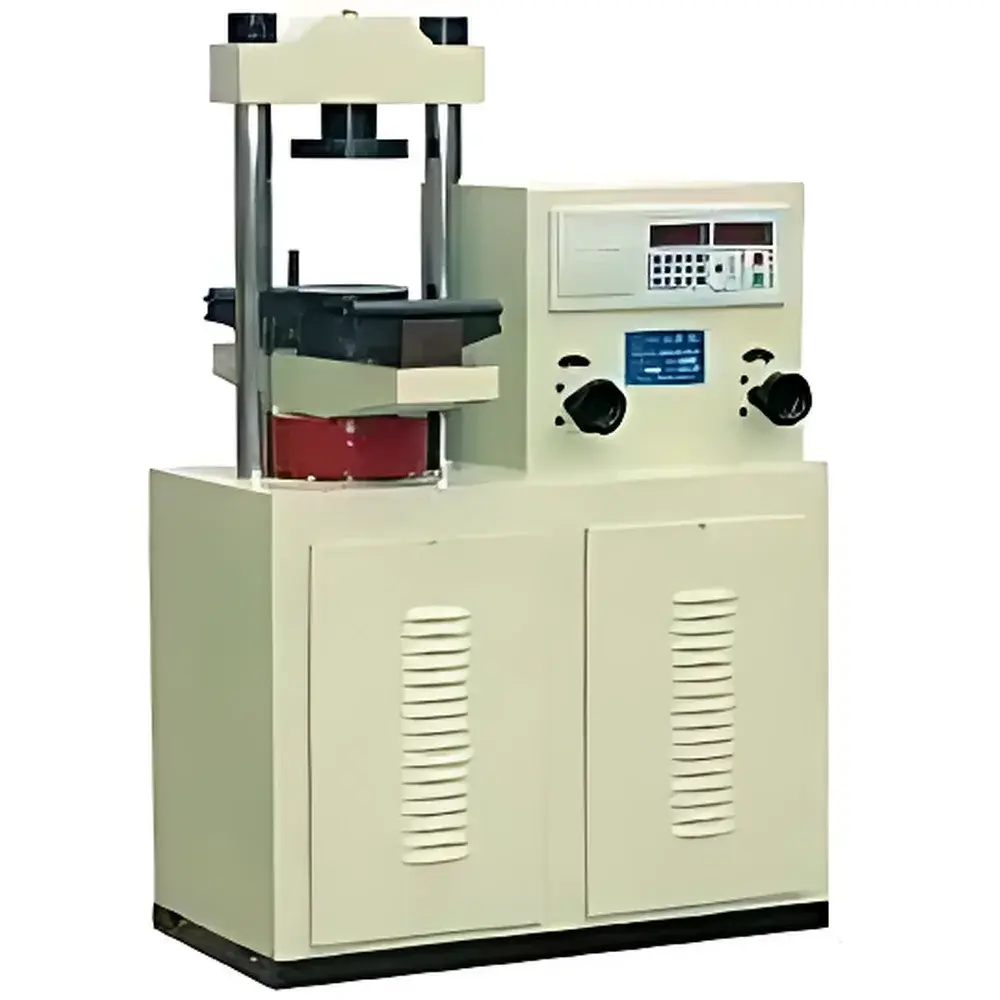
Concrete Testing Machine SYD Series – Universal Compression and Flexural Strength Tester for Concrete, Mortar, and Masonry
| Key | Origin: Hunan, China |
|---|---|
| Manufacturer Type | Authorized Distributor |
| Regional Origin | Domestic (PRC) |
| Model | SYD |
| Pricing | Available Upon Request |
| Max Load Options | 30 kN, 50 kN, 100 kN, 200 kN, 300 kN |
| Relative Indication Error | ±1% |
| Hydraulic Pump Rated Pressure | 25 MPa |
| Flexural Roller Diameter | 30 mm |
| Max Spacing Between Lower Rollers | 450 mm |
| Center Distance Between Upper Rollers | 150 mm |
| Center Distance Between Lower Rollers | 450 mm |
| Support Plate Length | 155 mm |
| Max Clearance Between Compression Platens | 230 mm |
| Piston Diameter × Stroke | 125 mm × 80 mm |
| Piston Stroke | 120 mm |
| Motor Power | 0.75 kW |
| Overall Dimensions (L×W×H) | 850 × 600 × 1340 mm |
| Compliance | GB/T 3722 |
Overview
The SYD Series Concrete Testing Machine is a dual-function universal testing system engineered for standardized mechanical evaluation of civil construction materials under controlled quasi-static loading conditions. It operates on the principle of hydraulic force generation coupled with high-precision electronic load measurement, enabling both compressive strength testing (per ASTM C39/C109/EN 12390-3) and three-point flexural strength testing (per ASTM C78/EN 12390-5) in a single integrated platform. Designed for quality control laboratories, precast concrete plants, and material certification facilities, the system delivers repeatable, traceable, and standards-compliant results for concrete cylinders, mortar cubes, fired clay bricks, and cementitious composites. Its architecture adheres to the structural and metrological requirements defined in GB/T 3722—General Requirements for Hydraulic Universal Testing Machines—and incorporates fail-safe mechanisms including overload cut-off, power-loss data retention, and real-time load rate monitoring.
Key Features
- Hydraulic loading system with 25 MPa rated pressure capacity, ensuring stable force application across full load range (30–300 kN options)
- Digital load indication with ±1% relative error accuracy, traceable to national metrological standards
- Manually adjustable compression space via precision-ground rotating screw mechanism—reducing setup time between specimens by up to 40% compared to manual spacer systems
- Modular flexural test assembly: includes dual lower support rollers (450 mm center-to-center), single upper loading roller (150 mm center-to-center), and 30 mm diameter hardened steel rollers conforming to ISO 7500-1 Class 1 geometry specifications
- Integrated motorized oil source cabinet (0.75 kW) with thermal protection, pressure relief valve, and low-noise gear pump for consistent flow delivery
- Plug-and-play operation: requires only hydraulic oil filling, electrical connection (220 V AC, 50 Hz), and leveling—no field calibration or mechanical alignment needed prior to first use
- Optional constant-load (creep) test module available upon order specification, supporting long-term stress maintenance for durability studies per ASTM C496 or EN 12390-12
Sample Compatibility & Compliance
The SYD machine accommodates standard specimen geometries used in international cement and concrete testing protocols. Compression tests are performed on cylindrical concrete specimens (Ø100 × 200 mm or Ø150 × 300 mm), 40 × 40 × 160 mm mortar prisms, and 240 × 115 × 53 mm clay bricks. Flexural configurations comply with three-point bending setups for 100 × 100 × 400 mm or 150 × 150 × 600 mm beam specimens. All mechanical components—including platens, rollers, and load train elements—meet dimensional tolerances specified in GB/T 3722 and are compatible with third-party verification against ISO 7500-1:2018 (static calibration of uniaxial testing machines). The system supports audit-ready documentation workflows aligned with GLP and ISO/IEC 17025 laboratory accreditation requirements.
Software & Data Management
While the base configuration includes an embedded digital display unit with real-time load, rate, and peak-hold functions, the system is fully compatible with optional PC-based data acquisition software. This software enables automated test sequencing, timestamped result logging, statistical analysis (mean, SD, CV%), and export to CSV or PDF formats compliant with internal QA reporting templates. When configured with optional USB or RS232 interface modules, the system supports audit trails, user access levels, and electronic signatures—facilitating compliance with FDA 21 CFR Part 11 for regulated construction material testing environments. Calibration parameters are stored in non-volatile memory and can be reloaded after power interruption without recalibration.
Applications
- Compressive strength verification of ready-mix and precast concrete per ACI 318, EN 206, or GB/T 50081
- Flexural tensile strength assessment of pavement-grade concrete and fiber-reinforced cementitious composites
- Quality conformance testing of masonry units (fired clay, concrete blocks) per ASTM C67 or GB/T 5101
- Early-age strength development monitoring using rapid-cure test specimens (e.g., 6-hour or 24-hour break tests)
- Calibration validation of field rebound hammers and ultrasonic pulse velocity devices
- Research-level mechanical characterization in university civil engineering labs and national building materials institutes
FAQ
Does the SYD machine meet international calibration standards?
Yes—it complies with GB/T 3722 and is designed to satisfy the geometric and metrological criteria of ISO 7500-1:2018 Class 1 for static force measurement systems. Third-party verification is supported via certified reference load cells.
Can the system perform tests in accordance with ASTM or EN standards?
Yes—the mechanical configuration and control logic align with ASTM C39 (compression), ASTM C78 (flexure), EN 12390-3, and EN 12390-5. Full compliance requires proper specimen preparation and environmental conditioning per those standards.
Is remote diagnostics or firmware update capability available?
Firmware updates are performed locally via USB drive; remote diagnostics are not supported in the base model but can be enabled through optional Ethernet-enabled controller modules.
What maintenance intervals are recommended for hydraulic oil and filter replacement?
Hydraulic oil should be replaced every 1,500 operating hours or biannually, whichever occurs first. The return-line filter requires inspection every 500 hours and replacement if clogging is observed.
Is technical documentation provided in English?
Yes—English-language operation manuals, calibration procedures, and compliance declarations are supplied with all export-configured units.



