
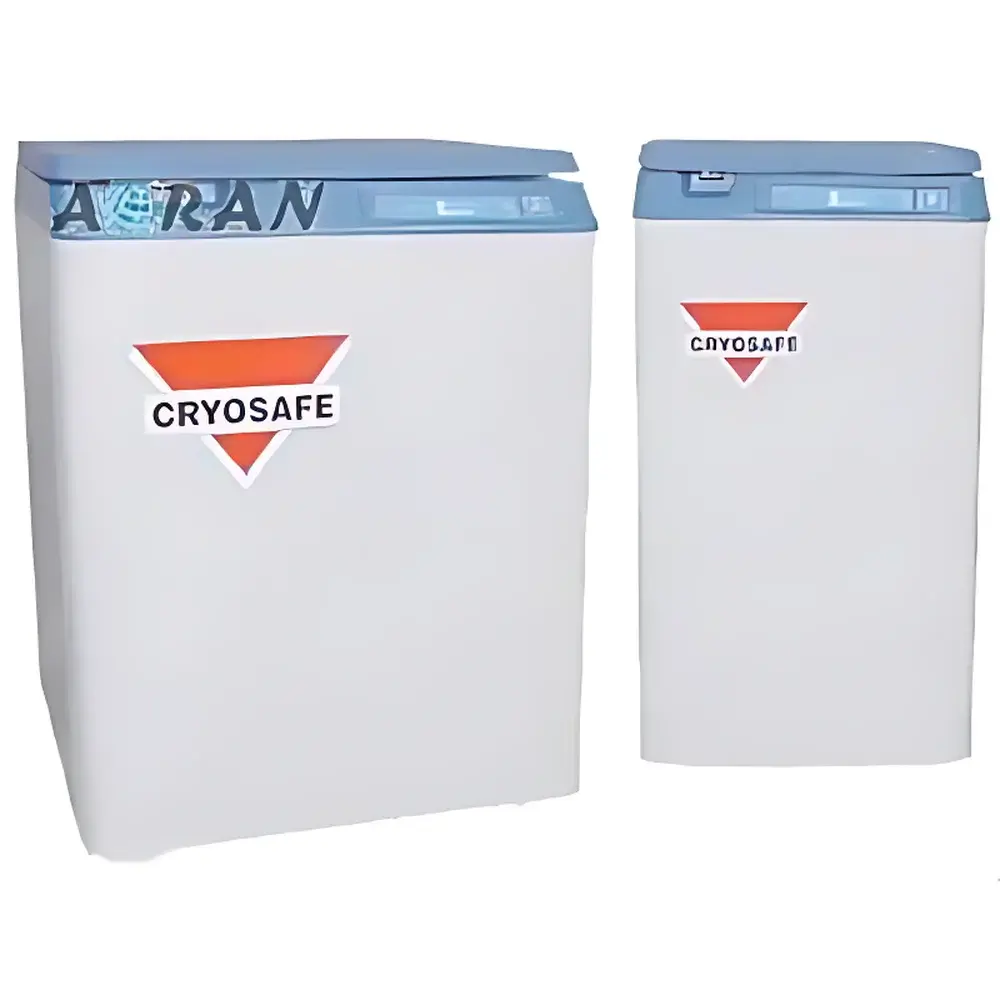
Cryosafe Auto Basic Automated Liquid Nitrogen Storage System
| Brand | Cryosafe |
|---|---|
| Origin | USA |
| Model | Auto Basic |
| Liquid Nitrogen Capacity | 165 L (AB-1) / 365 L (AB-2) |
| Evaporation Rate | 5 L/day (AB-1) / 7 L/day (AB-2) |
| Hold Time | 33 days (AB-1) / 52 days (AB-2) |
| Maximum Sample Capacity | 10,400 vials (AB-1) / 24,050 vials (AB-2) |
| Neck Opening Diameter | 533 mm (AB-1) / 787 mm (AB-2) |
| External Dimensions (L×W×H) | 775×587×1118 mm (AB-1) / 965×864×1118 mm (AB-2) |
| Usable Height | 737 mm (both models) |
| Empty Weight | 111 kg (AB-1) / 184 kg (AB-2) |
| Full Weight | 243 kg (AB-1) / 474 kg (AB-2) |
| Shipping Weight | 182 kg (AB-1) / 291 kg (AB-2) |
Overview
The Cryosafe Auto Basic Automated Liquid Nitrogen Storage System is an engineered solution for long-term, ultra-low-temperature biological sample preservation at –196 °C. Designed for high-throughput biorepositories, clinical laboratories, and academic core facilities, this system integrates a high-vacuum stainless steel cryogenic vessel with an intelligent Auto-Tend control platform to deliver autonomous liquid nitrogen replenishment, real-time inventory-level monitoring, and robust thermal stability. Unlike manually refilled dewars, the Auto Basic system operates on a closed-loop vapor-phase or liquid-phase storage architecture—configurable per application requirements—ensuring consistent temperature uniformity across all storage zones while minimizing thermal shock during access. Its double-walled, vacuum-insulated construction complies with ISO 23587:2019 standards for cryogenic storage equipment, and the 18 cm thick polyurethane foam lid provides both exceptional thermal resistance and pneumatically assisted opening, reducing operator fatigue without compromising vapor loss performance.
Key Features
- High-integrity stainless steel vacuum vessel with helium-leak-tested insulation, certified for continuous operation under ambient conditions up to 35 °C
- Auto-Tend intelligent control system featuring dual-sensor liquid level detection (capacitive + ultrasonic), programmable refill thresholds, and fail-safe interlocks
- Low-evaporation design validated per ASTM F2143–22: measured evaporation rates of 5 L/day (AB-1) and 7 L/day (AB-2) under controlled ISO Class 7 cleanroom conditions
- Pneumatically actuated insulated lid with adjustable opening force and soft-close mechanism—mechanically decoupled from the vacuum chamber to preserve seal integrity
- Modular rack system supporting standardized 1.2 mL, 2.0 mL, and 5.0 mL cryovials; compatible with ANSI/SLAS format racks and customizable aluminum or stainless steel configurations
- Integrated alarm hierarchy including local audible/visual low-level alerts, supply line pressure monitoring, and optional Ethernet-enabled remote notification via SNMP or SMTP protocols
Sample Compatibility & Compliance
The Cryosafe Auto Basic accommodates diverse biospecimens—including primary cells, PBMCs, stem cell lines, embryos, oocytes, tissue sections, and nucleic acid extracts—without cross-contamination risk, thanks to its vapor-phase storage configuration (standard) or optional liquid-phase immersion mode. All internal surfaces are electropolished 316L stainless steel, meeting USP material compatibility requirements for biopharmaceutical storage. The system supports GLP/GMP-aligned workflows through audit-trail-capable event logging (timestamped refill cycles, alarm triggers, lid open/close events), and firmware complies with IEC 62304 Class B software safety standards. It is CE-marked for medical device use (Class IIa under MDR 2017/745) and listed with the U.S. FDA as a Class I exempt device (21 CFR 864.9150).
Software & Data Management
The embedded Auto-Tend controller runs proprietary firmware with secure, password-protected access levels (Operator, Technician, Administrator). Data is stored locally on industrial-grade EEPROM with 10-year retention and exportable via USB-C or RS-485 to LIMS platforms using HL7 or ASTM E1384-compliant message structures. Optional cloud integration enables centralized fleet monitoring across multi-site biobanks via TLS 1.2–encrypted RESTful API endpoints. All system logs—including nitrogen consumption trends, thermal gradient maps, and maintenance history—are timestamped, digitally signed, and compliant with FDA 21 CFR Part 11 electronic record requirements when paired with validated identity management modules.
Applications
- Long-term archiving of clinical trial biospecimens in CAP- and CLIA-accredited laboratories
- Stem cell banking requiring uninterrupted –150 °C to –196 °C stability per ISBER Best Practices guidelines
- Vaccine development workflows where thermal excursion history must be documented per WHO TRS No. 1025 Annex 6
- Genomic biobanking operations managing >10,000 aliquots per unit with traceability down to individual vial position
- Regulatory submissions requiring full chain-of-custody records for frozen samples under ICH M10 and FDA Bioanalytical Method Validation guidance
FAQ
What storage phase options does the Auto Basic support?
It operates primarily in vapor-phase mode (–150 °C to –190 °C) for maximum sample safety; liquid-phase immersion is available as a factory-configured option for applications requiring –196 °C uniformity.
Is the Auto-Tend system compatible with third-party LN₂ supply infrastructure?
Yes—it accepts standard 3/8″ VCR inlet connections and interfaces with bulk tank regulators delivering 15–30 psig supply pressure; custom manifolds can be validated per ASME B31.1.
How is calibration and verification performed?
The system includes NIST-traceable temperature mapping ports and integrated level sensor validation routines; annual verification follows ISO/IEC 17025 procedures conducted by Cryosafe-certified field service engineers.
Can the system be integrated into an existing facility monitoring network?
Yes—via Modbus TCP, BACnet MS/TP, or optional OPC UA server license, enabling interoperability with Siemens Desigo, Honeywell Experion, or Schneider EcoStruxure platforms.
What documentation is provided for regulatory submissions?
Each unit ships with a Device Master Record (DMR), Installation Qualification (IQ) and Operational Qualification (OQ) templates, and a complete Design History File (DHF) summary compliant with ISO 13485:2016.




