
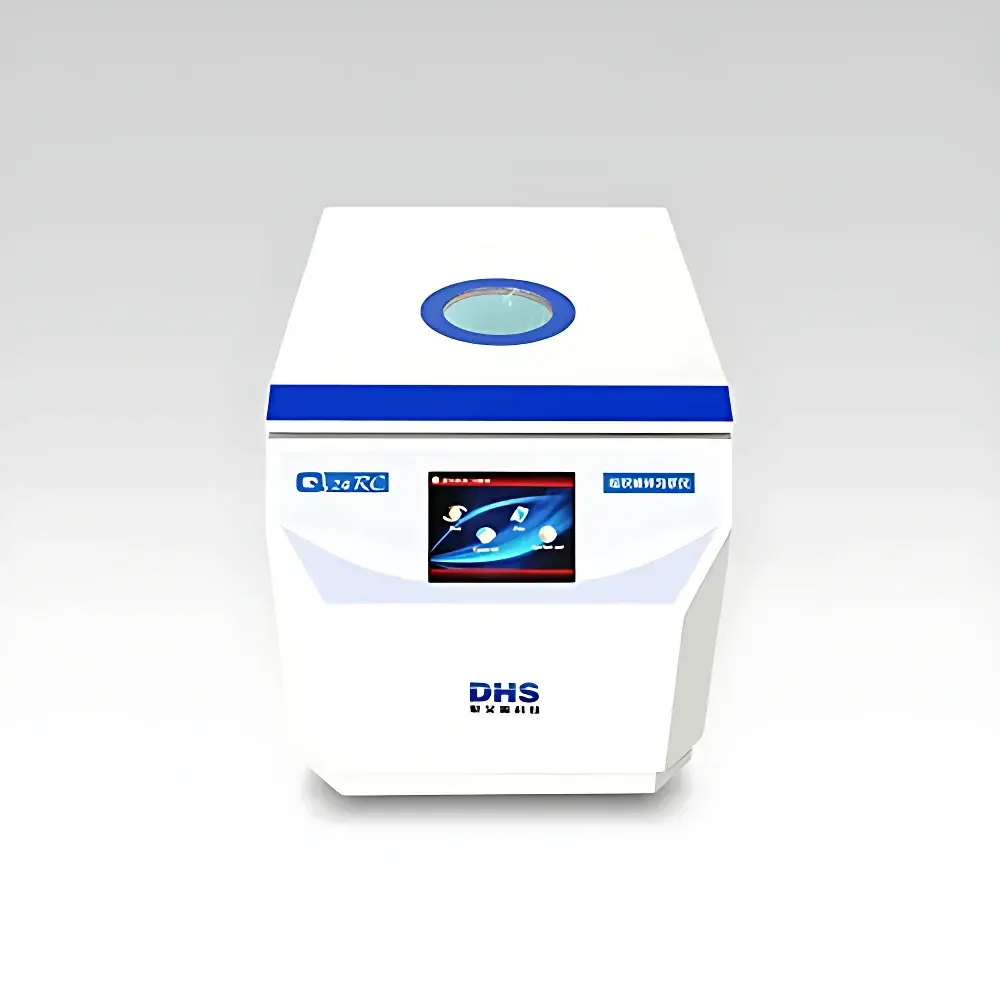
DHS Q24RC Cryo-Enabled High-Speed Tissue Homogenizer with Integrated Centrifugation
| Brand | DHS |
|---|---|
| Origin | Tianjin, China |
| Model | Q24RC |
| Instrument Type | Cryogenic Tissue Homogenizer & Benchtop Refrigerated Centrifuge |
| Sample Capacity | 24 × 2.0 mL tubes |
| Input Size | ≤ 8 mm |
| Output Particle Size | < 5 µm (typical) |
| Grinding Velocity Range | 2.0–6.5 m/s (adjustable in 0.05 m/s increments) |
| Refrigeration Range | 0–35 °C |
| Max Centrifugal Speed | 6,000 rpm |
| Noise Level | ≤ 54 dB(A) |
| Display | 5.7″ color touchscreen |
| Programmable Methods | 99 stored protocols |
| Max Cycle Count | 99 |
| Max Single Run Duration | 99 min 59 sec |
| Dimensions (L×W×H) | 510 × 370 × 360 mm |
| Weight | 32 kg |
| Power Supply | 200–240 V, 50/60 Hz |
| Safety Features | Lid interlock, automatic stop on lid opening |
| Chamber Material | Stainless steel (304) |
| Motor Type | Brushless frequency-controlled AC motor |
| Data Interface | Yes (RS-232 or USB, vendor-specified) |
Overview
The DHS Q24RC is an integrated cryo-capable tissue homogenizer and refrigerated benchtop centrifuge engineered for high-fidelity biomolecular extraction from sensitive biological specimens. It operates on the principle of high-frequency oscillatory bead-beating within temperature-controlled microtubes—leveraging kinetic energy transfer from ceramic or stainless-steel beads to disrupt cellular and subcellular structures while minimizing thermal denaturation. Unlike conventional rotor-stator or sonication-based systems, the Q24RC employs a dual-axis horizontal shaking mechanism combined with active Peltier-based cooling, enabling simultaneous mechanical lysis and thermal stabilization during processing. This architecture ensures reproducible disruption across heterogeneous tissues—including fibrous plant material, dense mammalian organs, and microbial cell walls—while maintaining nucleic acid integrity (RIN > 9.0), native protein conformation, and metabolite stability. The system is designed for compliance with GLP-aligned laboratory workflows and supports traceable sample handling under ISO/IEC 17025-conducive conditions.
Key Features
- Integrated cryogenic homogenization and centrifugation in a single platform—eliminates manual tube transfers and reduces contamination risk.
- Precise temperature control (0–35 °C) via solid-state Peltier cooling; maintains sample chamber stability within ±1.5 °C during extended runs (up to 99 min 59 sec).
- Adjustable impact velocity (2.0–6.5 m/s) with fine-grained resolution (0.05 m/s), enabling method optimization for fragile samples (e.g., brain tissue) or resilient matrices (e.g., seeds, bone).
- 24-position rotor accommodating standard 2.0 mL microcentrifuge tubes—compatible with commercially available lysis kits and custom reagent formulations.
- Brushless AC motor with sealed bearing assembly: zero carbon dust generation, no scheduled brush replacement, and >20,000-hour service life under routine use.
- Full stainless-steel (AISI 304) interior chamber: corrosion-resistant, autoclavable surface finish; facilitates rapid decontamination between batches.
- Intuitive 5.7″ capacitive touchscreen interface with multilingual OS support (English, German, French, Spanish); stores up to 99 user-defined protocols with timestamped execution logs.
- Lid-interlocked safety system: immediate motor and refrigeration shutdown upon lid opening—compliant with IEC 61010-1 requirements for laboratory equipment.
Sample Compatibility & Compliance
The Q24RC accommodates a broad spectrum of biological and industrial matrices without requiring liquid nitrogen or hazardous cryogens. Validated applications include fresh/frozen mammalian tissues (liver, spleen, muscle), plant materials (roots, leaves, seeds), microbial pellets (Gram-positive bacteria, yeast), and composite food or pharmaceutical excipients. All sample tubes remain hermetically sealed during operation, preventing aerosol release and cross-contamination—meeting containment criteria equivalent to WHO BSL-2 handling standards. The instrument’s firmware supports audit-trail generation (user ID, timestamp, parameter set, duration), aligning with FDA 21 CFR Part 11 readiness when paired with validated LIMS integration. Mechanical performance adheres to ISO 13355 (laboratory centrifuges) and ASTM D4292 (particle size reduction efficiency testing protocols).
Software & Data Management
Protocol management is handled through an embedded real-time operating system supporting password-protected user roles (Operator, Supervisor, Administrator). Each executed run generates a structured metadata file containing ambient temperature, chamber setpoint, actual velocity profile, cycle count, and lid-open events. Export formats include CSV and XML for downstream integration with ELN platforms (e.g., LabArchives, Benchling) or statistical analysis tools (R, Python pandas). Optional Ethernet or USB data export enables centralized logging in GxP-regulated environments where electronic record retention is mandated per ALCOA+ principles.
Applications
- High-yield genomic DNA isolation for NGS library preparation—particularly effective for GC-rich or methylation-sensitive loci due to low-heat lysis.
- Preservation of phosphoprotein epitopes and labile post-translational modifications during proteomic sample prep.
- Routine QC grinding of herbal medicines, dietary supplements, and nutraceutical powders prior to HPLC or ICP-MS analysis.
- Pre-analytical processing of clinical biobank specimens under standardized SOPs compliant with ISBER Best Practices.
- Cellular organelle enrichment workflows combining differential lysis and on-instrument pelleting (e.g., mitochondrial isolation from adipose tissue).
FAQ
Can the Q24RC process samples below 0 °C?
No—the Peltier cooling system maintains chamber temperatures between 0 °C and 35 °C. Sub-zero operation requires external cryogenic accessories not supported by this model.
Is rotor balancing required before each run?
No—the symmetrical 24-position rotor design and dynamic load compensation algorithm eliminate manual balancing; tubes must be loaded symmetrically in pairs only if fewer than 24 are used.
What maintenance is required beyond routine cleaning?
None. The brushless motor, sealed bearings, and solid-state cooler have no consumable parts. Annual calibration verification of temperature and speed sensors is recommended for regulated labs.
Does the system support remote monitoring or control?
Yes—via optional RS-232 or USB-to-Ethernet gateway; third-party SCADA or LabVantage integration is achievable using Modbus RTU or HTTP API (documentation provided upon request).
Are validation documents (IQ/OQ/PQ) available?
Yes—DHS provides factory-issued IQ/OQ templates and protocol guidance. Site-specific PQ execution support is offered through certified field application specialists.
Related Products



