
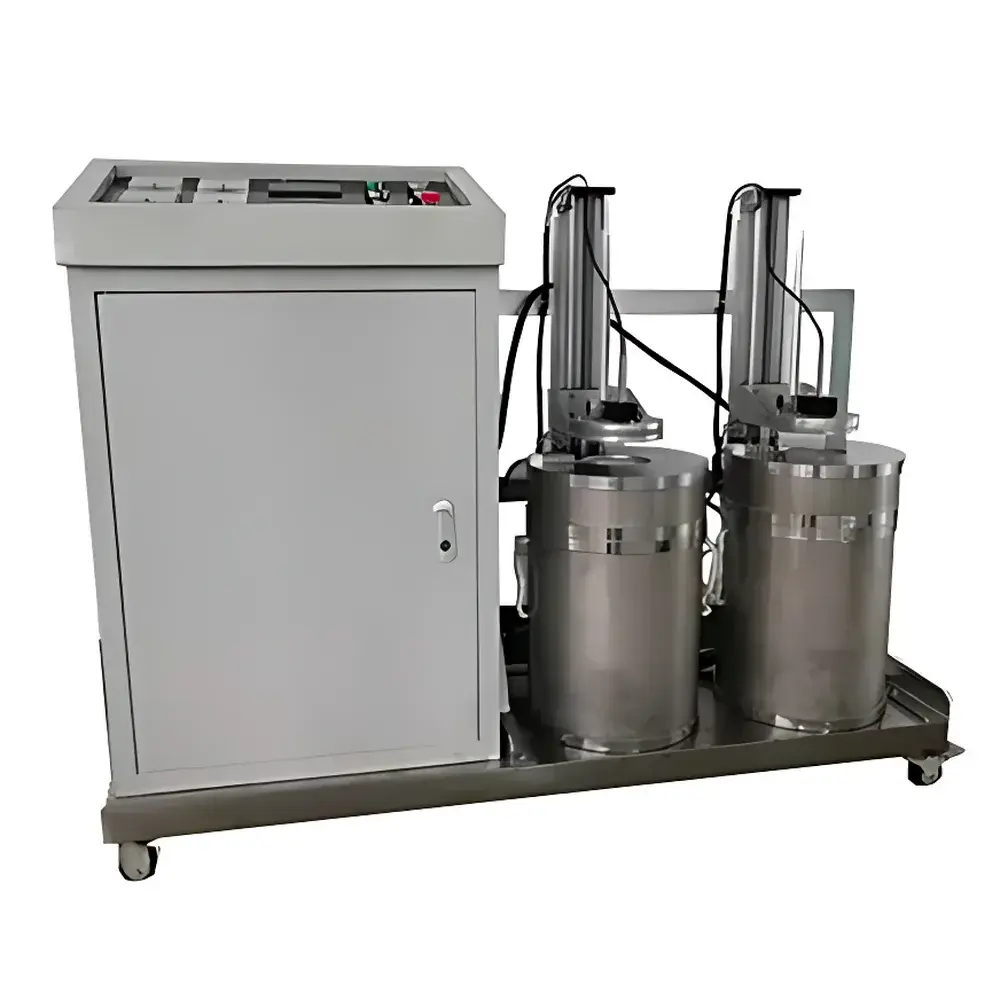
DIL0806 A/B Thermal Dilatometer for Coefficient of Linear Expansion (CTE) Measurement
| Origin | Hunan, China |
|---|---|
| Manufacturer Type | Distributor |
| Origin Category | Domestic |
| Model | DIL0806 A/B |
| Price Range | USD 7,000–14,000 |
| Temperature Range | RT to 1000 °C |
| Heating Rate | 0–20 °C/min |
| Temperature Accuracy | ±1 °C |
| Max. Sample Length | 50 mm |
| Stroke Range | 5 mm |
| Measurement Resolution | 0.1 µm |
| Atmosphere Options | Air, Reducing, Inert |
Overview
The DIL0806 A/B Thermal Dilatometer is a precision instrument engineered for quantitative determination of the coefficient of linear expansion (CTE) and dimensional changes in solid materials as a function of temperature. It operates on the principle of contact-based high-resolution displacement measurement using a calibrated inductive transducer system coupled with a programmable high-temperature furnace. The system supports both horizontal (Model A) and vertical (Model B) configurations, enabling optimal alignment for diverse sample geometries and thermal stability requirements. Designed for laboratory-grade thermal analysis, it delivers traceable, reproducible dilatometric data compliant with international standards including ASTM E228, ISO 11359-1/-2, and DIN 51045. Its dual-mode furnace architecture accommodates a broad operational range—from ambient to 1000 °C—with optional extensions up to 2000 °C—while maintaining thermal homogeneity and minimizing axial thermal gradients across the sample zone.
Key Features
- High-stability inductive displacement sensor with 0.1 µm resolution and full-scale stroke of 5 mm, integrated into a vacuum-sealed, water-jacketed sensor base maintained by a recirculating chiller (±0.01 K stability)
- Adjustable contact force mechanism (15–45 cN) ensuring consistent mechanical loading without sample deformation or slippage during thermal cycling
- Modular furnace design with interchangeable heating elements and thermocouple types (K, E, R, S, B, W-Re) to match temperature ranges: RT–1000 °C (standard), RT–1600 °C, RT–1700 °C, and RT–2000 °C
- Gas-tight quartz or alumina sample holders with integrated gas inlet/outlet ports; compatible with air, nitrogen, argon, hydrogen, and forming gas atmospheres
- Programmable temperature control with linear ramp rates from 0.01 to 999.99 K/min and isothermal hold durations up to 99 h 59 min
- Dual-channel analog input module with optical isolation, 24-bit resolution (±2,000,000 counts), and auto-ranging preamplifier for simultaneous acquisition of displacement and temperature signals
Sample Compatibility & Compliance
The DIL0806 A/B accepts cylindrical or rectangular specimens with lengths between 25–50 mm and diameters of 5–10 mm. Standard sample supports include fused silica, high-purity alumina (Al2O3), and graphite—selected based on maximum operating temperature and chemical compatibility. Each configuration includes a pushrod assembly, reference thermocouple, and protective sheath. The system meets essential requirements for GLP-compliant thermal characterization workflows: full audit trail logging, user-access level controls, electronic signature support (via optional software upgrade), and compliance with FDA 21 CFR Part 11 when deployed with validated software modules. All hardware components are CE-marked and conform to IEC 61000-6-2/6-3 for electromagnetic compatibility.
Software & Data Management
Control and analysis are executed via a Windows-native thermal analysis suite (compatible with Windows 10/7/XP, 32-bit). The software provides real-time visualization of displacement vs. temperature curves, automatic CTE calculation over user-defined intervals, baseline correction tools, and derivative analysis (dL/dT). Raw data is stored in ASCII-compatible .txt format with metadata headers—including instrument ID, operator name, date/time stamp, atmospheric conditions, and calibration coefficients—to ensure full traceability. Export options include CSV, Excel, and image formats (PNG, TIFF) suitable for inclusion in technical reports and peer-reviewed publications. USB 2.0 or PCI interface ensures stable communication with host PCs; no proprietary drivers required.
Applications
- Quantification of CTE in ceramics, metals, composites, and refractory materials for aerospace and power generation applications
- Thermal stress modeling inputs for electronic packaging and microelectromechanical systems (MEMS)
- Phase transition detection via inflection points in dilatometric curves (e.g., martensitic transformations, glass transitions in amorphous alloys)
- Quality control of sintered components in powder metallurgy and additive manufacturing processes
- Validation of thermal expansion models used in finite element analysis (FEA) simulations
- Long-term dimensional stability assessment of nuclear fuel cladding materials under simulated reactor conditions
FAQ
What is the difference between Model A and Model B?
Model A features a horizontal sample orientation optimized for gravity-independent measurements and improved thermal uniformity in low-density or fragile samples. Model B employs a vertical configuration, preferred for high-temperature applications requiring enhanced convection management and easier integration with cryogenic accessories.
Can the system operate under vacuum?
The standard configuration supports inert and reducing atmospheres but does not include vacuum pumping capability. Vacuum operation (≤10−2 mbar) is available upon request with modified furnace sealing and feedthroughs.
Is calibration traceable to national standards?
Yes—displacement calibration is performed using NIST-traceable gauge blocks; temperature calibration follows ITS-90 via certified reference thermocouples, with documentation provided per ISO/IEC 17025 guidelines.
Does the software support automated report generation?
The base software enables manual report export; fully automated PDF report generation with company branding, test parameters, and pass/fail criteria requires the optional Report Generator Module.
What maintenance is required for long-term accuracy?
Annual recalibration of the displacement sensor and thermocouple reference junction is recommended. Routine inspection of pushrod wear, furnace insulation integrity, and chiller coolant levels ensures sustained metrological performance.



