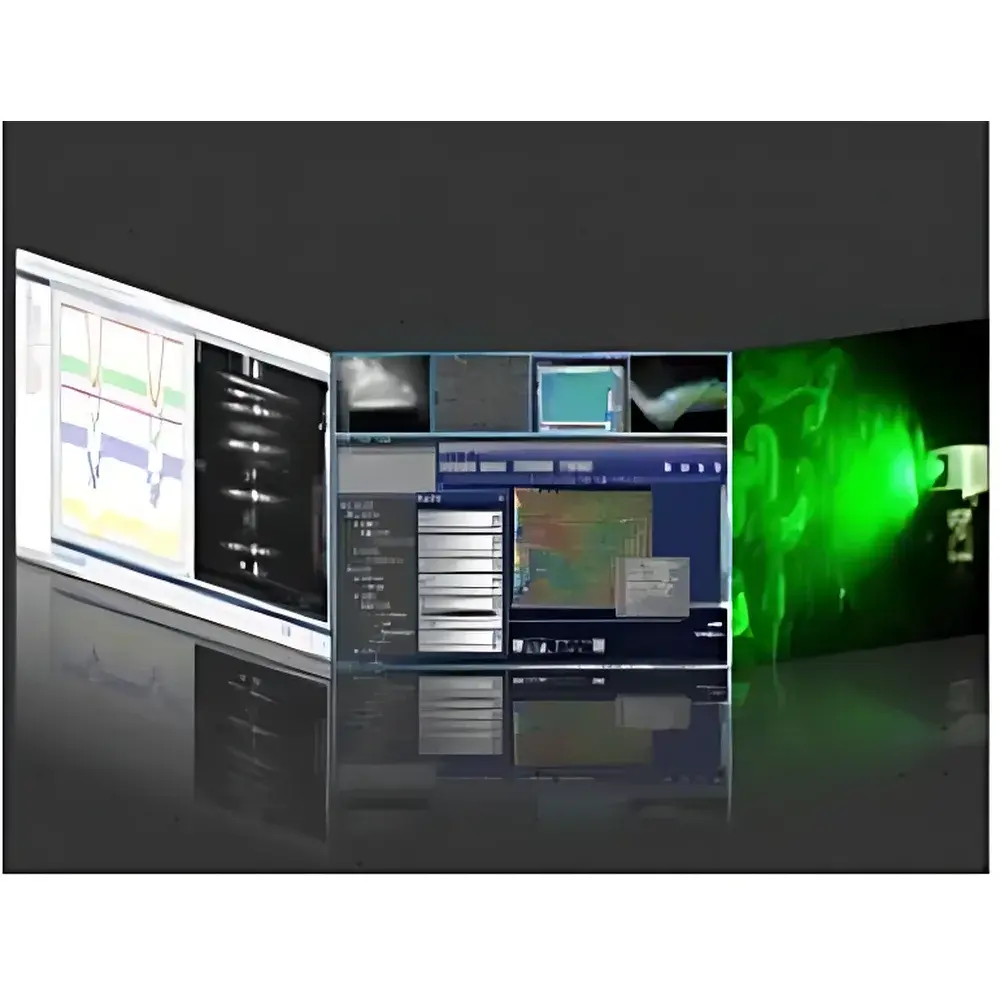
DITECT Flownizer 2D/3D PIV & PTV Analysis Software
| Brand | DITECT |
|---|---|
| Origin | Japan |
| Model | PIV 2D2C, PTV 2D2C (2D/3D), PIV 2D3C (3D) |
| Measurement Capability | 3D3C volumetric velocity field reconstruction |
| Frame Rate Support | ≥100 Hz |
| Supported Image Formats | AVI, WMV, JPG, BMP, TIFF, PNG |
| Data Export Formats | Project (.flw), CSV |
| Correlation Method | Direct Cross-Correlation (PIV), Binary Correlation (PTV) |
| Physical Quantities Computed | Vorticity, Turbulent Kinetic Energy, Reynolds Stresses, Velocity Gradient Tensor, RMS Velocity Fluctuations |
| Operating System | 64-bit Windows with SSE2/SSE3 instruction set support |
| CPU Architecture | Multi-core parallel processing optimized |
Overview
DITECT Flownizer is a high-performance, research-grade software platform engineered for quantitative fluid dynamics analysis using Particle Image Velocimetry (PIV) and Particle Tracking Velocimetry (PTV). Designed from the ground up for computational efficiency and experimental flexibility, Flownizer implements both 2D2C (two-dimensional, two-component) and 2D3C (two-dimensional, three-component) PIV methodologies, as well as 2D2C PTV — with native support for stereoscopic and tomographic extensions enabling full 3D3C (three-dimensional, three-component) vector field reconstruction. The software operates on the principle of spatial cross-correlation of seeded particle patterns between consecutive image frames (for PIV) or centroid-based trajectory tracking of individual particles (for PTV), delivering instantaneous velocity fields with high spatial resolution and temporal fidelity. Its architecture is rigorously optimized for modern multi-core x64 computing environments, leveraging SSE2/SSE3 instruction sets to accelerate correlation computation, interpolation, and post-processing routines — making it suitable for real-time feedback in wind tunnel testing, transient flow characterization in internal combustion engines, hemodynamic studies in biomedical models, and environmental hydraulics applications.
Key Features
- Native dual-mode operation: Simultaneous configuration and execution of PIV (direct cross-correlation) and PTV (binary correlation) workflows within a unified interface
- Tree-structured, context-aware menu system enabling intuitive navigation across preprocessing, interrogation, validation, and post-processing stages
- Multi-threaded parallel processing engine fully compatible with 64-bit Windows OS and modern Intel/AMD multi-core CPUs
- Comprehensive physical quantity derivation: vorticity, turbulent kinetic energy (TKE), Reynolds stress tensor components, velocity gradient tensor, and RMS velocity fluctuations
- Advanced visualization suite supporting streamline, pathline, streakline, and iso-velocity contour rendering with interactive point-, line-, and region-of-interest (ROI) queries
- Robust data export infrastructure: native .flw project files for full workflow reproducibility; standardized CSV output for integration with MATLAB, Python (NumPy/Pandas), and statistical analysis platforms
Sample Compatibility & Compliance
Flownizer accepts standard digital video and image sequence formats widely used in laboratory imaging systems, including AVI (uncompressed or MJPEG), WMV, and single-frame formats such as JPEG, BMP, TIFF, and PNG. It supports both planar and stereoscopic camera configurations, and is routinely deployed in setups compliant with ISO 20485 (PIV measurement uncertainty guidelines) and ASTM F3072 (standard practice for PIV in biomedical flow studies). While Flownizer itself is not a hardware device subject to FDA or CE marking, its output data structures and audit-ready project files align with GLP and GMP documentation requirements when integrated into validated laboratory workflows — particularly where traceability of image preprocessing parameters (e.g., window deformation, interrogation window size, peak locking, outlier replacement thresholds) is essential.
Software & Data Management
The software implements deterministic, non-proprietary algorithms with full parameter transparency — all interrogation settings (e.g., interrogation window size, overlap ratio, sub-pixel interpolation method, signal-to-noise thresholding) are user-configurable and logged automatically in each .flw project file. Batch processing mode enables unattended analysis of large-scale datasets (e.g., time-resolved series from high-speed cameras). Built-in quality control metrics include correlation peak ratio, RMS displacement deviation, and local vector consistency checks. All computed vector fields retain pixel-coordinate mapping metadata, ensuring geometric calibration integrity during downstream coordinate transformation (e.g., to physical units via known scale factors or stereo calibration matrices). No cloud dependency or online activation is required; licensing is node-locked to the host machine’s hardware fingerprint.
Applications
- Aerodynamics: Boundary layer analysis, wake characterization, and separation detection in wind tunnel experiments
- Thermal-fluid systems: Airflow visualization and quantification in HVAC ducts, heat exchangers, and electronic cooling modules
- Environmental hydraulics: Open-channel flow profiling, sediment transport modeling, and riverine turbulence structure analysis
- Biomedical engineering: In vitro pulsatile flow studies in arterial phantoms, microfluidic device validation, and intracranial aneurysm hemodynamics
- Powertrain development: Transient in-cylinder flow mapping, injector spray interaction, and swirl/tumble quantification in optical engines
FAQ
Does Flownizer support GPU-accelerated correlation computation?
No — Flownizer relies exclusively on CPU-based parallelization using OpenMP and hand-optimized SIMD instructions (SSE2/SSE3); no CUDA or OpenCL dependencies are included.
Can I import third-party calibration files (e.g., from DaVis or Insight)?
Yes — Flownizer accepts generic ASCII-based calibration matrices and supports manual entry of scaling factors, origin offsets, and rotation parameters for planar and stereo configurations.
Is batch processing available for time-series datasets?
Yes — the software includes a command-line interface (CLI) mode for scripting automated analysis pipelines across hundreds of image pairs or video segments.
What level of technical support is provided for academic users?
DITECT offers direct email-based engineering support with documented response SLAs; academic institutions may also access annotated tutorial datasets and methodology white papers covering uncertainty propagation and validation protocols.
Are software updates included after purchase?
Minor version updates (e.g., 5.2 → 5.3) are provided free of charge for 12 months post-license activation; major version upgrades require a maintenance agreement.