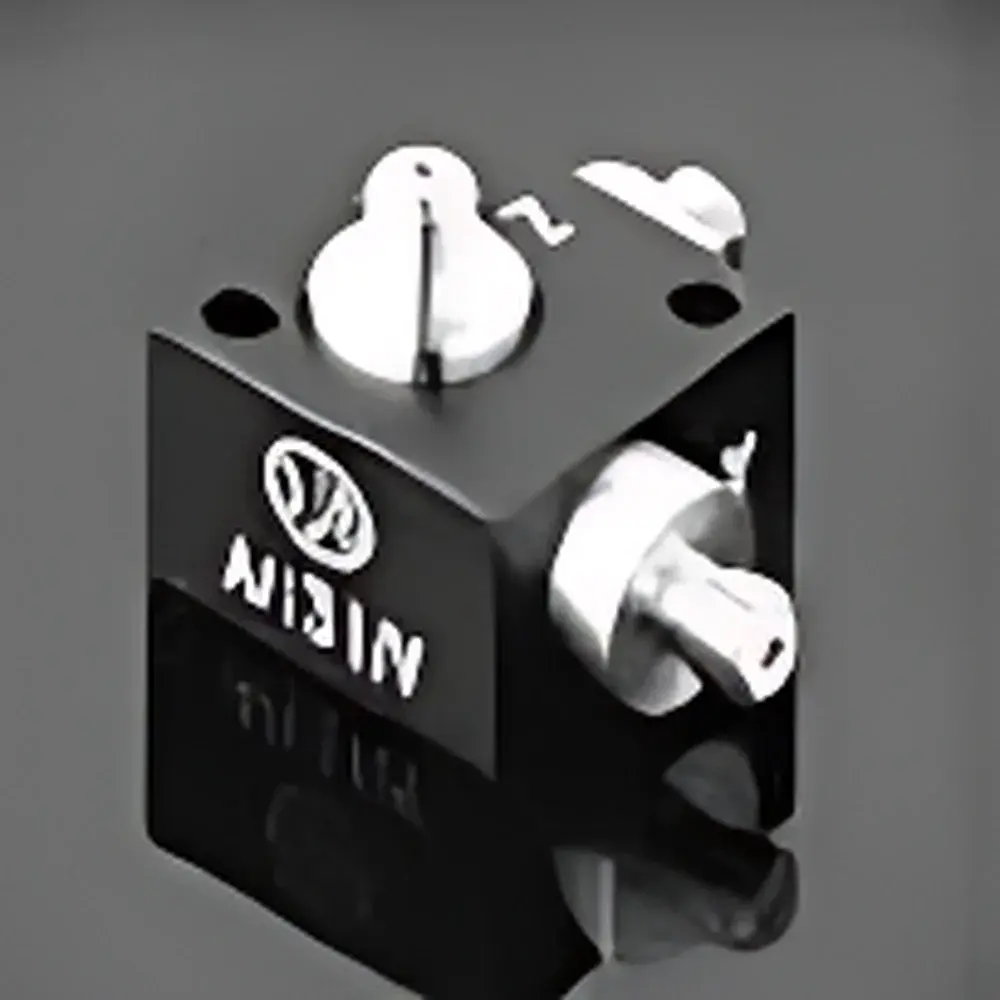
DJB A/131/V Three-Axis Voltage-Output Accelerometer
| Brand | DJB |
|---|---|
| Origin | Germany |
| Manufacturer Type | Authorized Distributor |
| Origin Category | Imported |
| Model | A/131/V |
| Price | Upon Request |
| Sensitivity | 10 mV/g or 100 mV/g |
| Weight | 19 g |
| Maximum Shock Range | ±1000 g |
| Resonant Frequency | ≥25 kHz (X/Y), ≥28 kHz (Z) |
| Operating Temperature | −50 °C to +125 °C (High-Temp Version: ±10% sensitivity shift at +185 °C) |
| Connector | Microdot (M) |
| Mounting | Through-hole or adhesive (isolated base) |
| Electrical Output | IEPE (Integrated Electronics Piezoelectric), Constant Current Powered (2–20 mA) |
Overview
The DJB A/131/V Three-Axis Voltage-Output Accelerometer is an IEPE (Integrated Electronics Piezoelectric) sensor engineered for high-fidelity, simultaneous measurement of dynamic acceleration along orthogonal X-, Y-, and Z-axes. Based on quartz-shear piezoelectric sensing elements with built-in low-noise charge-to-voltage conversion circuitry, the device delivers stable, low-impedance voltage output compatible with standard data acquisition systems, FFT analyzers, and condition monitoring hardware. Its monolithic triaxial architecture eliminates inter-axis misalignment errors common in stacked single-axis configurations, ensuring vectorially accurate vibration characterization under complex multi-directional loading conditions—critical for structural health monitoring, modal analysis, engine testing, and aerospace qualification.
Key Features
- True triaxial design with orthogonal shear-mode piezoelectric sensing elements, minimizing cross-axis sensitivity (<1% typical)
- IEPE interface with constant-current excitation (2–20 mA), enabling operation over standard coaxial cabling up to 300 m without signal degradation
- Two selectable sensitivity options: 10 mV/g (optimized for high-g, broad-frequency applications) and 100 mV/g (enhanced resolution for low-level vibration detection)
- Robust hermetically sealed titanium housing rated for continuous operation from −50 °C to +125 °C; high-temperature variant maintains ±10% sensitivity stability up to +185 °C
- Resonant frequencies ≥25 kHz (X/Y) and ≥28 kHz (Z) support usable bandwidths up to 8 kHz per axis (per ISO 5347-11 and ASTM E1876 guidelines)
- Microdot (M) connector ensures secure, low-noise mating in high-vibration environments; integrated strain relief minimizes cable-induced mechanical loading
- Mounting flexibility: isolated through-hole base or adhesive bonding surface—both configurations preserve mechanical decoupling and thermal isolation
Sample Compatibility & Compliance
The A/131/V is suitable for rigid attachment to metallic, composite, and ceramic test surfaces via M5 threaded holes or high-performance cyanoacrylate/epoxy adhesives. It complies with IEC 60794-2 (fiber-optic cable environmental requirements, by analogy for ruggedized sensor housing), meets MIL-STD-810G shock/vibration profiles when properly mounted, and conforms to electromagnetic compatibility standards per EN 61326-1 (industrial EMC). Calibration traceability follows ISO/IEC 17025:2017 through DJB’s accredited calibration laboratory, with optional NIST-traceable certificate (certified per ISO 16063-21 for triaxial accelerometers). The sensor supports GLP/GMP-aligned validation protocols—including documented mounting torque, thermal soak verification, and post-installation sensitivity verification—required for regulated environments such as automotive Tier-1 testing labs and medical device R&D facilities.
Software & Data Management
The A/131/V integrates natively with industry-standard DAQ platforms including National Instruments PXIe, Dewesoft X, Siemens Desi, and HBK Catman. Its analog voltage outputs (±5 V full scale) are compatible with 24-bit delta-sigma ADCs, supporting dynamic range >120 dB and real-time sampling up to 50 kS/s per channel. DJB provides configuration utilities for gain scaling, axis labeling, and unit conversion (g → m/s², PSD → g²/Hz); raw time-series data exports to .tdms, .uff, and .csv formats. For audit-ready deployments, the sensor supports metadata embedding (timestamp, serial number, calibration date) and is compatible with FDA 21 CFR Part 11-compliant software environments when paired with validated acquisition firmware and electronic signature modules.
Applications
- Rotating machinery diagnostics: bearing fault detection, imbalance identification, and gear mesh analysis across turbomachinery, wind turbine gearboxes, and electric motor drivetrains
- Aerospace structural testing: flutter suppression validation, wingbox modal survey, and payload bay vibration mapping during shaker table qualification
- Automotive NVH: powertrain mount characterization, chassis component resonance mapping, and battery pack mechanical integrity assessment under road-load simulation
- Geotechnical and civil infrastructure monitoring: bridge deck response under live load, seismic retrofit performance evaluation, and foundation pile integrity verification
- Research-grade modal analysis: experimental determination of mass, stiffness, and damping matrices for finite element model correlation (FEA/EMA correlation per ASTM E2534)
FAQ
What is the recommended excitation current range for stable IEPE operation?
The A/131/V is specified for constant-current excitation between 2 mA and 20 mA; optimal performance is achieved at 4 mA minimum to ensure full dynamic range and low-noise biasing of internal electronics.
Can this accelerometer be used in vacuum or high-humidity environments?
Yes—the titanium housing and hermetic seal meet IP68 ingress protection (per IEC 60529) and have been validated for operation at ≤10⁻³ mbar vacuum and 95% RH non-condensing environments without performance drift.
Is thermal transients compensated in the high-temperature version?
The HT variant includes integrated temperature-compensated amplifier circuitry, limiting sensitivity drift to ±10% over −50 °C to +185 °C; full calibration data versus temperature is provided in the accompanying certificate.
How is axis orientation verified during installation?
Each unit is laser-marked with X/Y/Z directional indicators and supplied with a calibrated alignment jig; DJB also offers optional triaxial angular deviation reports generated via coordinate measuring machine (CMM) verification.
Does the Microdot connector require special mating hardware?
Standard Microdot female receptacles (e.g., Amphenol 80-MD series) are compatible; DJB recommends crimp-type termination with silver-plated beryllium copper contacts to maintain impedance continuity and minimize triboelectric noise.