
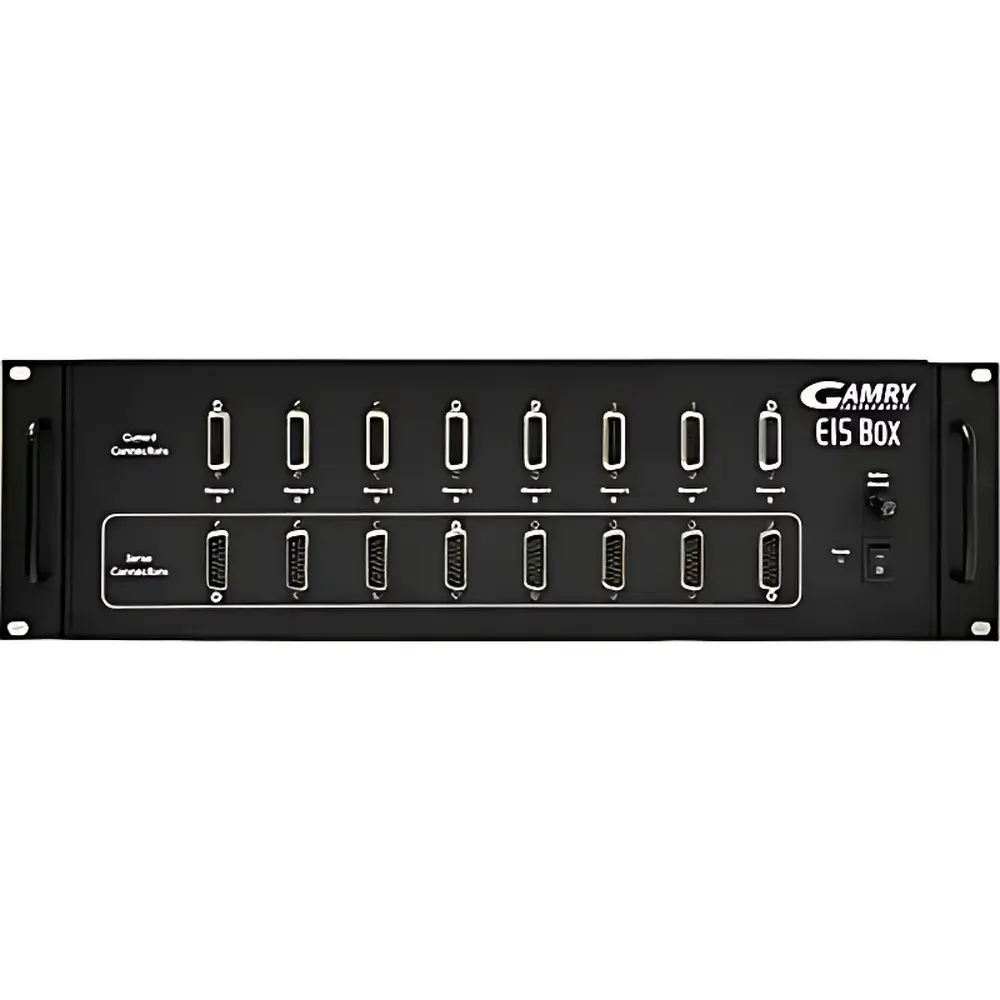
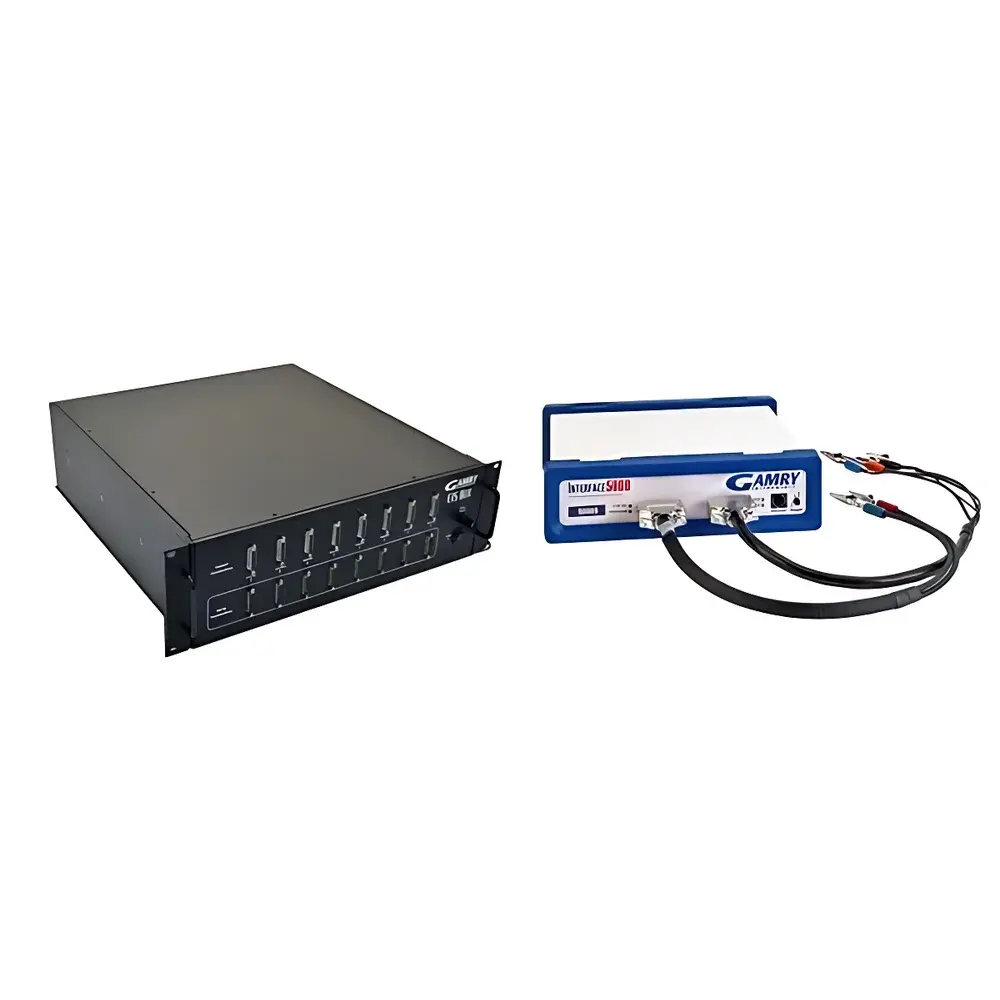
Gamry EIS BOX 8-Channel Battery Electrochemical Impedance Spectroscopy Multiplexer
| Brand | Gamry |
|---|---|
| Origin | USA |
| Model | EIS BOX |
| Instrument Type | Electrochemical Workstation |
| Current Range | ±5 A |
| Current Resolution | 20 pA |
| Potential Accuracy | ±1 mV |
| Potentiostatic Range | ±6 V |
| AC Impedance Frequency Range | 10 µHz – 100 kHz |
| Channel Count | 8 |
| Dual Electrometer Capability | Yes |
| Floating Ground Architecture | Yes |
| Data Interface | Ethernet / USB |
| Rack Mountable | 3U, 19-inch standard |
| Cable Length per Channel | 3 m |
| Minimum Measurable Impedance | < 10 µΩ |
| FRA Integration | Built-in Frequency Response Analyzer |
Overview
The Gamry EIS BOX is an 8-channel electrochemical impedance spectroscopy (EIS) multiplexer engineered specifically for high-throughput, time-resolved impedance characterization of energy storage and conversion devices. When paired with the Gamry Interface 5000 potentiostat/galvanostat, it forms a fully integrated, automated EIS testing platform compliant with modern electrochemical metrology standards. Unlike conventional single-channel systems, the EIS BOX employs true sequential channel switching—enabling unattended, synchronized impedance acquisition across up to eight independent samples without hardware reconfiguration. Its core architecture leverages floating-ground design and built-in frequency response analysis (FRA) firmware, ensuring galvanic isolation between channels and eliminating ground-loop interference during multi-cell battery testing. The system operates over an exceptionally wide dynamic frequency range (10 µHz to 100 kHz), supporting both ultra-low-frequency degradation monitoring (e.g., solid-electrolyte interphase evolution) and high-frequency contact resistance analysis (< 10 µΩ resolution). It is expressly designed for in situ and operando EIS measurements—capable of interleaving impedance scans with galvanostatic cycling protocols from external battery cyclers via TTL synchronization or analog voltage triggers.
Key Features
- Eight independently addressable, galvanically isolated channels with full potentiostatic control (±6 V, ±5 A)
- Dual-electrometer configuration enabling simultaneous three-terminal EIS on individual battery electrodes (anode, cathode, and full-cell)
- Sub-microamp current resolution (20 pA) and millivolt-level potential accuracy (±1 mV) for quantitative low-impedance measurement
- Floating-ground architecture compliant with IEEE Std 1139–2008 for safe, noise-immune operation in multi-battery rack environments
- Integrated FRA engine with phase-locked loop (PLL) detection, supporting Mott-Schottky, Bode, Nyquist, and Cole-Cole analysis natively
- Rack-mountable 3U 19-inch chassis with rear-panel Ethernet (10/100BASE-T) and USB 2.0 interfaces for deterministic real-time data streaming
- Pre-calibrated 3-meter shielded coaxial cables with Kelvin-sensing terminations for minimized lead inductance and contact resistance error
Sample Compatibility & Compliance
The EIS BOX supports standardized electrochemical testing of lithium-ion, sodium-ion, solid-state, flow, and metal–air batteries; proton-exchange membrane (PEM) and alkaline fuel cells; and symmetric/asymmetric supercapacitors. All channels meet IEC 62660-1:2022 requirements for battery impedance validation under load. The dual-electrometer topology satisfies ASTM D7242–17 guidelines for electrode-specific impedance deconvolution. System firmware implements audit-trail logging per FDA 21 CFR Part 11 Annex 11 requirements when operated under validated LabVIEW or Framework-based control environments. Electrical safety conforms to UL 61010-1 and EN 61010-1:2019 for laboratory instrumentation.
Software & Data Management
Control and analysis are performed using Gamry’s Framework™ software suite (v9.0+), which provides scriptable experiment sequencing, real-time FFT-based noise rejection, and automatic Kramers–Kronig validation. Raw impedance datasets are stored in HDF5 format with embedded metadata (timestamp, temperature, SOC, current protocol step), ensuring FAIR (Findable, Accessible, Interoperable, Reusable) compliance. Batch processing supports ISO 10993-18–aligned equivalent circuit fitting using distributed computing across local workstations. Export modules generate ASTM E29–23–compliant reports with uncertainty propagation for Rct, Rs, CPE, and Warburg parameters.
Applications
- Operando EIS during constant-current charge/discharge cycles to correlate impedance shifts with state-of-charge (SOC) and aging mechanisms
- High-throughput screening of electrode formulations, electrolyte additives, and separator coatings
- Multi-cell pack imbalance analysis via comparative Nyquist trajectory clustering
- In situ monitoring of SEI growth kinetics in half-cells using ultra-low-frequency (≤100 mHz) impedance sweeps
- Three-electrode EIS on working electrodes with reference counter separation to isolate anode/cathode contributions
- Accelerated lifetime testing (ALT) of solid-state batteries under thermal stress with synchronized impedance acquisition
FAQ
Can the EIS BOX operate independently without a Gamry potentiostat?
No. The EIS BOX is a multiplexer module and requires integration with a compatible Gamry potentiostat (e.g., Interface 5000, Reference 3000) to supply excitation signals and acquire current/voltage responses.
Is remote operation over the internet supported?
Ethernet connectivity is limited to local area networks (LAN); internet-based remote access is not supported for security and latency-critical timing reasons.
How is channel crosstalk mitigated during simultaneous measurements?
Channels are sequentially measured—not simultaneously—with hardware-enforced dead time between switches and active guard shielding, achieving >120 dB channel-to-channel isolation at 1 kHz.
Does the system support custom equivalent circuit modeling?
Yes. Framework software includes a modular circuit editor supporting user-defined elements (e.g., transmission lines, fractal capacitors) and global fitting across multiple spectra.
What calibration procedures are required before use?
Factory calibration is traceable to NIST standards. Users perform daily open/short/load verification using included calibration fixtures per ASTM E2421–22 Section 6.2.
Related Products





