
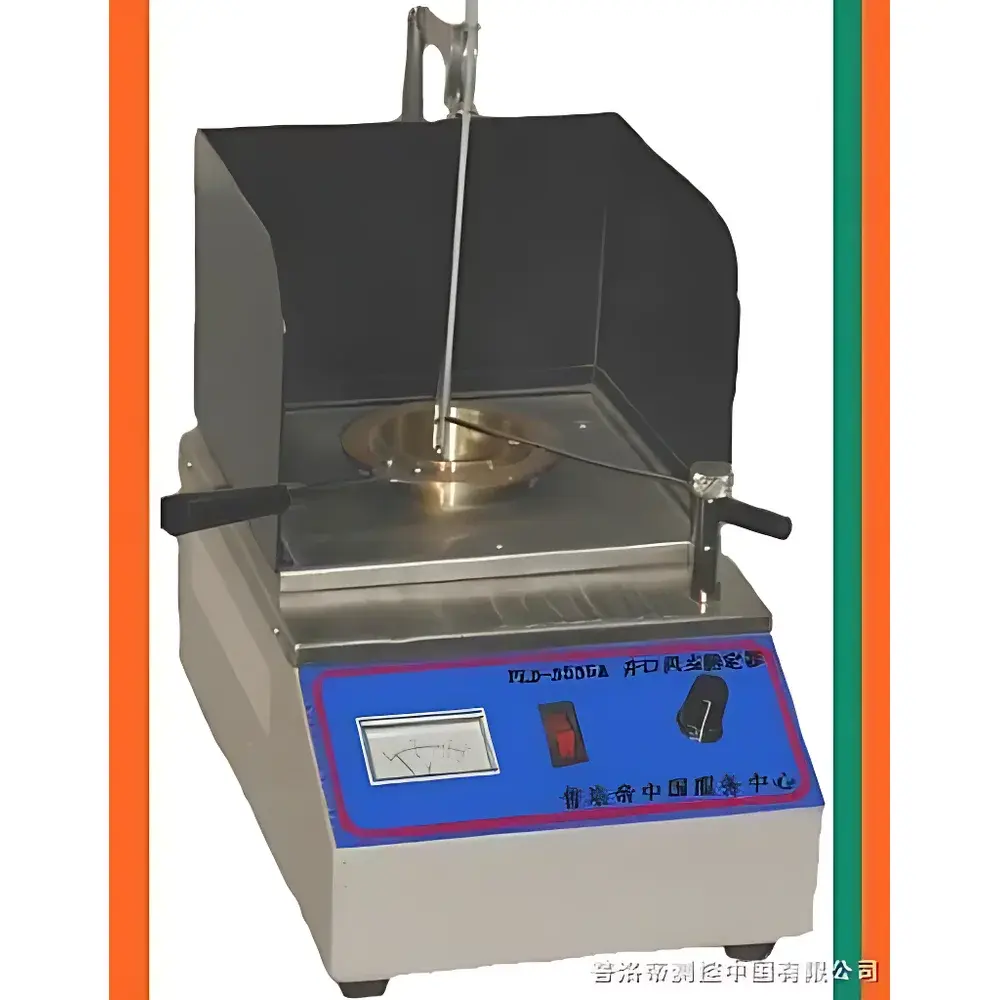
PULUODY PLD-3536A Cleveland Open Cup Flash Point Tester
| Brand | PULUODY |
|---|---|
| Origin | Shaanxi, China |
| Manufacturer Type | Direct Manufacturer |
| Country of Origin | China |
| Model | PLD-3536A |
| Detection Method | Cleveland Open Cup (COC) |
| Input Power | 1250 W |
| Power Supply | AC 220 V / 50 Hz |
| Fuel Gas Options | Coal gas, butane, hydrogen, or LPG |
| Test Flame Ball Radius | 150 mm |
Overview
The PULUODY PLD-3536A Cleveland Open Cup Flash Point Tester is a precision-engineered instrument designed for the standardized determination of flash point and fire point of petroleum products—including lubricating oils, residual fuels, bituminous materials, and other non-volatile or high-boiling-point hydrocarbons—according to internationally recognized test methods. It implements the Cleveland Open Cup (COC) principle, which relies on controlled heating of a sample in an open crucible while periodically introducing a standardized test flame across the surface. The flash point is defined as the lowest temperature at which vapors above the heated sample ignite momentarily upon exposure to the flame; the fire point is the subsequent temperature at which sustained combustion occurs for at least five seconds. This method is widely adopted under ASTM D92 and GB/T 3536, ensuring compatibility with global refinery QA/QC protocols, regulatory submissions, and material safety data sheet (MSDS/SDS) generation.
Key Features
- Compliant architecture engineered for strict adherence to ASTM D92 and GB/T 3536 test procedures, including precise crucible geometry, flame delivery timing, and thermal ramp control.
- Standard Cleveland open cup fabricated from corrosion-resistant, high-purity brass per ASTM specification—ensuring dimensional accuracy and long-term repeatability.
- Dual-mode heating system: A chromium-plated steel heating plate provides uniform base conduction, while an infrared-heated quartz-sheathed resistance coil delivers rapid, stable, and oil-splash-resistant thermal input—eliminating risks associated with exposed heating elements.
- Integrated solid-state voltage regulator enables fine-grained, real-time adjustment of heating rate, with direct analog voltage readout for traceable process monitoring and operator verification.
- Modular flame delivery assembly featuring adjustable 150 mm radius flame ball trajectory, calibrated ignition source positioning, and manual trigger actuation—supporting both manual and semi-automated test execution.
- Robust mechanical design includes an integrated wind shield enclosure, rigid support frame, and ergonomic sample handling interface—optimized for benchtop operation in laboratory, refinery, and third-party testing environments.
Sample Compatibility & Compliance
The PLD-3536A is validated for use with viscous and thermally stable petroleum-based samples including asphalt binders, heavy fuel oils (e.g., No. 6 fuel oil), cylinder oils, marine distillates, and oxidized lubricants. It excludes low-volatility solvents, halogenated compounds, or water-miscible fluids not covered under ASTM D92 scope. All mechanical components conform to CE-relevant electromagnetic compatibility (EMC) and electrical safety directives when operated within rated supply parameters (AC 220 V ±10%, 50 Hz). While the instrument itself does not carry UL or CSA certification, its operational methodology aligns with ISO/IEC 17025–accredited laboratories’ requirements for method validation, equipment qualification (IQ/OQ), and routine performance verification per internal SOPs referencing ASTM E202 or ISO 4787.
Software & Data Management
The PLD-3536A operates as a manually supervised, hardware-controlled instrument without embedded microprocessor-based data logging. Temperature readings are recorded via calibrated ASTM-certified glass thermometers (Class IP or equivalent), and flash/fire point determinations are documented manually in laboratory notebooks or electronic lab notebooks (ELNs). For laboratories requiring digital traceability, the unit is compatible with external digital temperature acquisition systems (e.g., PT100 probes interfaced via USB DAQ modules) and supports integration into LIMS platforms through CSV export workflows. Audit trails, calibration records, and maintenance logs must be maintained per GLP and GMP principles—particularly where results inform regulatory filings under EPA 40 CFR Part 79 or EU REACH Annex VII.
Applications
- Refinery quality assurance: Verification of flash point compliance for finished lubricants and residual fuel batches prior to shipment.
- Materials safety assessment: Determination of hazard classification per GHS Category 3 or 4 flammability criteria.
- Research & development: Thermal stability evaluation of bio-based lubricants, synthetic esters, and formulated additives during accelerated aging studies.
- Contract testing laboratories: Execution of ASTM D92-compliant flash point analysis for ISO/IEC 17025-accredited reports.
- Educational instruction: Demonstration of open-cup flash point theory, fire triangle dynamics, and petroleum product volatility behavior in chemical engineering curricula.
FAQ
What standards does the PLD-3536A comply with?
ASTM D92 and GB/T 3536 for Cleveland Open Cup flash and fire point testing.
Can this instrument be used for closed-cup testing?
No—it is exclusively configured for open-cup methodology; closed-cup applications require a dedicated Pensky-Martens (ASTM D93) or Tag (ASTM D56) instrument.
Is calibration certificate included with purchase?
A factory-verified calibration report for the heating control circuit and flame positioning mechanism is provided; user-performed thermometer calibration per ASTM E77 is required prior to each test series.
What gas sources are compatible with the ignition system?
Coal gas, butane, hydrogen, and liquefied petroleum gas (LPG)—all must be supplied at regulated pressure (typically 0.5–1.0 bar) and filtered to prevent nozzle clogging.
Does the unit support automated data export?
Not natively; however, it interfaces with external digital thermometry and data acquisition systems for compliant electronic recordkeeping.






