
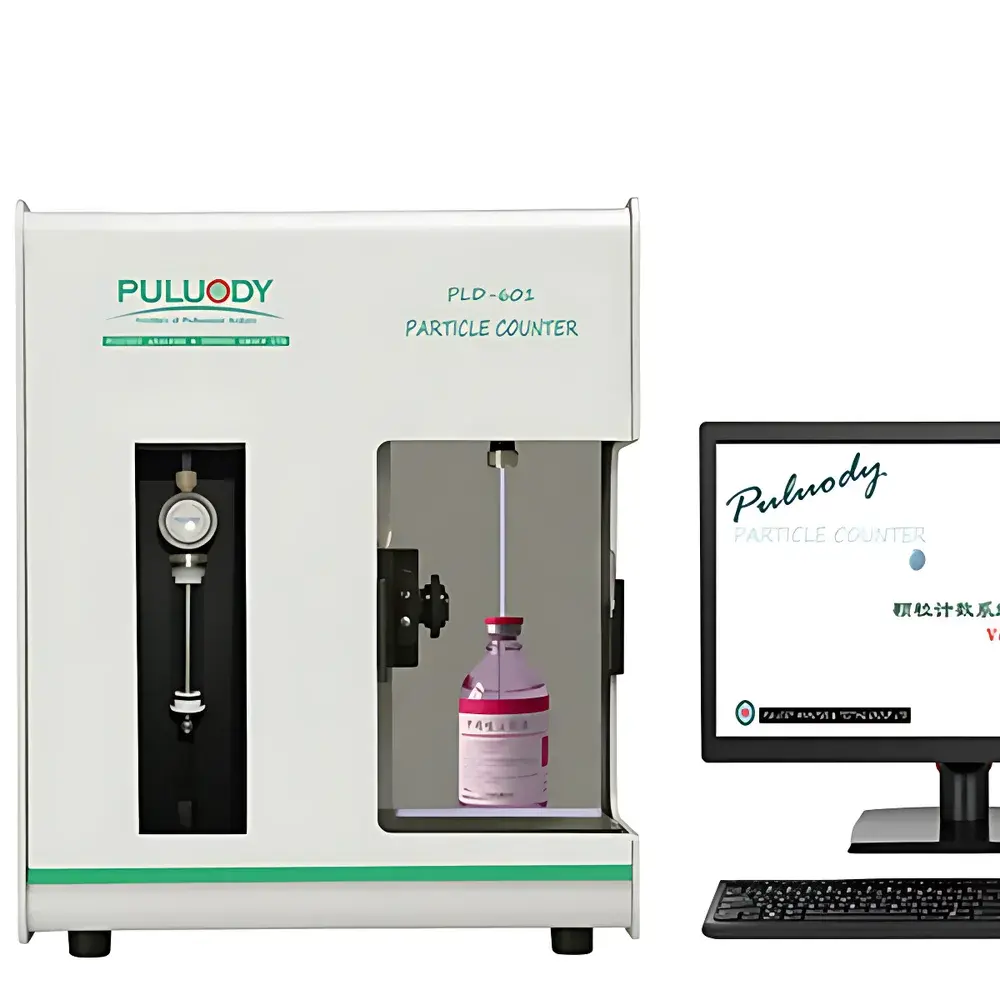
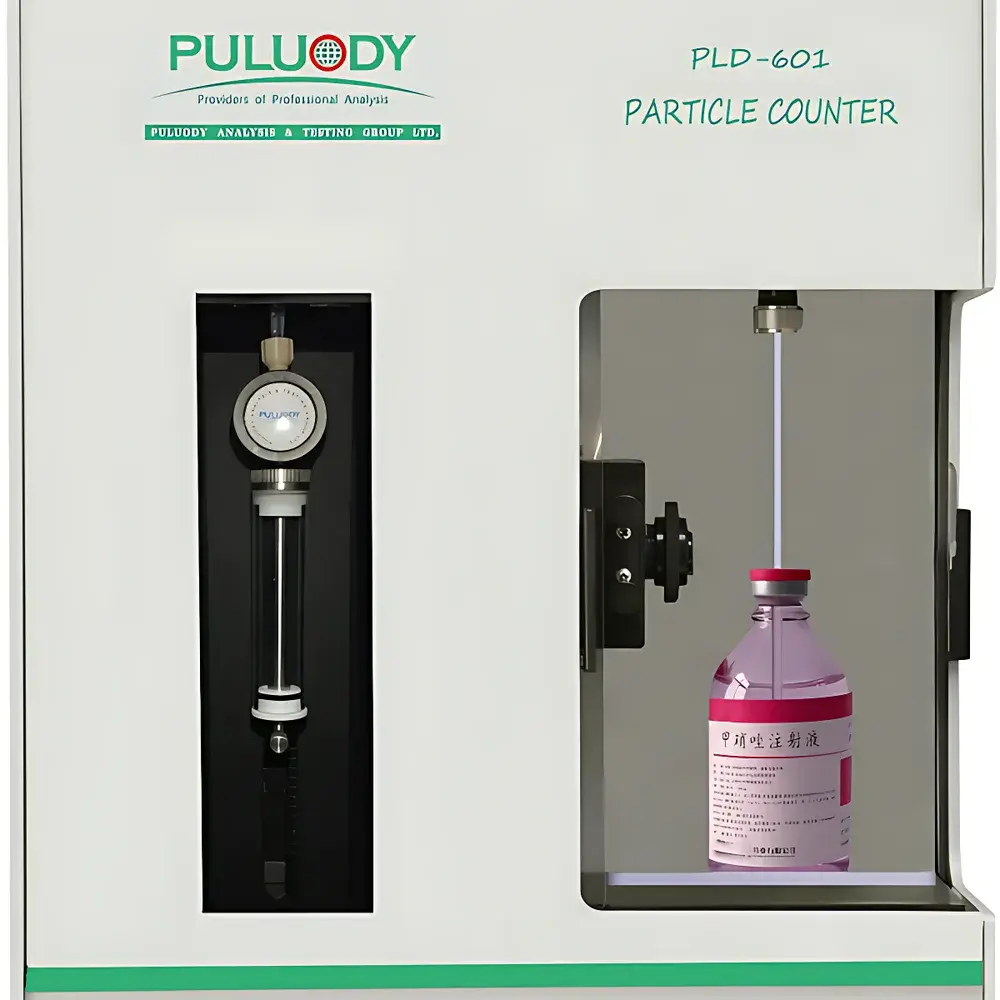
PULUODY PLD-601Y Sterile Syringe Insoluble Particulate Counter
| Brand | PULUODY |
|---|---|
| Origin | Shaanxi, China |
| Model | PLD-601Y |
| Instrument Type | Optical Particle Counter |
| Detection Principle | Light Obscuration (LO) / Dual-Laser Narrow-Beam Sensor |
| Measurement Range | 1–450 µm (customizable to 0.03–3000 µm) |
| Channel Count | 1000 adjustable size channels |
| Sampling Flow Rate | 5–150 mL/min |
| Cleaning Flow Rate | 5–500 mL/min |
| Sample Temperature Range | 0–80 °C |
| Accuracy | ±5% typical (per ChP 2020 & USP <788>) |
| Coincidence Limit | ≤5% at 1000 particles/mL |
| Resolution | >95% (ChP-calibrated), >90% (ISO 21501-2 compliant) |
| Software | V8.9 Regulatory-Compliant Analysis Suite |
| Compliance | FDA 21 CFR Part 11, GMP/GLP Audit Trail, Electronic Signature, Five-Tier User Access Control |
| Standards Supported | ChP 0903 (2015/2020), USP <788>/<789>/<797>, EP 10.0, BP 2019, JP 17, ISO 21501-2, ISO 11171, GB/T 11446.9-2013, YBB00272004-2015, GB 8368 |
Overview
The PULUODY PLD-601Y Sterile Syringe Insoluble Particulate Counter is a regulatory-grade optical particle counter engineered for precise quantification and sizing of insoluble particulate matter in parenteral drug products and critical liquid pharmaceuticals. It operates on the light obscuration (LO) principle—where particles suspended in a laminar fluid stream pass through a dual-laser narrow-beam sensing zone, generating pulse signals proportional to their cross-sectional area. This eighth-generation dual-laser sensor architecture minimizes signal noise and enhances detection fidelity across ultra-fine (0.01 µm) to coarse (450 µm) particle populations. Designed specifically for compliance with pharmacopoeial monographs—including Chinese Pharmacopoeia (ChP) General Chapter 0903, United States Pharmacopeia (USP) , , and , European Pharmacopoeia (EP) 10.0, and Japanese Pharmacopoeia (JP) 17—the instrument delivers traceable, reproducible, and audit-ready data for quality control laboratories operating under GMP, GLP, or ISO/IEC 17025 frameworks.
Key Features
- Eighth-generation dual-laser narrow-beam optical sensor with sub-micron resolution and optimized signal-to-noise ratio for high-fidelity particle discrimination.
- Dual-precision flow control system integrating a calibrated positive-displacement piston pump and ultra-stable electromagnetic flow regulation—ensuring volumetric accuracy better than ±1% and repeatability within ±5% (typical).
- 1000-channel configurable particle sizing matrix, supporting user-defined thresholds from 1 µm to 450 µm (with optional extension to 0.03–3000 µm), enabling full alignment with over 510 international standards.
- V8.9 regulatory software suite featuring five-level hierarchical user access, electronic signatures, immutable audit trail, automatic timestamping, and full 21 CFR Part 11 compliance—including data integrity safeguards such as backup/recovery, power-fail recovery, and encrypted database logging.
- Integrated thermal management supporting sample temperatures from 0 °C to 80 °C, accommodating viscous formulations, cold-chain biologics, and heat-sensitive ophthalmic solutions without compromising sensor stability.
- Touchscreen HMI with bilingual (English/Chinese) interface, intuitive workflow navigation, and <30-second average analysis time per 5 mL sample—optimized for high-throughput QC environments.
Sample Compatibility & Compliance
The PLD-601Y is validated for direct analysis of sterile syringes, vials, ampoules, and IV bags containing solution-type injectables, lyophilized powders, concentrated solutions, sterile active pharmaceutical ingredients (APIs), ophthalmic preparations, vaccines, water-for-injection (WFI), purified water (PW), and pharmaceutical packaging materials (e.g., stoppers, tubing, filters). It supports filter challenge testing—including terminal sterilizing filter efficiency evaluation (e.g., 0.22 µm PES membranes)—and quantitative assessment of particle removal rates per ISO 13408-2 and USP . All operational parameters adhere to pharmacopoeial validation requirements: calibration traceability to NIM (National Institute of Metrology, China) or DL/T 432-certified reference standards; verification per JJG 1061 or ISO 21501-2 using NIST-traceable polystyrene latex (PSL) spheres; and linearity, limit of detection (LOD), and counting efficiency validation per ChP 0903 Annex and USP Appendix.
Software & Data Management
The embedded V8.9 software provides end-to-end data lifecycle management—from method setup and real-time particle histogram visualization to automated report generation and long-term archival. Each test record includes full metadata: operator ID, timestamp, instrument serial number, calibration status, environmental conditions, and raw pulse data export (CSV/Excel). The system enforces ALCOA+ principles: attributable, legible, contemporaneous, original, accurate, complete, consistent, enduring, and available. Audit logs capture all user actions—including parameter changes, result overrides, and report exports—with hash-verified immutability. Data backups are supported via network share, USB, or cloud-synced secure repositories compliant with GDPR and HIPAA-aligned storage protocols.
Applications
- Pharmaceutical QC: Routine batch release testing of injectables per ChP 0903, USP , and EP 2.9.19; root cause analysis of filter clogging or container closure integrity failures.
- Medical device evaluation: Quantitative assessment of particulate shedding from IV sets, syringe barrels, stoppers, and elastomeric components per YBB00272004-2015 and GB 8368.
- Water system monitoring: Continuous or grab sampling of WFI, PW, and ultrapure water (UPW) in cleanroom utilities, aligned with ISO 8573-7 and ASTM D5127.
- Semiconductor process fluids: Slurry contamination monitoring in CMP applications, nanoparticle dispersion stability in photoresist carriers, and wafer rinse water cleanliness per SEMI F63.
- Advanced material R&D: Characterization of nanocarriers, liposomal suspensions, and colloidal drug delivery systems where sub-100 nm particle distribution affects bioavailability and immunogenicity.
FAQ
Does the PLD-601Y comply with FDA 21 CFR Part 11 requirements for electronic records and signatures?
Yes. The V8.9 software implements full Part 11 controls including role-based access, electronic signature workflows, audit trail generation, and data encryption—all validated per IQ/OQ/PQ protocols.
Can the instrument be used for filter integrity testing and particle retention studies?
Yes. With programmable flow rate control (5–500 mL/min cleaning mode) and real-time differential counting, it supports quantitative evaluation of filter performance per ISO 13408-2 and ASTM F838-22.
What calibration standards are supported for routine verification?
Calibration and verification may be performed using NIST-traceable PSL standards (e.g., Duke Scientific 3000 series), ISO 21501-2 reference materials, or certified reference suspensions per JJG 1061.
Is the system compatible with LIMS integration?
Yes. The instrument supports ASTM E1384-compliant HL7 and ASTM E2500-07 data export formats, enabling seamless bidirectional communication with major laboratory information management systems.
How is temperature control managed during analysis of thermolabile samples?
An optional Peltier-cooled sample chamber maintains fluid temperature between 0 °C and 80 °C with ±0.5 °C stability, ensuring measurement integrity for protein therapeutics and mRNA vaccine formulations.



