
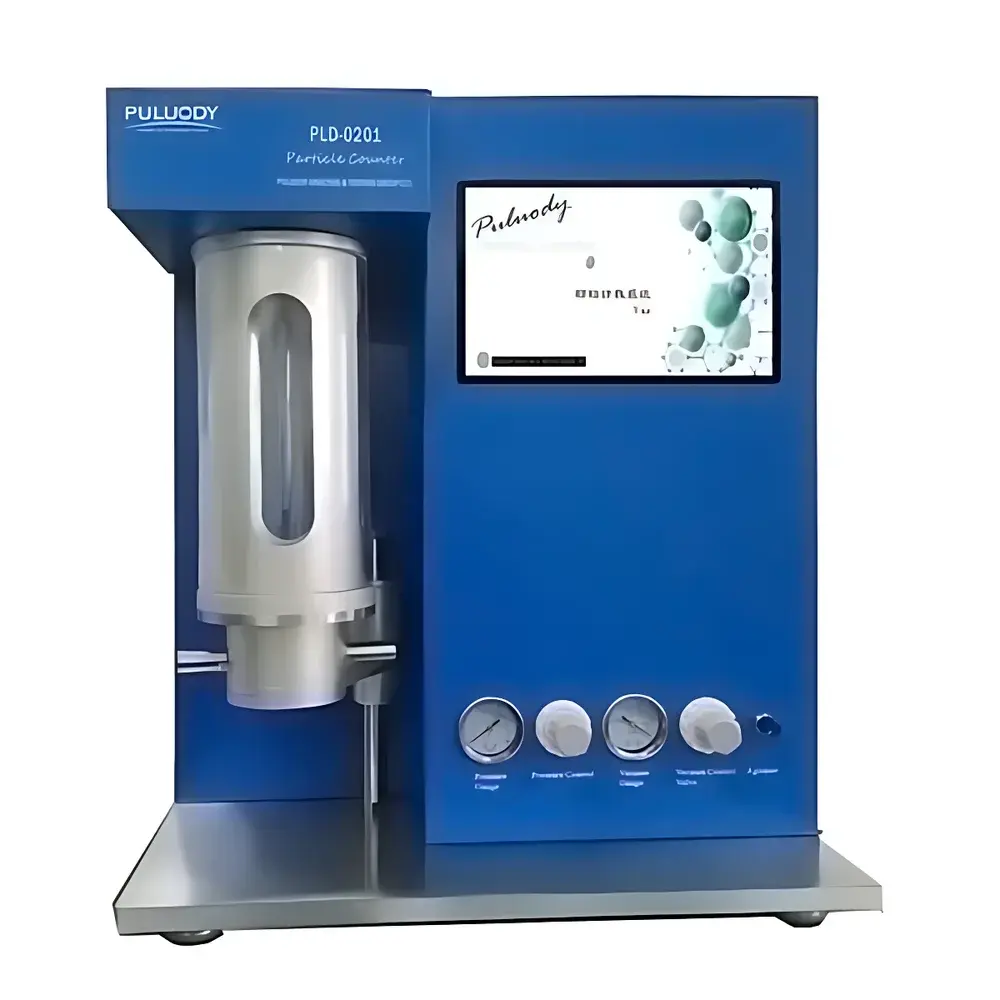
PULUODY PLD-0201-GT Optical Oil Particle Counter for Steel Mill Fluid Contamination Monitoring
| Brand | PULUODY |
|---|---|
| Origin | Shaanxi, China |
| Model | PLD-0201-GT |
| Instrument Type | Optical Particle Counter |
| Detection Principle | Light Obscuration (LO) |
| Calibration Standards | ISO 11171, ISO 4402, GB/T 18854 |
| Sensitivity | 1 µm (per ISO 4402), 4 µm(c) (per ISO 11171 & GB/T 18854) |
| Measurement Range | 1–1000 µm (sensor-dependent) |
| Channel Resolution | Up to 1000 user-configurable size channels |
| Sample Volume Accuracy | ±1% |
| Flow Control | Precision piston pump + electromagnetic flow regulation (5–60 mL/min) |
| Viscosity Handling | ≤450 mm²/s |
| Operating Temperature | Ambient to 65 °C |
| Pressure Range | −0.08 to 0.8 MPa (dual-polarity pre-treatment system) |
| Data Storage | 3000 tests onboard |
| Compliance | ASTM D6786, ISO 4406:2017, NAS 1638, DL/T 1096, GJB 420B, MOOG, ISO 11218 |
Overview
The PULUODY PLD-0201-GT Optical Oil Particle Counter is an industrial-grade, fully integrated particle contamination analyzer engineered specifically for continuous reliability assurance in steel mill hydraulic and lubrication systems. It operates on the internationally standardized light obscuration (LO) principle—where particles suspended in oil pass through a focused laser beam, generating transient signal pulses proportional to their cross-sectional area. This method delivers high reproducibility and traceable quantification of solid particulate contamination per ISO 4406:2017, NAS 1638, and GJB 420B. Designed for harsh metallurgical environments, the instrument features dual-polarity pressure conditioning (−0.08 to 0.8 MPa), automatic degassing, and in-situ homogenization—enabling robust measurement of high-viscosity oils (up to 450 mm²/s) without offline dilution or filtration. Its eighth-generation dual-laser narrow-beam sensor ensures stable baseline performance across extended operational cycles, critical for predictive maintenance programs in rolling mills, blast furnace control hydraulics, and continuous caster lubrication circuits.
Key Features
- Integrated dual-mode sample handling: automated degassing, magnetic stirring, and pressure-assisted aspiration ensure representative sampling from viscous, aerated, or sediment-prone fluids.
- Precision volumetric control via servo-regulated piston pump and electromagnetic flow valve—achieving ±1% accuracy over 1 mL to unlimited sample volumes, with programmable flow rates (5–60 mL/min).
- 1000-channel high-resolution pulse analysis engine supporting customizable binning from 1 µm to 1000 µm; optional 16/32/64-channel configurations available for compliance-driven workflows.
- Onboard industrial-grade embedded controller with 7-inch color TFT touchscreen, full QWERTY keyboard support, and real-time histogram visualization.
- Self-cleaning fluidic pathway with programmable rinse cycle (10–100 mL/min) and residual solvent purge—minimizing carryover between samples and reducing operator intervention.
- Traceable calibration architecture compliant with ISO 11171:2010 and GB/T 18854–2002; supports certified reference materials (GBW series) and third-party verification via CAAC Particle Metrology Station or NWMS National Metrology Center.
Sample Compatibility & Compliance
The PLD-0201-GT is validated for direct analysis of undiluted industrial oils including hydraulic fluids (ISO L-HM, L-HV), gear oils (L-CKD), turbine oils (L-TSA, L-TGA), transformer insulating oils, and water-glycol emulsions. It accommodates samples at temperatures from ambient to 65 °C and tolerates entrained air and microbubbles via its negative-pressure deaeration module. Regulatory alignment includes full support for ISO 4406:2017 (code-based reporting), NAS 1638 Class 00–12, GJB 420B Levels 000–12, and DL/T 1096 for power plant oil monitoring. The system satisfies GLP data integrity requirements through audit-trail-enabled firmware, time-stamped test logs, and electronic signature-capable software (P6.4 Analysis Suite). Optional 21 CFR Part 11 compliance packages are available for pharmaceutical-grade hydraulic system validation.
Software & Data Management
The instrument ships with P6.4 Analysis Software (integrated embedded version + Windows PC edition), enabling granular post-acquisition analysis—including differential distribution curves, cumulative counts, beta-ratio calculations (βₓ), and multi-sample trend overlays. All raw pulse data and metadata (flow rate, temperature, pressure, calibration ID) are stored in structured CSV and XML formats. On-device storage retains up to 3000 complete test records with full parameter snapshots; external PC connectivity via RS232 allows centralized database integration using SQL-compatible import tools. Custom report templates conform to internal QA protocols or external standards such as ISO 55001 asset management frameworks. Firmware updates and method templates are distributed via encrypted USB key or authenticated FTP.
Applications
This particle counter serves as a frontline diagnostic tool across steel production infrastructure: monitoring cleanliness of hydraulic control fluids in hot-strip mill AGC systems; verifying filter efficiency in continuous caster mold lubrication loops; validating oil condition prior to turbine gearbox commissioning; and auditing contamination ingress in blast furnace stave cooling circuits. It is equally deployed in upstream supplier qualification (e.g., OEM hydraulic component vendors), in-process lubricant reclamation verification, and root-cause analysis of bearing wear debris patterns. Beyond ferrous metallurgy, it meets specification requirements for aerospace ground support equipment (GSE), marine propulsion hydraulics, and nuclear plant auxiliary lubrication systems where ISO 4406 Code ≥16 is mandated.
FAQ
Does the PLD-0201-GT require sample dilution or pre-filtration before testing?
No—its integrated pressure conditioning and high-viscosity flow path enable direct analysis of undiluted oils up to 450 mm²/s without manual preparation.
Can the instrument generate ISO 4406:2017 and NAS 1638 codes automatically?
Yes—real-time code assignment is performed onboard based on particle counts per specified size thresholds (e.g., ≥4 µm(c) and ≥6 µm(c)), with configurable rounding rules.
Is third-party calibration certification available?
Yes—customers may request accredited calibration reports issued by the China Aviation Industry Particle Metrology Station or the National Northwest Metrology Testing Center, traceable to SI units.
What maintenance intervals are recommended for routine operation?
Daily: fluidic path rinse and optical window inspection; quarterly: sensor alignment verification and pump seal check; annually: full metrological recalibration using GBW-certified reference suspensions.
How does the system handle air bubbles or water droplets in oil samples?
The dual-polarity pressure module actively removes free and entrained air; water-in-oil emulsions <5% v/v are tolerated but may require method-specific threshold adjustment to avoid misclassification.



