
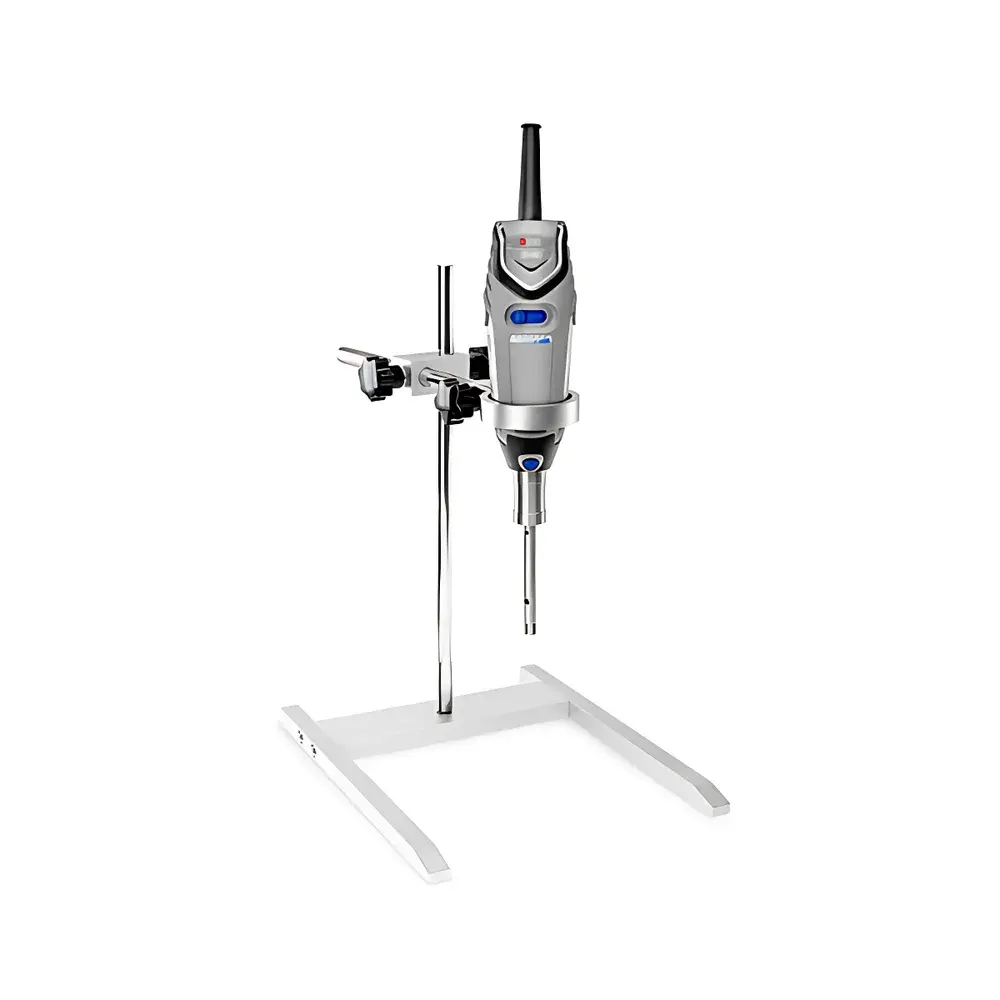
DLAB D-160 Handheld High-Shear Homogenizer
| Brand | DLAB |
|---|---|
| Origin | Beijing, China |
| Manufacturer Type | Direct Manufacturer |
| Product Category | Domestic |
| Model | D-160 |
| Instrument Type | Probe-type Rotor-Stator Homogenizer |
| Dimensions (W×D×H) | 46 × 55 × 230 mm |
| Processing Volume Range | 0.1–50 mL (with DS-160/5 probe) |
| Rated Voltage | 200–240 V / 50–60 Hz |
| Input/Output Power | 160 W |
| Speed Range | 8,000–30,000 rpm |
| Rotor Tip Speed | 6.3–14 m/s |
| Speed Control | 6-step mechanical dial |
| Max. Viscosity | 5,000 mPa·s |
| Wetted Materials | 316L stainless steel & PTFE |
| Weight | 0.6 kg |
| Sound Pressure Level | 72 dB(A) |
| Operating Ambient | 0–40 °C, ≤85% RH |
| Duty Cycle | Continuous (100%) |
| IP Rating | IP30 |
| Compliance | CE-marked per EN 61000-6-2/6-4, EN 61000-3-2/3-3 |
Overview
The DLAB D-160 Handheld High-Shear Homogenizer is an engineered solution for rapid, reproducible sample homogenization, dispersion, and emulsification in laboratory-scale applications. Based on the rotor-stator principle, it generates intense hydrodynamic shear forces within a narrow clearance between a rotating probe tip and a stationary sleeve—effectively disrupting cellular structures, deagglomerating nanoparticles, and stabilizing immiscible phases. Unlike ultrasonic or bead-based methods, this mechanical approach delivers consistent energy input without cavitation-induced sample heating or nucleic acid degradation, making it particularly suitable for sensitive biological matrices such as mammalian tissues (e.g., liver, muscle, mammary gland), microbial cultures, and plant extracts. Its compact form factor and ergonomic design support direct handheld operation during time-critical protocols, while maintaining compatibility with standard benchtop workflows via optional H370 support stands.
Key Features
- High-performance brushless motor delivering stable rotational speeds from 8,000 to 30,000 rpm with minimal thermal drift
- Interchangeable precision-machined rotor-stator probes: DS-160/5 (0.1–50 mL) and DS-160/10 (1–250 mL), both constructed entirely from electropolished 316L stainless steel and PTFE-sealed components
- Tool-free probe attachment/detachment mechanism enabling rapid cleaning, sterilization (autoclavable at 121 °C, 2 bar), and cross-contamination control
- Six-step mechanical speed selector offering repeatable setpoints without electronic calibration drift
- Robust IP30-rated housing designed for routine use in ISO Class 5–8 cleanrooms and GLP-compliant analytical laboratories
- Low acoustic emission profile (72 dB(A)) compatible with open-bench environments and shared core facilities
Sample Compatibility & Compliance
The D-160 accommodates diverse sample types including soft animal tissues, suspension-cultured cells, viscous polymer solutions (up to 5,000 mPa·s), oil-in-water emulsions, and colloidal nanomaterial dispersions. All wetted surfaces comply with USP Class VI biocompatibility standards and FDA 21 CFR 177.1550 for repeated food-contact use. The device meets essential requirements of the EU Machinery Directive 2006/42/EC and Electromagnetic Compatibility Directive 2014/30/EU, certified under EN 61000-6-2 (immunity) and EN 61000-6-4 (emission). It supports audit-ready documentation workflows aligned with ISO/IEC 17025:2017 and ASTM E2500-13 for instrument qualification.
Software & Data Management
As a manually operated analog instrument, the D-160 does not incorporate embedded firmware or digital connectivity. This architecture eliminates software validation overhead and ensures deterministic performance across regulatory environments requiring strict separation of instrumentation and data systems. Users maintain full traceability through manual logbook entries or integration with validated LIMS platforms via external timing devices and calibrated volume dispensers. Speed settings are physically indexed and mechanically locked, preventing inadvertent parameter changes during GxP operations.
Applications
- Pre-analytical tissue homogenization for downstream DNA/RNA extraction, protein solubilization, and metabolite profiling
- Rapid formulation development of nanoemulsions and liposomal carriers in pharmaceutical R&D
- Dispersion stabilization of carbon nanotubes, graphene oxide, and metal oxide nanoparticles for materials characterization
- Emulsion preparation in cosmetic science (e.g., silicone-in-water systems) and dairy research (microfluidized milk analogs)
- Cell lysis optimization for monoclonal antibody production and CRISPR-Cas9 editing workflows
- Environmental sample processing—including soil slurry homogenization and microplastic suspension standardization
FAQ
What is the maximum recommended operating time per cycle?
Continuous operation is permitted; however, for samples exceeding 25 °C initial temperature or viscosity >2,000 mPa·s, intermittent duty (e.g., 30 s ON / 15 s OFF) is advised to limit thermal accumulation.
Can the D-160 be used under sterile conditions?
Yes—both DS-160/5 and DS-160/10 probes are fully autoclavable (121 °C, 20 min, saturated steam), and the main unit housing resists disinfectant wiping with 70% ethanol or 0.5% sodium hypochlorite.
Is calibration required prior to use?
No formal calibration is mandated; speed accuracy is maintained by factory-set gear ratios and verified during CE conformity testing per EN 61000-6-2 Annex A.
How does the D-160 compare to ultrasonic homogenizers for nucleic acid integrity?
Rotor-stator homogenization avoids cavitation-induced shearing of high-MW DNA, resulting in higher yield and integrity scores in Qubit and Bioanalyzer assessments compared to sonication-based methods.
Does DLAB provide IQ/OQ documentation templates?
Yes—validated installation and operational qualification templates compliant with ASTM E2500-13 are available upon request for regulated users in pharmaceutical and clinical diagnostics settings.



