
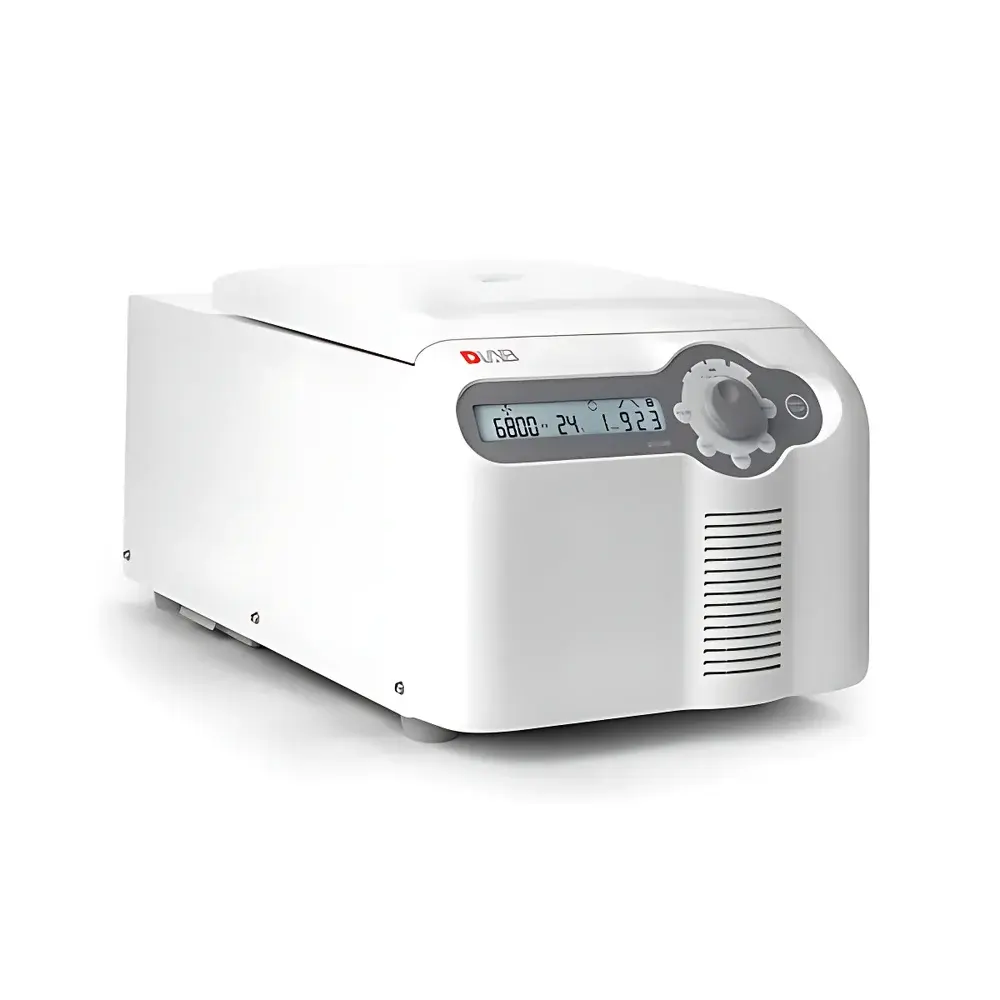
DLAB D1524R High-Speed Refrigerated Microcentrifuge
| Brand | DLAB |
|---|---|
| Origin | Beijing, China |
| Manufacturer Type | Direct Manufacturer |
| Instrument Type | Benchtop Centrifuge |
| Speed Range | 200–15,000 rpm (adjustable in 100-rpm increments) |
| Max RCF | 21,380 × g (adjustable in 10 × g increments) |
| Capacity | 5 mL × 18 |
| Temperature Range | −20 °C to +40 °C |
| Acceleration/Deceleration | 9 programmable ramp profiles each |
| Dimensions (W × D × H) | 332 mm × 553 mm × 283 mm |
| Weight | 30 kg |
| Power Supply | 200–240 V, 50 Hz, 500 W |
| Noise Level | < 56 dB(A) |
| Sterilization Compatibility | Rotor withstands 121 °C autoclaving |
| Safety Features | Dual interlocked door locks, overspeed protection, overtemperature cutoff, real-time diagnostic monitoring |
| Compliance | Designed for GLP-compliant laboratories |
Overview
The DLAB D1524R is a high-performance benchtop refrigerated microcentrifuge engineered for precision separation of small-volume biological samples under controlled thermal conditions. Utilizing a brushless DC motor and optimized aerodynamic rotor chamber design, it delivers stable rotational dynamics across its full speed range (200–15,000 rpm), generating up to 21,380 × g relative centrifugal force (RCF). Its integrated compressor-based cooling system maintains setpoint temperature stability within ±1 °C across the operational range (−20 °C to +40 °C), with rapid thermal equilibration—achieving 4 °C from ambient in under 7 minutes. The unit complies with IEC 61010-1 safety standards for laboratory electrical equipment and incorporates hardware-level safeguards including dual mechanical door interlocks, real-time imbalance detection, and automatic shutdown upon fault condition recognition.
Key Features
- Brushless DC motor ensures low maintenance, extended service life, and consistent torque delivery at all speeds.
- Static refrigeration architecture activates compression only when lid is closed and set temperature is below ambient—minimizing energy use and thermal cycling stress on samples.
- Triple-sealed aluminum rotor assembly provides biosafety containment per WHO BSL-2 guidelines and withstands full-cycle autoclaving at 121 °C for 20 minutes without degradation.
- Nine-step acceleration and deceleration profiles allow fine-tuned control over sedimentation kinetics—critical for pelleting fragile organelles or preserving nucleic acid integrity during spin-down.
- Intuitive interface supports nine user-programmable protocols with persistent memory; displays real-time rpm, RCF, time remaining, temperature, and run progress.
- Acoustic alert signals completion of run; optional hold mode enables continuous operation for extended protocols such as density gradient equilibration.
- External condensate collection tray prevents moisture accumulation inside the centrifuge chamber—reducing corrosion risk and eliminating manual wipe-down steps.
- Dynamic imbalance detection triggers audible/visual alerts and halts rotation if mass asymmetry exceeds 0.5 g per tube position, ensuring mechanical integrity and sample reproducibility.
Sample Compatibility & Compliance
The D1524R accommodates standard microcentrifuge formats including 0.2 mL, 0.5 mL, 1.5 mL, 2 mL, and 5 mL conical tubes, as well as PCR strip tubes (8-well format, 4 positions). Its rotor geometry supports both fixed-angle and swing-out configurations (five rotor options available separately), enabling optimization for differential centrifugation, viral pellet recovery, or RNA/DNA precipitation workflows. All rotors are certified to ISO 15195:2019 for calibration traceability and validated for compliance with ASTM F2623-20 (centrifuge performance verification). The instrument’s firmware architecture supports electronic record generation suitable for FDA 21 CFR Part 11–aligned environments when paired with compliant LIMS integration.
Software & Data Management
While the D1524R operates via embedded standalone controller, its RS-232 serial port enables external logging and remote parameter adjustment using third-party laboratory automation platforms. Timestamped run logs—including start/stop time, final speed, achieved RCF, average temperature, and error codes—are stored internally for up to 100 cycles and exportable via ASCII text dump. Audit trail functionality records all parameter changes, user logins (via optional password-enabled access), and system diagnostics—supporting GLP/GMP documentation requirements and internal quality review processes.
Applications
- Purification of plasmid DNA, genomic DNA, and total RNA from bacterial, mammalian, and plant lysates.
- Clarification of cell lysates prior to chromatographic analysis or enzymatic assays.
- Concentration and recovery of exosomes, microvesicles, and extracellular nanoparticles.
- Preparative isolation of mitochondria, nuclei, and synaptic vesicles using differential centrifugation schemes.
- Routine processing of clinical specimens including serum, plasma, CSF, and PBMC suspensions under CLIA-certified temperature-controlled conditions.
- High-throughput sample preparation for NGS library construction where thermal stability and RCF consistency directly impact adapter ligation efficiency.
FAQ
What is the maximum allowable imbalance tolerance before automatic shutdown?
The system detects mass asymmetry exceeding ±0.5 g per tube position and initiates immediate deceleration and lockout.
Can the D1524R be used for continuous operation (e.g., overnight runs)?
Yes—HOLD mode permits indefinite runtime; however, sustained operation above 10,000 rpm at sub-zero temperatures requires periodic compressor duty cycle monitoring per local HVAC specifications.
Is rotor calibration required prior to first use?
No—factory-calibrated rotors ship with NIST-traceable certificates; users must verify rotor identification code against displayed model number during installation.
Does the unit support temperature ramping during a run?
No—temperature is held constant throughout the run; stepwise thermal transitions require sequential program execution.
How often should the condensate tray be emptied?
Under typical lab conditions (25 °C / 50% RH), emptying every 5–7 days suffices; frequency increases proportionally with ambient humidity and low-temperature usage duration.



