
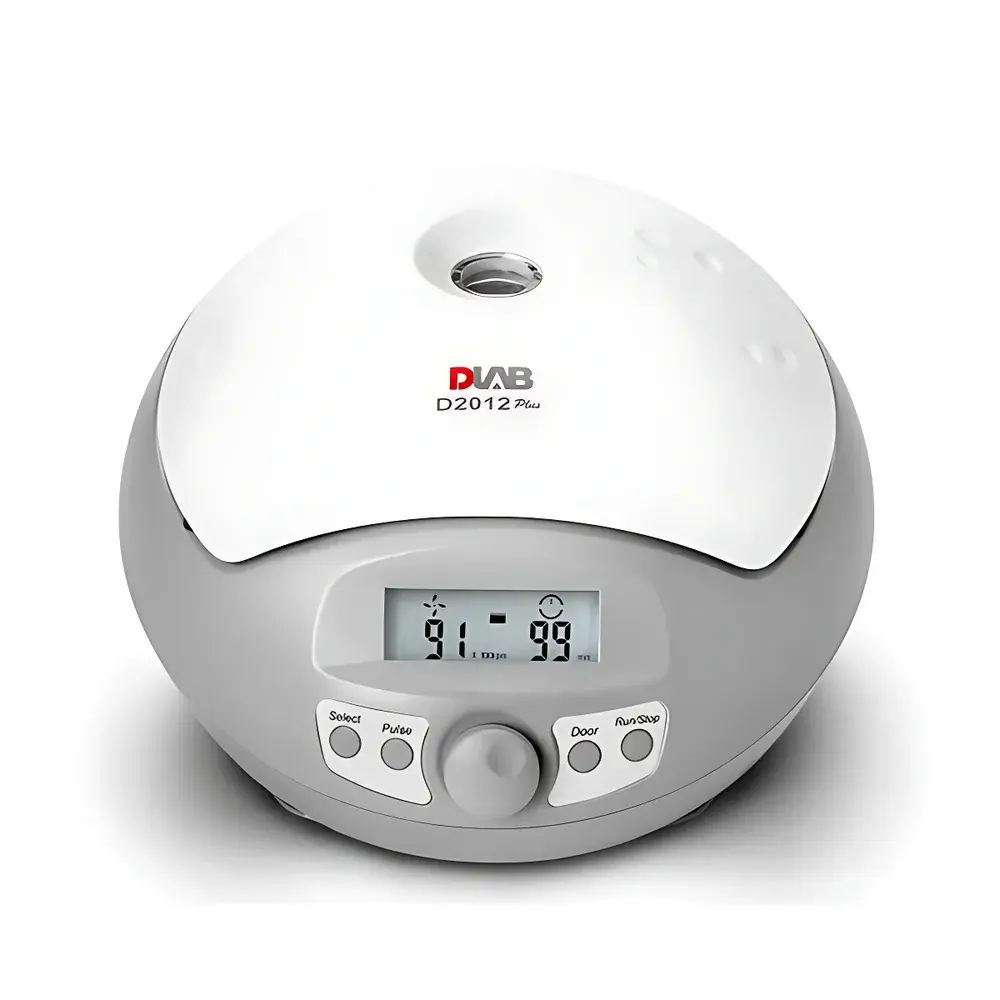
DLAB D2012plus Benchtop High-Speed Microcentrifuge
| Brand | DLAB |
|---|---|
| Origin | Beijing, China |
| Manufacturer | DLAB Scientific Instrument Co., Ltd. |
| Type | Benchtop Centrifuge |
| Speed Range | 500–15,000 rpm (adjustable in 100-rpm increments) |
| Max RCF | 15,100 × g (adjustable in 100 × g increments) |
| Capacity | 12 × 2 mL tubes (compatible with 0.2 mL, 0.5 mL, 1.5 mL, and 2 mL microtubes) |
| Rotor Material | High-strength A12-2P polymer |
| Acceleration/Deceleration | 11 s to max speed / 9 s to stop |
| Timer Range | 30 s – 99 min or HOLD mode |
| Power Supply | AC 100–240 V, 50/60 Hz, 100 W |
| Dimensions (L×D×H) | 255 × 245 × 140 mm |
| Weight | 6 kg |
| Safety Features | Lid interlock, overspeed protection, overtemperature monitoring, real-time system diagnostics |
| Additional Functions | rpm/RCF conversion, soft-start/short-spin mode, progress bar display, audible end-of-run alert |
| Compliance | Designed for GLP-compliant laboratories |
Overview
The DLAB D2012plus is a compact, high-performance benchtop microcentrifuge engineered for precision separation of small-volume biological samples in demanding research, clinical, and quality control environments. Utilizing a brushless DC motor architecture, it delivers stable rotational dynamics across its full operating range (500–15,000 rpm), generating up to 15,100 × g relative centrifugal force—sufficient for pelleting nucleic acids, cellular organelles, bacteria, and precipitated proteins from volumes as low as 0.2 mL. Its optimized mechanical design centers mass distribution within a low-profile cast iron base, minimizing vibration and ensuring operational stability even at maximum speed. The unit operates independently of input voltage fluctuations due to integrated wide-range AC power regulation (100–240 V, 50/60 Hz), maintaining consistent rotational accuracy under variable lab power conditions.
Key Features
- Brushless DC motor: Eliminates carbon brush wear, enabling maintenance-free operation over extended service life and delivering rapid acceleration (0–15,000 rpm in 11 s) and controlled deceleration (15,000 rpm to rest in 9 s).
- A12-2P polymer rotor: Lightweight yet mechanically robust, certified for continuous use at rated speeds; accommodates standard microtube formats (0.2 mL, 0.5 mL, 1.5 mL, and 2 mL) in a single 12-position configuration without adapter changes.
- Dual-stage mechanical safety: Integrated lid interlock prevents operation with the chamber open; reinforced base with vacuum suction feet provides secondary stabilization on smooth surfaces, reducing lateral displacement during high-speed runs.
- Precision control interface: Digital display with intuitive navigation supports direct rpm or RCF input, real-time run progression visualization, programmable timer (30 s–99 min), and HOLD mode for indefinite operation.
- Comprehensive safety monitoring: Embedded sensors continuously track rotor speed, motor temperature, and drive current; automatic shutdown triggers upon detection of overspeed, thermal anomaly, or lid failure.
Sample Compatibility & Compliance
The D2012plus accepts standard conical-bottom microcentrifuge tubes (polypropylene or polyethylene) conforming to ISO 7218 and ASTM D4169 specifications. Its rotor geometry ensures uniform radial distribution and minimal tube deformation during high-g loading. The device complies with IEC 61010-1:2010 for electrical safety in laboratory instrumentation and is suitable for use in ISO/IEC 17025-accredited testing laboratories. While not inherently 21 CFR Part 11 compliant, audit-ready operation is supported through manual logbook documentation of run parameters, operator ID, date/time stamps, and outcome verification—consistent with GLP/GMP-aligned workflows where electronic signatures are not mandated.
Software & Data Management
The D2012plus operates as a standalone instrument with no embedded firmware-based data logging or network connectivity. All operational parameters—including setpoint rpm/RCF, elapsed time, and final status—are displayed in real time and retained only during active use. For traceability, users are advised to record settings manually or integrate the unit into external LIMS via timestamped procedural documentation. Its simple command structure (rotor identification, speed selection, duration entry) minimizes training overhead and reduces risk of parameter misentry—a critical consideration in regulated QC/QA labs handling biospecimens or reference standards.
Applications
- Routine nucleic acid purification: Rapid pelleting of silica-membrane spin columns and ethanol-precipitated DNA/RNA.
- Cellular fractionation: Separation of cytoplasmic lysates from nuclear debris in sub-100 µL volumes.
- Clinical diagnostics: Concentration of serum analytes, exosomes, or viral particles prior to ELISA, PCR, or TEM analysis.
- Pharmaceutical QA: Recovery of precipitated active pharmaceutical ingredients (APIs) from small-scale formulation trials.
- Educational laboratories: Demonstrating sedimentation kinetics and rotor dynamics principles under controlled, low-footprint conditions.
FAQ
What tube sizes does the D2012plus support without adapters?
It accommodates 0.2 mL, 0.5 mL, 1.5 mL, and 2 mL microcentrifuge tubes directly in its fixed-angle rotor—no additional accessories required.
Is the rotor autoclavable?
No—the A12-2P polymer rotor is not rated for steam sterilization; cleaning is recommended with 70% ethanol or isopropanol followed by air drying.
Can the centrifuge be used in cold rooms?
Yes, provided ambient temperature remains between 5 °C and 40 °C and relative humidity does not exceed 80% non-condensing, per IEC 61010-1 environmental classification.
Does it meet international electromagnetic compatibility (EMC) standards?
Yes—it conforms to IEC 61326-1:2013 for EMC requirements in laboratory measurement and test equipment.
What maintenance is required beyond routine cleaning?
None—the brushless motor and sealed rotor bearing assembly require no scheduled lubrication or calibration; periodic visual inspection of lid seal integrity and suction foot adhesion is recommended.



