
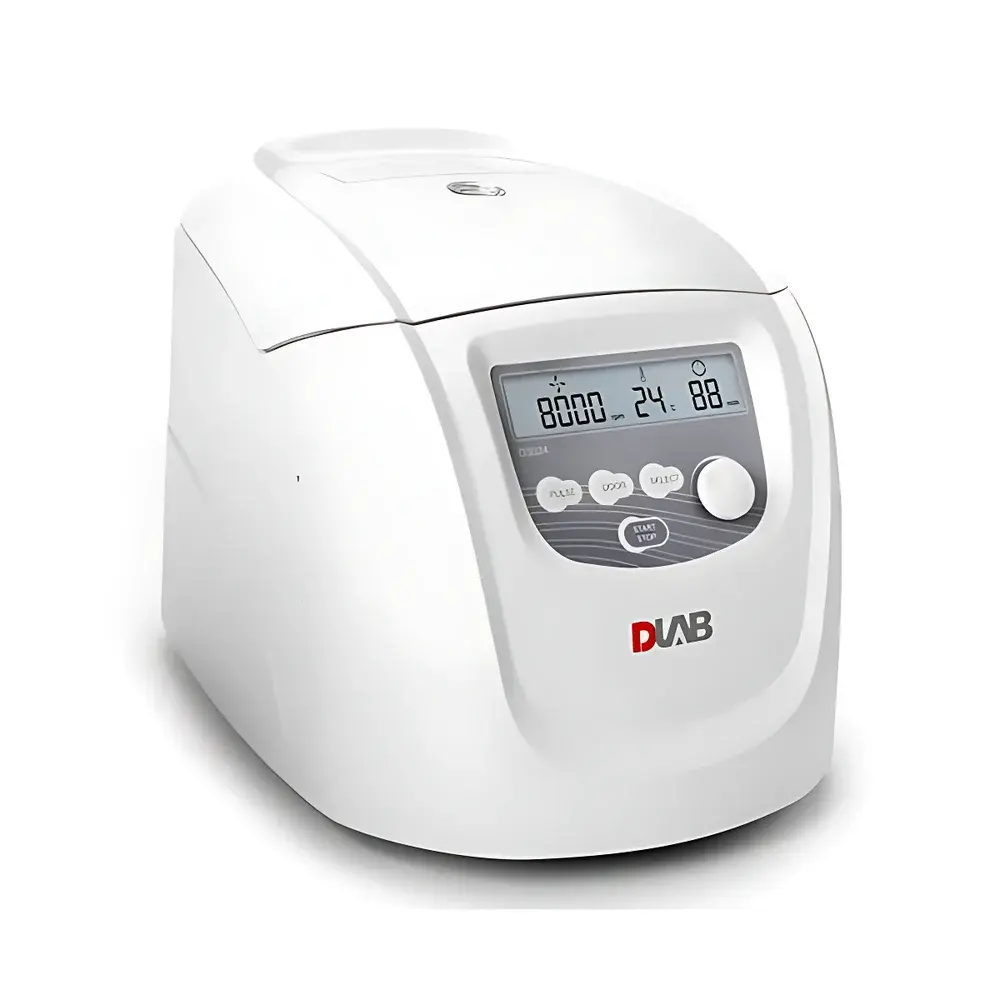
DLAB D3024 Benchtop High-Speed Microcentrifuge
| Brand | DLAB |
|---|---|
| Origin | Beijing, China |
| Manufacturer Type | Original Equipment Manufacturer (OEM) |
| Product Category | Domestic |
| Model | D3024 |
| Instrument Type | Benchtop Centrifuge |
| Speed Class | High-Speed Centrifuge (10,000–30,000 rpm) |
| Cooling Function | Refrigerated Centrifuge |
| Configuration Type | Fixed-Angle Rotor Centrifuge |
| Maximum Capacity | 0.5 mL × 36 |
| Maximum Speed | 15,000 rpm |
| Maximum RCF | 21,380 × g |
| Dimensions (L×W×H) | 280 mm × 364 mm × 266 mm |
| Weight | 12 kg |
| Power Supply | AC 220–240 V, 50/60 Hz, 5 A or AC 100–120 V, 50/60 Hz, 8 A |
| Power Consumption | 200 W |
| Noise Level | ≤64 dB(A) |
| Acceleration/Deceleration Time | 25 s / 25 s |
| Speed Increment | 10 rpm |
| RCF Increment | 10 × g |
| Speed Accuracy | ±20 rpm |
| Temperature Display | Yes |
| Timer Range | 30 s to 99 min, HOLD mode |
| Rotor Compatibility | 5 fixed-angle rotors |
Overview
The DLAB D3024 Benchtop High-Speed Microcentrifuge is an engineered solution for rapid, precise, and safe separation of small-volume biological samples in research, clinical diagnostics, and quality control laboratories. Designed around the principles of fixed-angle centrifugation—where sample tubes are held at a fixed angle (typically 45°) relative to the rotor axis—the instrument generates high radial acceleration to sediment particles based on size, density, and shape. With a maximum rotational speed of 15,000 rpm and a peak relative centrifugal force (RCF) of 21,380 × g, the D3024 delivers reproducible pelleting of nucleic acids, proteins, cellular organelles, and microorganisms from volumes as low as 0.2 mL. Its compact footprint (280 × 364 × 266 mm), integrated refrigeration system, and dual-fan cooling architecture enable stable thermal management during extended runs—critical for preserving thermolabile biomolecules such as RNA or enzymes.
Key Features
- Fixed-angle rotor design optimized for rapid pelleting of microliter-scale samples in standard microtubes and PCR strips.
- Dual-fan active cooling system maintains consistent chamber temperature during operation, minimizing rotor thermal drift and ensuring sample integrity.
- Triple-sealed rotor housing prevents aerosol leakage and cross-contamination—validated for biosafety compliance in BSL-2 environments.
- High-strength anodized aluminum rotor certified for repeated autoclaving at 121°C, 15 psi for 20 minutes—ensuring long-term sterility and mechanical reliability.
- Intuitive rotary knob interface enables tactile, one-handed parameter entry (speed, time, temperature) without menu navigation delays.
- Comprehensive safety architecture includes dual interlocked lid mechanisms, overspeed detection, real-time rotor temperature monitoring, dynamic imbalance sensing, and automatic shutdown under fault conditions.
- Programmable countdown initiation: centrifugation begins only after reaching the target speed—eliminating transient acceleration artifacts in sensitive assays.
- Brushless DC motor provides maintenance-free operation, rapid acceleration/deceleration (25 s each), and high torque consistency across the full speed range.
- LCD display shows real-time values for speed (rpm), RCF (× g), elapsed/remaining time, and chamber temperature—with unit conversion between rpm and RCF.
Sample Compatibility & Compliance
The D3024 supports five interchangeable fixed-angle rotors, each validated for specific tube formats. When used with optional adapters, it accommodates 0.2 mL, 0.5 mL, 1.5 mL, 2 mL, and 5 mL conical or round-bottom microcentrifuge tubes, as well as standard 8-strip PCR plates. All rotors conform to ISO 15195:2018 (requirements for centrifuge rotors) and undergo static and dynamic balance certification per ISO 21501-4. The sealed rotor assembly meets EN 61010-1:2010 safety standards for laboratory electrical equipment. While not a medical device per FDA 21 CFR Part 820, its design supports GLP-compliant workflows when paired with audit-trail-capable LIMS integration via optional RS-232 or USB data export.
Software & Data Management
The D3024 operates independently without proprietary software but supports traceable operation through its embedded timer, speed logging, and audible end-of-run alerts. Optional firmware updates (via USB flash drive) may introduce enhanced calibration routines or expanded rotor ID recognition. For regulated environments, users can document run parameters manually or integrate the centrifuge into electronic lab notebooks (ELNs) using timestamped screen captures or exported CSV logs (when connected to external data loggers). All operational states—including door status, error codes, and thermal history—are retained in non-volatile memory for post-run diagnostics.
Applications
- Routine nucleic acid purification (plasmid DNA, genomic DNA, RNA) from bacterial lysates or tissue homogenates.
- Protein precipitation and clarification prior to SDS-PAGE or mass spectrometry analysis.
- Microbial pelleting for colony isolation, antibiotic susceptibility testing, or downstream PCR amplification.
- Preparative centrifugation of exosomes and extracellular vesicles using differential ultracentrifugation protocols (as part of multi-step workflows).
- High-throughput sample preparation in molecular diagnostics labs handling patient-derived specimens under CLIA or CAP-aligned SOPs.
- Quality assurance testing of reagents, vaccines, or biologics requiring particulate removal and stability assessment.
FAQ
Is the D3024 compliant with international safety and electromagnetic compatibility standards?
Yes—the instrument conforms to IEC 61010-1:2010 for laboratory equipment safety and IEC 61326-1:2013 for EMC requirements in industrial and laboratory environments.
Can the centrifuge be operated without refrigeration?
Yes; the cooling system is user-selectable and can be disabled for ambient-temperature runs, though continuous high-speed operation (>12,000 rpm) is recommended with active cooling enabled.
What is the maximum allowable imbalance tolerance for safe operation?
The imbalance detection threshold is calibrated to ≤0.5 g difference between opposing tube positions—consistent with ISO 21501-4 Annex C for microcentrifuge rotors.
Are rotor lifetime and maintenance intervals documented?
Each rotor carries a serialized identification tag with a manufacturer-specified service life (≥500 autoclave cycles or 10,000 runs); no scheduled lubrication is required due to the brushless motor and sealed bearing design.
Does the D3024 support remote monitoring or network connectivity?
No native Ethernet or Wi-Fi capability is included; however, analog voltage outputs (0–5 V) for speed and temperature signals are available upon request for third-party SCADA integration.



