
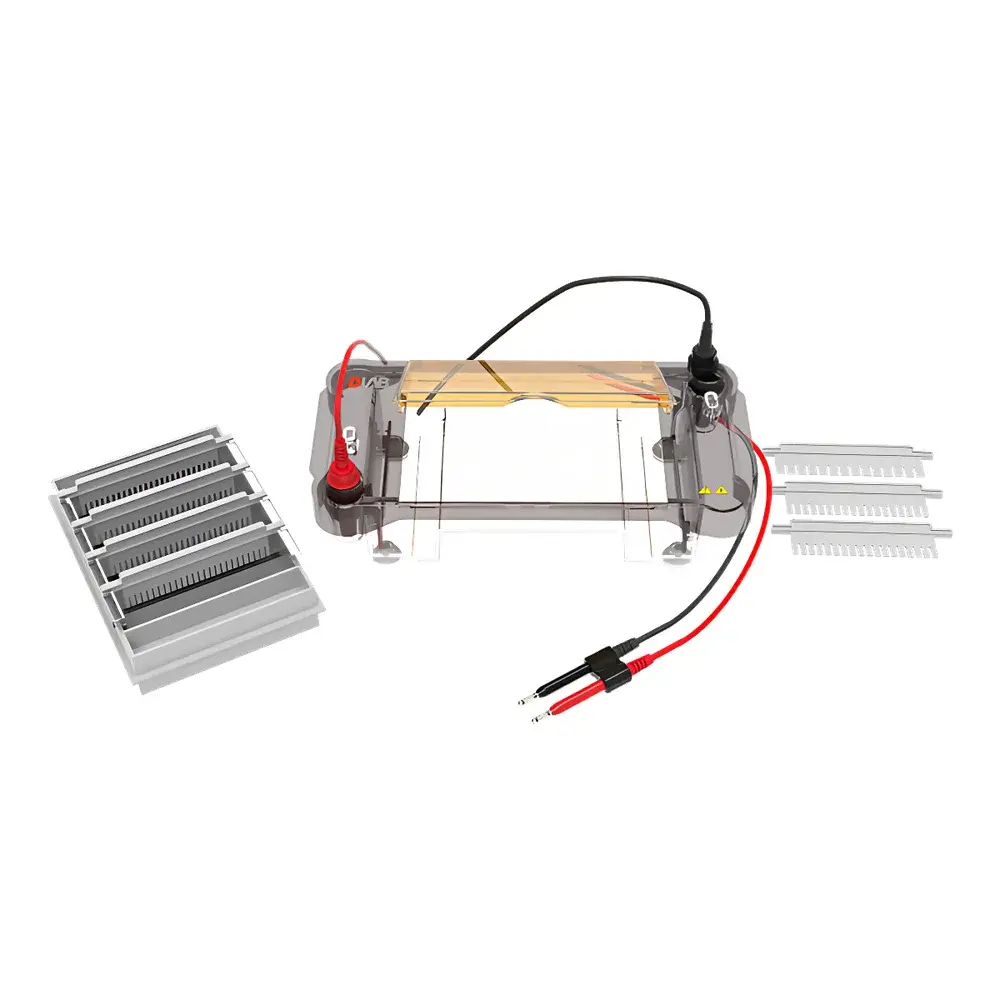
DLAB DL-SUB03 Multi-Function Horizontal Electrophoresis Cell
| Brand | DLAB |
|---|---|
| Origin | Beijing, China |
| Manufacturer Type | Original Equipment Manufacturer (OEM) |
| Product Origin | Domestic (China) |
| Model | DL-SUB03 |
| Pricing | Available Upon Request |
| Gel Tray Dimensions (W×L) | 13×20 cm and 13×15 cm |
| Comb Options | 1.0 mm thickness with 14/18/26 teeth |
| Buffer Volume Capacity | 800 mL |
| Overall Dimensions (L×W×H) | 340 × 170 × 130 mm |
| Weight | 0.94 kg |
| Electrode Material | 99.99% Pure Platinum |
| Construction Material | High-Impact Polycarbonate |
| Lid Design | Blue-Light-Shielding Flip Cover with Ventilation Aperture |
| Leveling Mechanism | Adjustable Bottom-Leveling Screws |
| Tray Orientation | Reversible Gel Casting Tray |
| Visual Aid | Integrated Background Strips on Tray Base |
Overview
The DLAB DL-SUB03 Multi-Function Horizontal Electrophoresis Cell is a precision-engineered platform for nucleic acid separation and molecular weight estimation under standard agarose or polyacrylamide gel electrophoresis (AGE/PAGE) conditions. Designed in accordance with fundamental electrokinetic principles—where charged biomolecules migrate through a porous matrix under an applied electric field—the DL-SUB03 delivers consistent, reproducible migration patterns essential for qualitative and semi-quantitative analysis of DNA fragments. Its horizontal configuration enables uniform buffer distribution and minimizes edge effects during electrophoresis, supporting reliable band resolution across the full gel surface. The system operates within conventional laboratory power supply ranges (typically 50–200 V DC), compatible with widely deployed constant-voltage or constant-current power supplies used in academic, clinical, and quality control laboratories.
Key Features
- High-Integrity Polycarbonate Construction: Molded from medical-grade, UV-stabilized polycarbonate, the chamber exhibits exceptional impact resistance, chemical inertness to common electrophoresis buffers (e.g., TAE, TBE), and zero leakage under static and dynamic buffer loading conditions.
- Optimized Thermal Management: The blue-light-shielding flip lid incorporates engineered ventilation apertures that facilitate passive heat dissipation during extended runs, reducing thermal gradient formation across the gel and mitigating band distortion.
- Dual-Gel Format Flexibility: Interchangeable gel trays support two standardized dimensions—13 × 20 cm (standard resolution) and 13 × 15 cm (high-throughput screening)—enabling method adaptation without hardware replacement.
- Precision Leveling System: Three-point adjustable leveling screws at the base allow fine-tuning of tray horizontality to ±0.2°, ensuring uniform electric field vector alignment and minimizing differential migration artifacts.
- Reversible Gel Casting Tray: Symmetrical tray design permits front-to-back orientation reversal, optimizing benchtop space utilization and facilitating integration into automated gel documentation workflows.
- Ultra-High-Purity Platinum Electrodes: 99.99% pure platinum wire electrodes provide stable, low-resistance current conduction with negligible polarization over repeated use cycles, sustaining consistent field strength and minimizing electrolysis byproducts.
Sample Compatibility & Compliance
The DL-SUB03 accommodates standard agarose concentrations (0.7–2.0%) and native/denaturing polyacrylamide gels (3–20% T). It supports routine applications including PCR product verification, restriction digest analysis, plasmid profiling, and RNA integrity assessment. All materials comply with ISO 10993-5 (biological evaluation of medical devices — cytotoxicity testing) and meet RoHS Directive 2011/65/EU requirements for hazardous substance restrictions. While not certified for GMP manufacturing environments per se, its design facilitates adherence to GLP documentation practices—including traceable electrode calibration logs and buffer batch records—commonly required in regulated life science research settings.
Software & Data Management
As a standalone electrophoresis cell, the DL-SUB03 does not incorporate embedded firmware or digital connectivity. However, it is fully interoperable with third-party gel documentation systems (e.g., Bio-Rad ChemiDoc, Azure Biosystems cSeries, UVP VisionWorks) via standardized tray footprint and optical clarity specifications. Its background-striped tray base enhances contrast for downstream image acquisition, improving signal-to-noise ratio in densitometric quantification. When integrated into validated laboratory workflows, users may apply audit-trail-enabled imaging software compliant with FDA 21 CFR Part 11 requirements for electronic record retention.
Applications
- Verification of PCR amplification products and cloning constructs
- Analysis of restriction enzyme digestion patterns for genotyping and plasmid mapping
- Assessment of DNA fragmentation in apoptosis or nuclease activity assays
- Quality control of synthetic oligonucleotides and next-generation sequencing libraries
- Educational demonstrations of electrophoretic mobility, charge-to-mass ratio dependence, and molecular sieving behavior
FAQ
What buffer volumes are supported, and how is buffer level stability maintained during long runs?
The DL-SUB03 holds 800 mL of running buffer. Its sealed polycarbonate housing and precisely mated lid interface prevent evaporation-induced concentration drift for up to 90 minutes at 120 V, provided ambient temperature remains ≤25°C.
Can this unit be used with ethidium bromide-free nucleic acid stains such as SYBR Safe or GelRed?
Yes—its UV-transparent polycarbonate construction transmits wavelengths from 254 nm to 365 nm, enabling direct visualization with standard transilluminators and compatible with all commercially available non-intercalating dyes.
Is the comb system interchangeable between the two tray sizes?
Combs are tray-specific due to dimensional tolerances; however, both tray variants accept the same set of comb configurations (1.0 mm / 1.5 mm thicknesses and specified tooth counts), ensuring protocol portability across formats.
Does the leveling mechanism require recalibration after transport or relocation?
A single re-leveling check using a bubble vial or digital inclinometer is recommended prior to each electrophoresis session to maintain field uniformity, especially after mechanical handling.
How does the reversible tray design improve workflow efficiency in high-throughput labs?
By allowing identical tray orientation relative to imaging equipment regardless of gel size, it eliminates repositioning steps during multi-gel documentation, reducing operator variability and accelerating data capture throughput.
Related Products



