
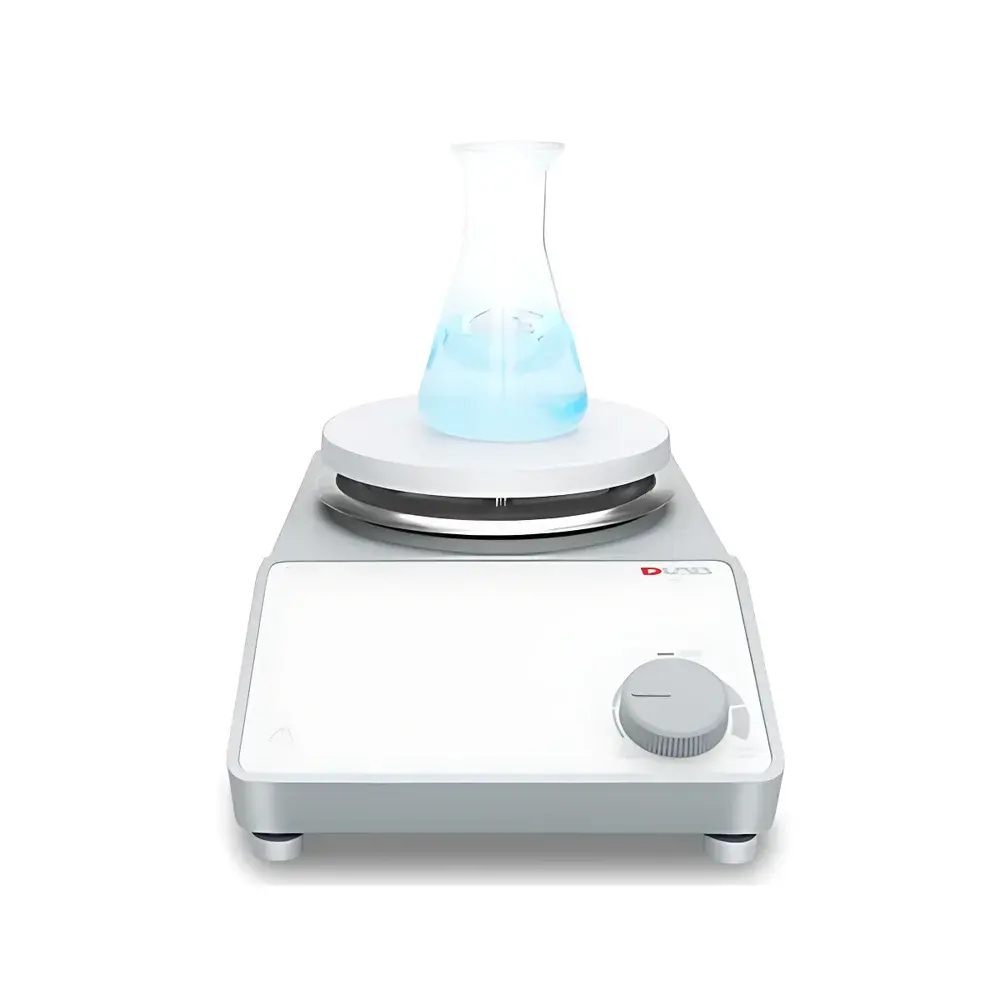
DLAB MS-S Magnetic Stirrer
| Brand | DLAB |
|---|---|
| Origin | Beijing, China |
| Manufacturer Type | Direct Manufacturer |
| Product Category | Domestic |
| Model | MS-S |
| Instrument Type | Magnetic Stirrer |
| Maximum Stirring Volume (Water) | 20 L |
| Speed Range | 0–1500 rpm |
| Temperature Control | Ambient Only |
| Workplate Diameter | Ø135 mm |
| Workplate Material | Stainless Steel with Ceramic Coating |
| Motor Type | Brushless DC Motor |
| Output Power | 10 W |
| Rated Power | 30 W |
| Input Voltage | 100–240 V, 50/60 Hz |
| Stir Bar Max Length | 80 mm |
| Display | Analog Speed Scale |
| IP Rating | IP42 |
| Dimensions (D×W×H) | 280 × 160 × 85 mm |
| Weight | 2.8 kg |
| Operating Environment | 5–40 °C, ≤80 % RH |
| Safety Certifications | CE, cTUVus, FCC, Compliant with DIN/EN 60529 |
Overview
The DLAB MS-S Magnetic Stirrer is a compact, single-position benchtop instrument engineered for reliable and consistent agitation of liquid samples in research laboratories, quality control environments, and educational settings. Utilizing a high-strength permanent magnet coupled with a brushless DC motor, the MS-S generates precise rotational torque to drive magnetic stir bars within vessels—enabling homogeneous mixing without mechanical contact between the drive mechanism and the sample. Its design prioritizes chemical resistance, operational stability, and compliance with international electrical safety standards. Unlike hotplate stirrers, the MS-S operates at ambient temperature only, making it ideal for applications where thermal input is undesirable or incompatible with sample integrity—such as pH-sensitive reactions, enzyme assays, or volatile solvent handling.
Key Features
- High-torque brushless DC motor delivering stable rotation across the full 0–1500 rpm range, ensuring reproducible mixing even in moderately viscous media (e.g., glycerol/water mixtures up to 500 mPa·s).
- Ceramic-coated stainless steel workplate (Ø135 mm) offering exceptional resistance to acids, bases, and organic solvents—compatible with routine cleaning using ethanol, acetone, or diluted nitric acid.
- Robust magnetic coupling system optimized for stir bars up to 80 mm in length, supporting effective agitation in vessels up to 20 L capacity when using appropriately sized stir bars and appropriate vessel geometry (e.g., tall-form beakers or cylindrical reactors).
- Analog speed scale with tactile feedback allows intuitive manual adjustment; no digital interface or software dependency required—reducing failure points and simplifying validation in regulated environments.
- IP42-rated enclosure provides protection against solid objects >1 mm and vertically falling water droplets, suitable for standard laboratory bench use under controlled indoor conditions.
- Universal power input (100–240 V, 50/60 Hz) enables seamless deployment across global laboratory infrastructures without voltage conversion hardware.
Sample Compatibility & Compliance
The MS-S accommodates standard laboratory glassware including beakers (50 mL–5 L), Erlenmeyer flasks, and jacketed reactors—provided the vessel base is non-magnetic and flat-bottomed. It is not intended for use with ferromagnetic containers or thick-walled borosilicate vessels exceeding 15 mm wall thickness, which may attenuate magnetic field transmission. The device complies with EN 61000-6-3 (EMC emission limits) and EN 61000-6-2 (immunity requirements), and carries TÜV-certified CE, cTUVus, and FCC marks. Its construction meets DIN/EN 60529 for ingress protection and aligns with general-purpose lab equipment requirements under ISO/IEC 17025-accredited facilities where equipment qualification includes documented operational checks and periodic performance verification.
Software & Data Management
The DLAB MS-S operates as a standalone analog instrument without embedded firmware, network connectivity, or data logging capability. This architecture eliminates cybersecurity risks, avoids software validation burdens, and supports straightforward IQ/OQ protocols in GLP- and GMP-regulated workflows. Users perform routine operational qualification by verifying speed accuracy (±10 rpm tolerance at mid-range setpoints) and magnetic coupling consistency using traceable reference stir bars and calibrated tachometers. No audit trail, electronic records, or 21 CFR Part 11 compliance features are provided—consistent with its classification as a Class A basic laboratory utility device per ICH Q7 Annex 12 guidance.
Applications
- Preparation of buffer solutions, reagent dilutions, and culture media in microbiology and molecular biology labs.
- Homogenization of suspensions prior to filtration, centrifugation, or particle size analysis.
- Facilitation of dissolution testing in pharmaceutical QC labs where temperature control is managed externally (e.g., water bath or environmental chamber).
- Supporting titration workflows requiring continuous mixing without introducing air bubbles or vibration artifacts.
- Use in teaching laboratories for demonstrating stoichiometric reactions, redox equilibria, and kinetic studies under ambient conditions.
FAQ
Does the MS-S support temperature control?
No. The MS-S is a non-heating magnetic stirrer. Temperature regulation must be achieved externally via water baths, chillers, or climate-controlled rooms.
Can it be used with plastic or aluminum containers?
Only non-ferromagnetic, thermally stable containers with flat, thin bases (e.g., polypropylene beakers <5 mm wall thickness) are recommended. Aluminum vessels may cause eddy current heating and inconsistent stirring.
Is speed calibration traceable to national standards?
While the unit does not include factory-calibrated digital readout, users may verify rotational speed using NIST-traceable handheld tachometers during equipment qualification.
What maintenance is required?
Routine cleaning of the ceramic surface with lint-free cloth and isopropanol; no lubrication or internal servicing is specified by the manufacturer.
How is it qualified for use in ISO 17025 laboratories?
Through documented operational checks (speed accuracy, magnetic coupling efficiency, physical inspection), recorded in equipment logs per clause 6.4.10 of ISO/IEC 17025:2017.



