
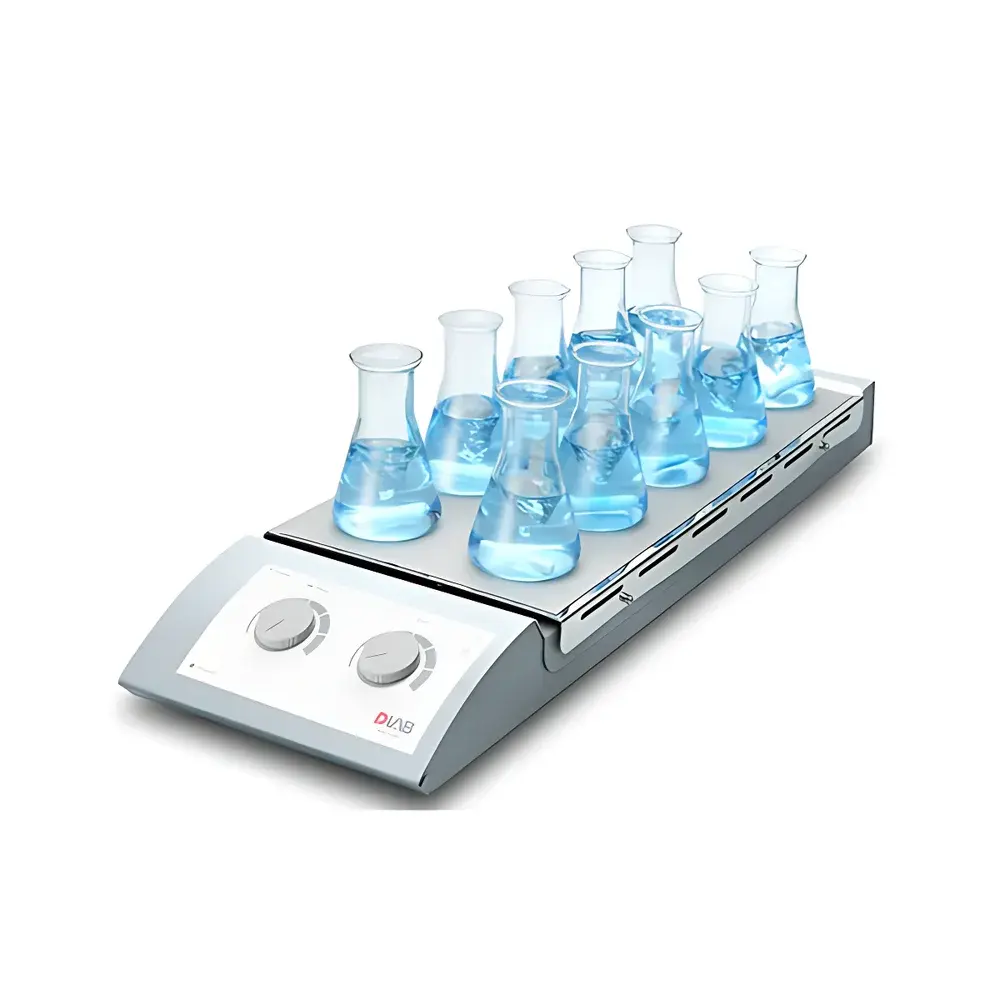
DLAB MS-H-S10 10-Position Magnetic Stirrer with Integrated Heating
| Brand | DLAB |
|---|---|
| Origin | Beijing, China |
| Manufacturer | DLAB (OEM/ODM Capable) |
| Model | MS-H-S10 |
| Instrument Type | Magnetic Stirrer |
| Max Stirring Volume | 0.4 L × 10 positions |
| Speed Range | 0–1100 rpm |
| Temperature Control Range | Ambient to 120 °C |
| Heating Plate Material | Anodized Aluminum with Silicone Resin Coating |
| Motor Type | Brushless DC Motor |
| Input Power | 12 W (Motor), 490 W (Total) |
| Output Power | 4 W (Motor), 470 W (Heating) |
| Voltage/Frequency | 100–120 V / 200–240 V, 50/60 Hz |
| Plate Dimensions | 180 × 450 mm |
| Max Stir Bar Length | 40 mm |
| Overheat Protection Threshold | 140 °C |
| Enclosure Rating | IP42 |
| Dimensions (L×W×H) | 622 × 182 × 65 mm |
| Weight | 3.2 kg |
| Operating Environment | 5–40 °C, ≤80% RH |
| Safety Certifications | CE, cTUVus, FCC |
Overview
The DLAB MS-H-S10 is a precision-engineered 10-position magnetic stirrer with integrated Peltier-free resistive heating, designed for high-throughput parallel sample preparation in analytical, pharmaceutical, and quality control laboratories. It operates on the principle of rotating magnetic fields generated beneath a thermally stable work surface, inducing synchronous rotation of magnetic stir bars placed within vessels. Unlike single-position units, the MS-H-S10 enables simultaneous, identical thermal and mechanical agitation across ten independent 400 mL reaction zones—eliminating inter-run variability caused by sequential processing. Its brushless DC motor architecture ensures consistent torque delivery across the full 0–1100 rpm range without commutation wear, while the uniform-heating aluminum plate—laser-etched and silicone-resin coated—provides corrosion resistance, non-slip stability, and thermal homogeneity (< ±3 °C deviation across plate surface at 100 °C steady state). The unit meets IEC 61010-1 safety requirements for laboratory electrical equipment and is certified to CE, cTUVus, and FCC standards, confirming compliance with electromagnetic compatibility (EMC) and low-voltage directive (LVD) mandates applicable in EU, North America, and global regulated markets.
Key Features
- Synchronous 10-channel operation: All positions driven by a single, phase-locked motor system ensuring identical rotational dynamics and temporal alignment—critical for kinetic studies and comparative dissolution testing.
- Brushless DC motor: Delivers maintenance-free operation over >20,000 hours MTBF; eliminates carbon dust, arcing, and speed drift associated with brushed alternatives.
- Uniform-heating aluminum plate: Laser-engraved surface enhances grip and chemical resistance; silicone resin coating prevents oxidation and facilitates cleaning under GLP-compliant lab protocols.
- Dual-mode temperature control: Digital PID algorithm regulates plate surface temperature from ambient to 120 °C with ±1 °C setpoint accuracy and automatic overtemperature cutoff at 140 °C.
- Low-noise design: Acoustic emission <45 dB(A) at 1 m distance under full load—suitable for open-bench deployment in shared instrumentation suites.
- Rugged IP42-rated enclosure: Protects internal electronics against dripping water and solid objects ≥1 mm, supporting use in humid or splash-prone environments.
Sample Compatibility & Compliance
The MS-H-S10 accommodates standard round-bottom flasks (up to 500 mL), beakers, and vials up to 40 mm in stir bar length. Its 180 × 450 mm plate supports staggered vessel layouts without positional interference. All materials contacting the work surface comply with USP Class VI biocompatibility requirements for short-term labware contact. The instrument’s electrical safety architecture conforms to EN 61010-1:2010 + A1:2019 and its EMC profile satisfies EN 61326-1:2013 for laboratory measurement equipment. While not inherently 21 CFR Part 11 compliant (as it lacks electronic audit trail functionality), its analog-digital hybrid interface allows integration into validated workflows when paired with external data loggers meeting ALCOA+ principles.
Software & Data Management
The MS-H-S10 operates via front-panel rotary encoder and dual LED displays (speed and temperature), with no embedded software or network interface. For traceable operation in regulated settings, optional RS-232 or USB-to-serial adapters enable connection to third-party logging platforms (e.g., LabVIEW, MATLAB, or custom Python-based acquisition scripts). All parameter changes are manually entered and visually confirmed—supporting manual record-keeping per ISO/IEC 17025 Clause 7.7 and ASTM E2500-13 guidance on equipment qualification. Calibration verification templates (speed and temperature) are supplied in DLAB’s IQ/OQ documentation package.
Applications
- Parallel buffer equilibration and pH adjustment in molecular biology workflows.
- High-throughput solubility screening under controlled thermal conditions (e.g., USP ).
- Accelerated stability studies requiring identical agitation profiles across replicate samples.
- Preparation of homogeneous catalyst suspensions for heterogeneous reaction optimization.
- QC batch release testing where inter-vessel consistency directly impacts assay precision (e.g., dissolution per USP ).
- Teaching labs requiring robust, multi-student access to standardized stirring conditions.
FAQ
Does the MS-H-S10 support individual speed or temperature control per position?
No. All 10 positions operate synchronously at the same speed and plate temperature—this design prioritizes inter-positional reproducibility over independent control.
What is the maximum recommended vessel diameter for stable operation?
Vessels up to 100 mm base diameter are supported; optimal performance is achieved with diameters between 40–80 mm to ensure magnetic coupling efficiency and thermal transfer uniformity.
Is the unit suitable for use with organic solvents or acidic solutions?
Yes—the silicone resin-coated aluminum plate and stainless-steel housing resist corrosion from common lab solvents (e.g., ethanol, acetone, 1 M HCl, 1 M NaOH) when wiped promptly after exposure.
Can the MS-H-S10 be integrated into a LIMS or ELN environment?
Not natively. However, with an external serial interface adapter and middleware, real-time speed/temperature data can be streamed to compliant LIMS or ELN systems for metadata linkage.
What calibration services does DLAB provide?
DLAB offers factory-certified IQ/OQ documentation and on-site calibration support through authorized service partners in EMEA, APAC, and North America—traceable to NIST or PTB standards.



