
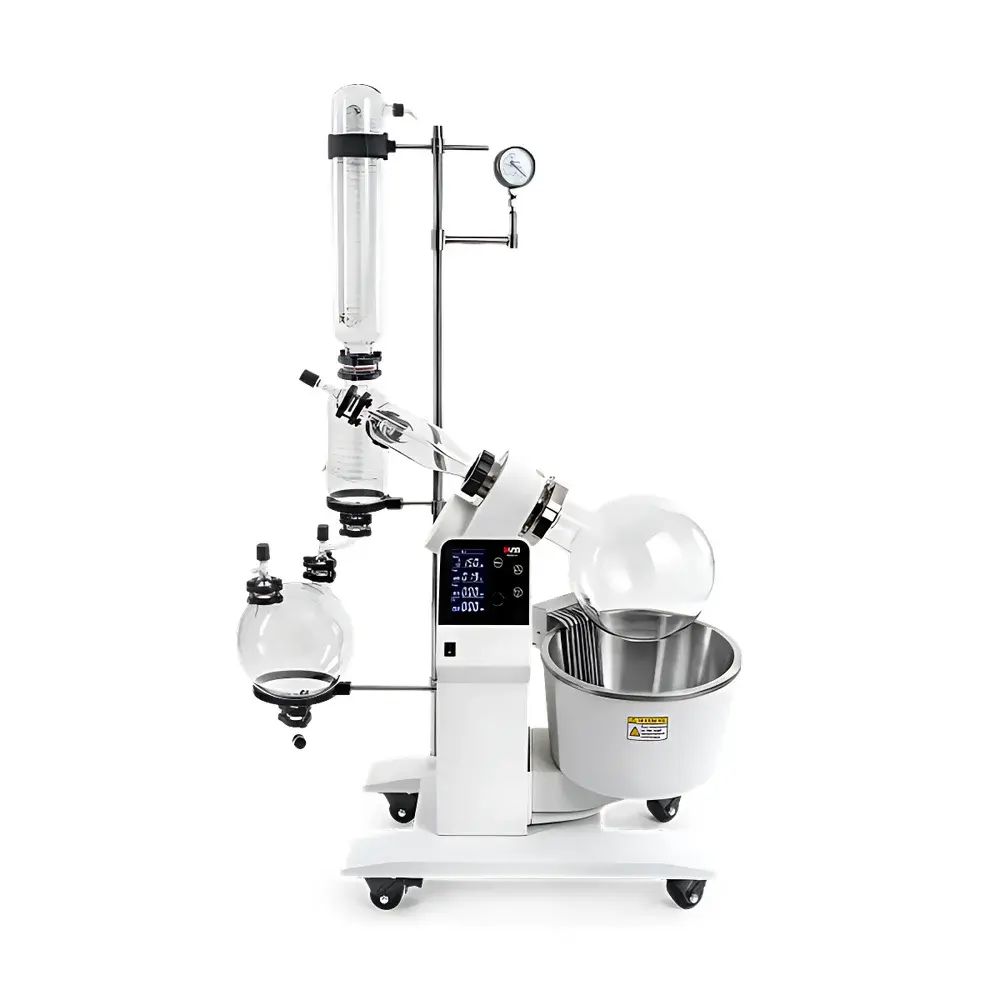
DLAB RE200-Pro 20L Digital Rotary Evaporator
| Brand | DLAB |
|---|---|
| Origin | Beijing, China |
| Manufacturer Type | Direct Manufacturer |
| Product Category | Domestic |
| Model | RE200-Pro |
| Capacity | 20 L |
| Ultimate Vacuum | < 2.6 hPa |
| Rotation Speed | 10–150 rpm (infinitely variable) |
| Temperature Range | Ambient to 180 °C (water/oil bath compatible) |
| Temperature Control Accuracy | ±1 °C (water bath), ±3 °C (oil bath) |
| Evaporation Rate | Up to 4.0 L/h |
| Condenser Surface Area | 1.2 m² |
| Heating Bath Dimensions | Φ450 × 240 mm |
| Power Supply | 220 V / 4600 W / 50–60 Hz or 380 V / 6000 W / 50–60 Hz |
Overview
The DLAB RE200-Pro 20L Digital Rotary Evaporator is an engineered solution for high-throughput solvent removal under reduced pressure in research laboratories, pilot-scale synthesis facilities, and quality control environments. Based on the fundamental principle of rotary evaporation—where simultaneous rotation, heating, and vacuum application lower the boiling point of solvents to enable gentle, efficient concentration or purification—the RE200-Pro integrates robust mechanical design with precise digital process control. Its 20 L evaporation capacity supports large-volume batch processing common in natural product isolation, polymer synthesis, pharmaceutical intermediate workup, and botanical extract concentration. The system operates across a wide thermal envelope (ambient to 180 °C), accommodating both water and oil heating media to match diverse solvent volatility profiles—from low-boiling diethyl ether (35 °C) to high-boiling dimethyl sulfoxide (189 °C). Vacuum performance down to < 2.6 hPa ensures rapid vapor phase transition even for moderately polar or viscous solvents, while the triple-coil vertical condenser provides uniform thermal gradient distribution and maximizes latent heat exchange efficiency.
Key Features
- Dual-mode heating bath (Φ450 × 240 mm) with independent P.I.D temperature regulation for water or oil media, delivering ±1 °C stability in aqueous mode and ±3 °C in oil mode
- Infinitely variable motor-driven rotation (10–150 rpm) with programmable forward/reverse direction switching to prevent bumping and improve film uniformity on the 20 L evaporation flask
- Integrated motorized lift mechanism (180 mm stroke) with overload and position-limit protection, enabling reproducible immersion depth control without manual intervention
- Triple-serpentine vertical condenser with 1.2 m² effective cooling surface area, fabricated from borosilicate glass and coupled with a high-efficiency coolant circulation interface (16 mm outer diameter ports)
- Double-layer modified PTFE sealing gasket system rated for continuous operation up to 180 °C and resistant to aggressive organic solvents including chlorinated hydrocarbons and strong acids
- Dedicated vacuum bypass valve permitting uninterrupted solvent collection during fractional distillation—critical for multi-step purification workflows requiring sequential fraction recovery without venting
- Large backlit LCD display showing real-time values for bath temperature, rotational speed, direction status, countdown timer, and system error codes
Sample Compatibility & Compliance
The RE200-Pro accommodates standard ISO/KG-type ground-glass joints (29/32 and 35/40 taper interfaces) and is compatible with 20 L evaporation flasks, dual 10 L round-bottom collection flasks (each fitted with drain valves), and optional vacuum traps. Its construction adheres to IEC 61010-1:2010 safety standards for laboratory electrical equipment, including overtemperature cutoff, dry-run prevention, earth leakage detection, and motor current limiting. While not certified for GMP manufacturing use out-of-the-box, the unit’s deterministic control logic, non-volatile parameter storage, and audit-ready operational logs support alignment with GLP documentation requirements. When integrated with validated vacuum pumps and temperature calibration protocols, it meets method suitability criteria for ASTM E260 and USP <721> evaporation procedures.
Software & Data Management
The RE200-Pro operates via embedded microcontroller firmware with no external PC dependency. All setpoints—including ramp-hold temperature profiles, rotation acceleration/deceleration rates, and timed auto-shutdown—are stored in non-volatile memory and retain configuration after power cycling. Event logging records timestamped entries for critical thresholds (e.g., “Temp exceeded 180 °C”, “Vacuum loss > 5 hPa sustained > 30 s”), supporting root-cause analysis during method troubleshooting. Optional RS-485 Modbus RTU interface enables integration into centralized lab automation networks for remote monitoring and data archiving—compatible with LabArchives ELN, Thermo Fisher SampleManager, and custom SCADA platforms compliant with FDA 21 CFR Part 11 when paired with electronic signature modules.
Applications
- Concentration of thermolabile natural extracts (e.g., curcuminoids, flavonoids) under mild vacuum and controlled bath temperature
- Removal of reaction solvents (THF, toluene, ethyl acetate) following Grignard, Suzuki, or amidation reactions at pilot scale
- Recovery and recycling of high-purity solvents in synthetic chemistry workflows to reduce waste disposal costs
- Preparative purification of polymer solutions prior to GPC analysis or film casting
- Dehydration of hygroscopic compounds where inert gas purging can be coupled via optional inlet adapters
- Standardized residue-on-evaporation assays per pharmacopoeial monographs (EP 2.2.33, JP 2.05)
FAQ
What vacuum level is required to achieve optimal evaporation of ethanol at 40 °C?
At 40 °C, ethanol’s vapor pressure is ~18 kPa (~135 mmHg). A system vacuum of ≤ 2.6 hPa (< 2 mmHg) ensures rapid phase transition with minimal thermal stress.
Can the RE200-Pro be used with corrosive solvents such as concentrated HCl in dioxane?
Yes—provided all wetted parts (seals, condenser, flasks) are verified as chemically compatible; the double-layer modified PTFE gaskets resist HCl exposure, but glass components require post-use passivation.
Is the heating bath calibrated traceable to NIST standards?
Factory calibration uses reference thermistors traceable to national metrology institutes; users must perform in-situ verification using a calibrated PT100 probe per ISO/IEC 17025 guidelines.
Does the unit support programmable multi-step evaporation protocols?
No—protocol sequencing requires external PLC or third-party controller; onboard programming is limited to single-setpoint temperature and rotation profiles.
What maintenance intervals are recommended for long-term reliability?
Inspect PTFE seals every 200 operating hours; clean condenser coils quarterly with ethanol/acetone; verify vacuum line integrity and pump oil condition biweekly in continuous operation.



