
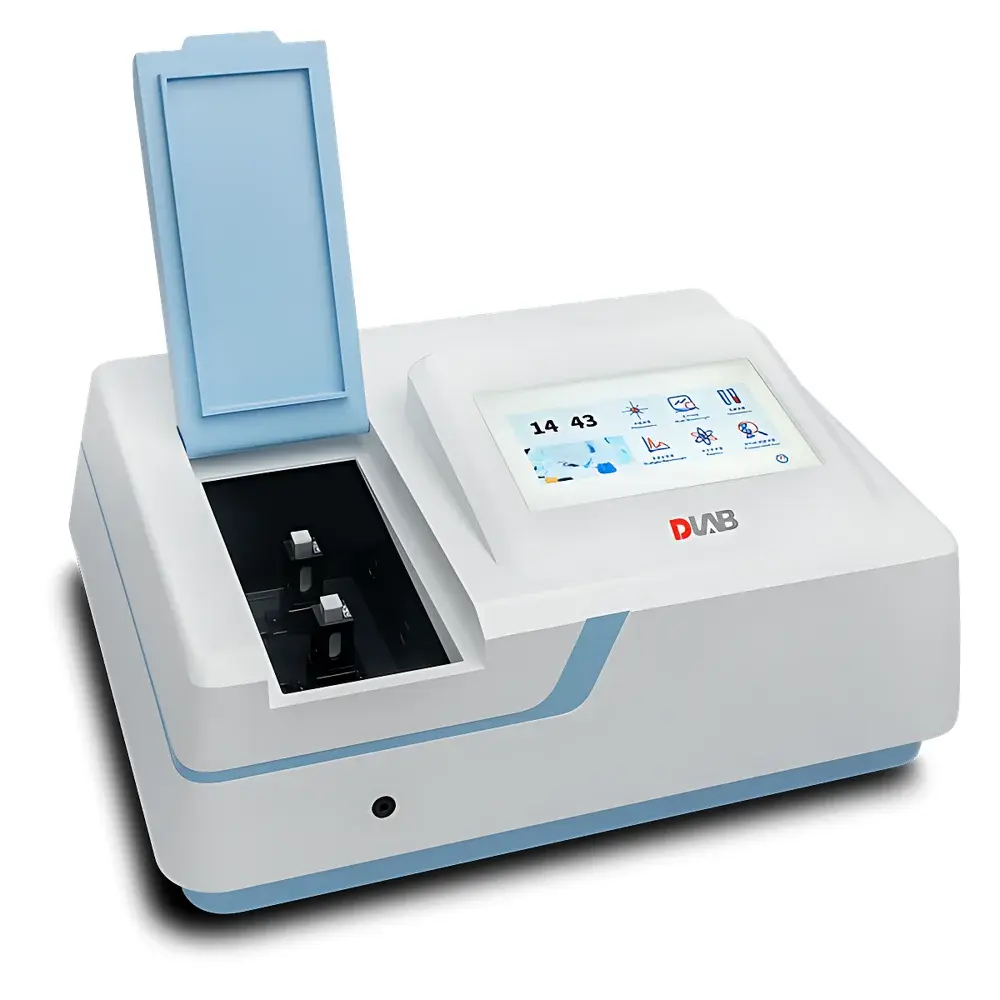
DLAB SP-UV3102 Dual-Beam Ultraviolet-Visible Spectrophotometer
| Brand | DLAB |
|---|---|
| Origin | Beijing, China |
| Manufacturer Type | Original Equipment Manufacturer (OEM) |
| Instrument Architecture | Dual-Beam |
| Wavelength Range | 190–1100 nm |
| Spectral Bandwidth | 2.0 nm |
| Wavelength Accuracy | ±0.1 nm at 656.1 nm, ±0.3 nm across full range |
| Wavelength Repeatability | ≤0.1 nm |
| Stray Light | ≤0.03% T at 220 nm and 360 nm |
| Photometric Range | –0.3 to 3 A, 0–9999 C (0–9999 F) |
| Photometric Accuracy | ±0.002 A (0–0.5 A), ±0.003 A (0.5–1 A) |
| Photometric Repeatability | ±0.001 A (0–0.5 A), ±0.0015 A (0.5–1 A) |
| Baseline Stability | ≤0.001 A/h at 500 nm (after 1-hour warm-up) |
| Display | 10.1-inch color capacitive touchscreen (1024 × 600) |
| Dimensions (L × W × H) | 570 × 440 × 210 mm |
| Weight | 20 kg |
| Power Supply | 110/220 V, 50/60 Hz, 120 W |
| Interface | USB port, printer port |
Overview
The DLAB SP-UV3102 is a high-performance dual-beam ultraviolet-visible (UV-Vis) spectrophotometer engineered for precision absorbance, transmittance, and concentration measurements across the 190–1100 nm spectral range. Its optical architecture employs a holographic grating monochromator and digitally calibrated photodiode array detection, delivering low stray light (≤0.03% T), minimal photometric noise, and exceptional baseline stability (≤0.001 A/h at 500 nm after 1-hour thermal equilibration). The instrument utilizes separate deuterium and tungsten-halogen lamps—sourced from MiraLabs (D₂) and HYBEC (W)—to ensure seamless spectral continuity and optimal intensity output across both UV and visible regions. Designed for routine QC/QA laboratories, academic research facilities, and regulated environments, the SP-UV3102 supports method-driven workflows including fixed-wavelength photometry, multi-point quantitative analysis, kinetic monitoring, DNA/protein quantification (A260/A280), and full-spectrum scanning with variable scan speed (high/medium/low).
Key Features
- Dual-beam optical design with real-time reference beam compensation, minimizing drift caused by source fluctuation or detector thermal drift
- 10.1-inch high-resolution capacitive touchscreen (1024 × 600) with intuitive graphical user interface—enabling standalone operation without PC connection
- Holographic grating monochromator with 2.0 nm spectral bandwidth ensures high resolution and reproducible peak shape fidelity
- Advanced wavelength drive mechanism achieving ±0.1 nm accuracy at 656.1 nm (hydrogen line) and ≤0.1 nm repeatability—critical for calibration verification per ISO 6425 and ASTM E275
- Integrated photometric validation routines including absorbance linearity checks, stray light assessment, and wavelength calibration traceable to NIST-traceable standards
- Robust mechanical architecture with vibration-damped optical bench and thermally stabilized lamp housing for long-term operational reliability
Sample Compatibility & Compliance
The SP-UV3102 accommodates standard 10-mm pathlength cuvettes in its fixed sample holder, with optional accessories expanding capability to microvolume samples (via adjustable-pathlength cells), solid films (film holder), turbid suspensions (integrating sphere), reflectance measurements (specular/diffuse reflectance kit), and temperature-controlled studies (Peltier-based thermostatted cell holder). All hardware and firmware comply with IEC 61010-1 safety requirements for laboratory equipment. The embedded software architecture adheres to GLP and GMP principles: user access levels (administrator/operator), full electronic audit trail (including parameter changes, measurement events, and data exports), timestamped log files, and immutable data storage with cryptographic integrity checks. Data export formats (CSV, TXT, PDF) support interoperability with LIMS and electronic lab notebook (ELN) systems.
Software & Data Management
The PC-based control software provides extended functionality beyond onboard capabilities—including spectral derivative analysis, peak identification and integration, multi-component regression modeling, and customizable report templates compliant with FDA 21 CFR Part 11 requirements (electronic signatures, role-based permissions, and audit trail export). All measurement data—including raw spectra, processed curves, calibration curves, and kinetic time-series—are stored with metadata (operator ID, date/time, instrument serial number, method name). Internal memory retains ≥10,000 spectra; external storage via USB 2.0 interface enables direct transfer to network drives or cloud repositories. Power-loss recovery preserves current method settings and pending measurements, ensuring continuity during unexpected outages.
Applications
- Pharmaceutical quality control: assay of active pharmaceutical ingredients (APIs), excipient compatibility testing, dissolution profile analysis per USP & EP guidelines
- Life sciences: nucleic acid quantification (A260), protein concentration determination (Bradford/Lowry/BCA), enzyme kinetics (NADH/NADPH monitoring at 340 nm)
- Environmental testing: nitrate/nitrite, phosphate, heavy metal (e.g., Cr(VI), Fe²⁺) quantification using colorimetric methods per APHA Standard Methods
- Materials science: thin-film thickness estimation via interference fringe analysis, bandgap determination of semiconductors
- Food & beverage: pigment analysis (anthocyanins, carotenoids), preservative quantitation (sulfites, benzoates), and authenticity screening
FAQ
What wavelength calibration standards are recommended for routine verification?
DLAB recommends NIST-traceable holmium oxide (Ho₂O₃) and didymium filters for wavelength verification at 241.1, 279.4, 287.5, 333.7, 360.9, 418.5, 460.0, 484.5, 536.2, and 637.5 nm. Calibration should be performed daily in regulated labs or per ISO/IEC 17025 internal procedure.
Is the instrument compatible with third-party LIMS or ELN platforms?
Yes—the SP-UV3102 supports ASCII-based data export (CSV/TXT) and PDF report generation with embedded metadata, enabling seamless ingestion into most LIMS/ELN systems. Optional OPC UA or REST API integration is available upon request for enterprise deployments.
Can the instrument perform simultaneous multi-wavelength kinetic assays?
Yes—up to 10 user-defined wavelengths can be monitored concurrently during kinetic runs, with time-resolved absorbance logging at configurable intervals (0.1 s to 600 s), supporting enzyme inhibition studies and reaction rate modeling.
Does the software support 21 CFR Part 11 compliance out-of-the-box?
The embedded software includes electronic signature capability, role-based access control, and immutable audit trails. Full Part 11 compliance requires site-specific validation documentation and IT infrastructure alignment—DLAB provides IQ/OQ protocol templates and validation support services.
What maintenance is required for long-term optical performance?
Annual lamp replacement (D₂ and W), quarterly cleaning of optical windows and cuvette compartment, and biannual verification of stray light and photometric linearity using certified reference materials are recommended per DLAB Maintenance Schedule MS-UV3102 Rev. 3.




