
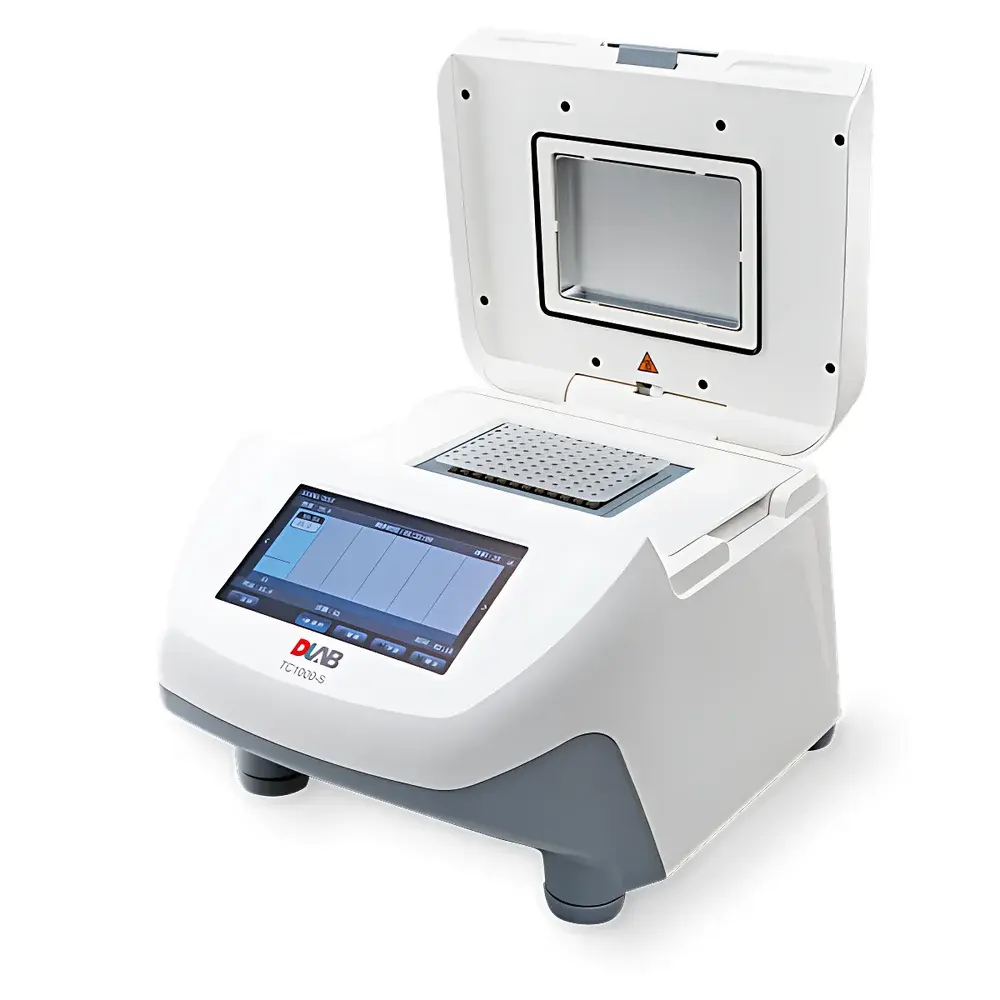
DLAB TC1000-S Isocratic Thermal Cycler
| Brand | DLAB |
|---|---|
| Origin | Beijing, China |
| Manufacturer Type | Original Equipment Manufacturer (OEM) |
| Country of Origin | China |
| Model | TC1000-S |
| Sample Throughput | 96-well format |
| Temperature Accuracy | ±0.3 °C |
| Well-to-Well Temperature Uniformity | <0.3 °C |
Overview
The DLAB TC1000-S Isocratic Thermal Cycler is a benchtop polymerase chain reaction (PCR) instrument engineered for precision, reliability, and operational simplicity in molecular biology laboratories. Unlike gradient thermal cyclers, the TC1000-S maintains a uniform temperature across all 96 wells during each thermal step—making it ideal for standardized amplification protocols where reproducibility and inter-run consistency are critical. It employs Peltier-based thermoelectric heating and cooling with real-time closed-loop feedback control to achieve ±0.3 °C temperature accuracy and sub-0.3 °C well-to-well uniformity—performance metrics aligned with ISO/IEC 17025-compliant validation requirements for nucleic acid amplification. Designed for routine PCR, endpoint genotyping, plasmid verification, and cDNA synthesis, the TC1000-S supports robust thermal ramping profiles without requiring user calibration or manual offset adjustment.
Key Features
- Graphical color touchscreen interface with intuitive icon-driven navigation—enabling rapid protocol creation, editing, and recall without training overhead.
- Intelligent power-loss recovery: automatically resumes interrupted runs from the exact cycle and step upon restoration of mains power—ensuring data integrity and minimizing sample loss.
- User-configurable heated lid: adjustable lid temperature (30–110 °C) and activation logic (e.g., auto-disable when block temperature falls below 30 °C) to prevent condensation while conserving energy.
- Dedicated Quick Incubation mode: single-button activation for non-cycling thermal holds (e.g., 95 °C for denaturation, 37 °C for restriction digestion, or 25 °C for ligase incubation), compatible with enzymatic assays including ELISA, methylation, and phosphorylation workflows.
- Thermally isolated aluminum block with optimized fin geometry—ensuring mechanical stability and minimal thermal drift over extended run durations (>4 h).
Sample Compatibility & Compliance
The TC1000-S accepts standard 0.2 mL PCR tubes, 8-strip tubes, and full 96-well plates (non-skirted, semi-skirted, and full-skirted formats). Its block design complies with ANSI/SLAS microplate footprint standards (ANSI/SBS 1-2004), ensuring compatibility with automated liquid handlers and plate sealers. The instrument meets IEC 61010-1:2010 safety requirements for laboratory electrical equipment and operates within Class II, Division 1 environmental specifications. While not pre-certified for clinical diagnostics under FDA 21 CFR Part 820 or IVDR, its performance characteristics support GLP-aligned validation protocols—including IQ/OQ/PQ documentation templates available upon request for regulated environments.
Software & Data Management
The TC1000-S operates independently of PC software; all programs are stored locally in non-volatile flash memory (retains >1,000 protocols). Each run logs timestamped thermal profile metadata—including start time, cycle count, actual block temperature history, and lid status—to internal memory. USB port enables export of CSV-formatted run reports for audit trail generation. No proprietary drivers or cloud connectivity are required, eliminating cybersecurity concerns associated with networked instruments. Data export files comply with MIAME-compliant metadata conventions and may be imported into LIMS systems supporting generic CSV ingestion. Audit trails meet basic ALCOA+ principles (Attributable, Legible, Contemporaneous, Original, Accurate) for quality-controlled research settings.
Applications
- Routine DNA amplification for cloning, sequencing library prep, and qPCR template generation.
- Endpoint genotyping via allele-specific PCR and ARMS assays.
- cDNA synthesis using reverse transcriptase enzymes with defined incubation steps.
- Enzyme-mediated reactions requiring precise thermal holding: restriction digests, ligation, phosphatase treatment, and dephosphorylation.
- Validation of primer specificity and annealing optimization under isothermal conditions.
- Educational use in undergraduate and graduate molecular biology laboratories—where simplicity, durability, and low maintenance are prioritized.
FAQ
Does the TC1000-S support touchdown or long-range PCR?
No—the TC1000-S is an isocratic cycler and does not implement programmed temperature decrement (touchdown) or extended extension timing profiles. Those capabilities are exclusive to the TC1000-G-Pro model.
Can I validate temperature uniformity across the block?
Yes—DLAB provides a certified NIST-traceable validation kit (optional accessory) including calibrated PT100 probes and a validation report template compliant with ISO/IEC 17025 Annex A.2.
Is the heated lid programmable per protocol?
Yes—the lid temperature and activation behavior (e.g., “on only above 40 °C”) can be set independently for each saved program.
What is the maximum ramp rate?
The TC1000-S achieves typical heating and cooling rates of 4.0 °C/s and 2.5 °C/s respectively, measured from 25 °C to 95 °C and vice versa, under standard ambient conditions (20–25 °C, ≤60% RH).
Does it support remote monitoring or network integration?
No—the TC1000-S has no Ethernet, Wi-Fi, or Bluetooth interfaces. It is designed as a standalone, air-gapped instrument to minimize IT infrastructure dependencies and cybersecurity exposure in core lab environments.




