
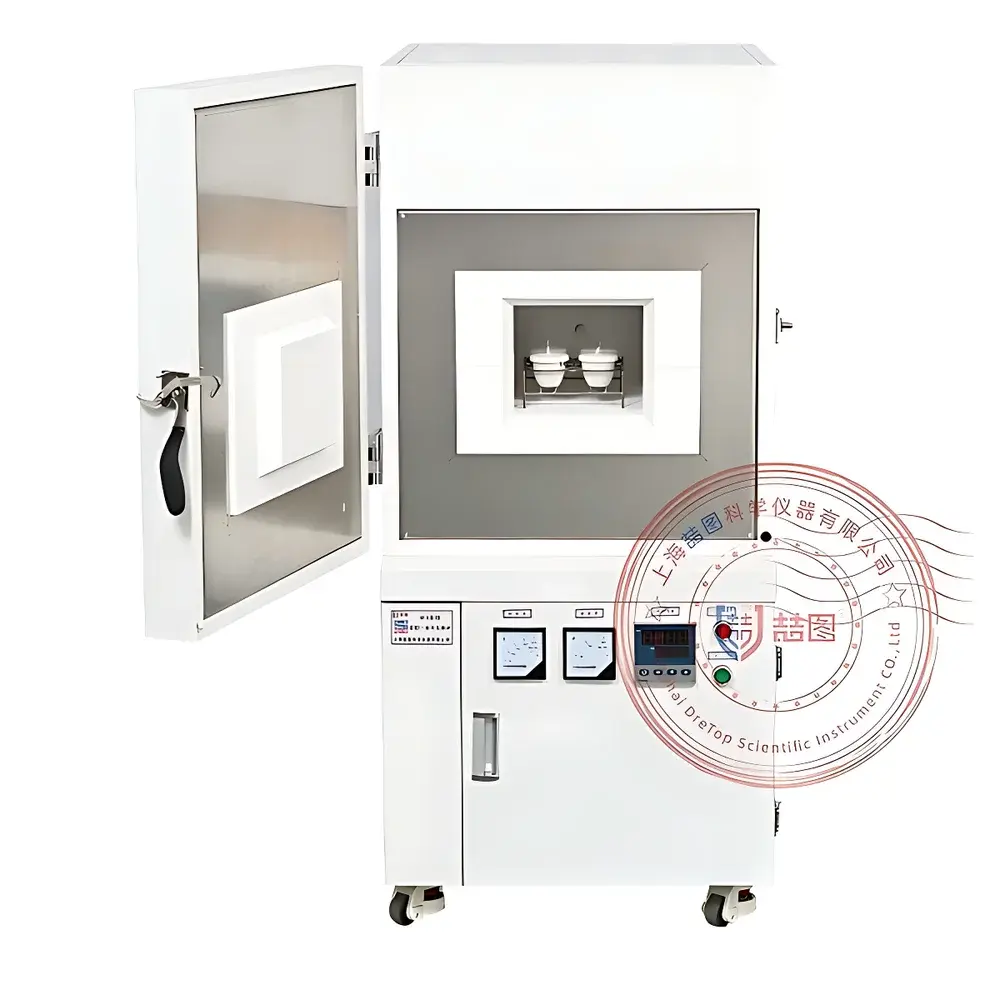
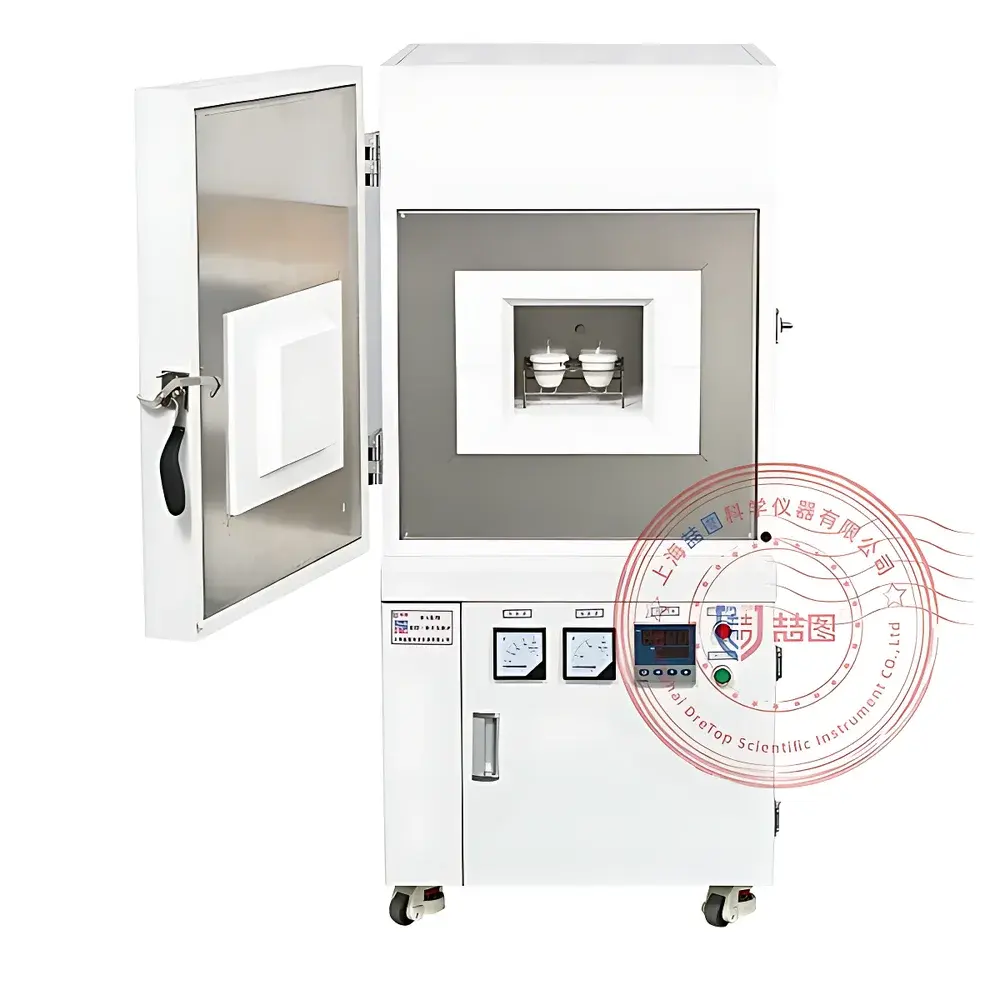
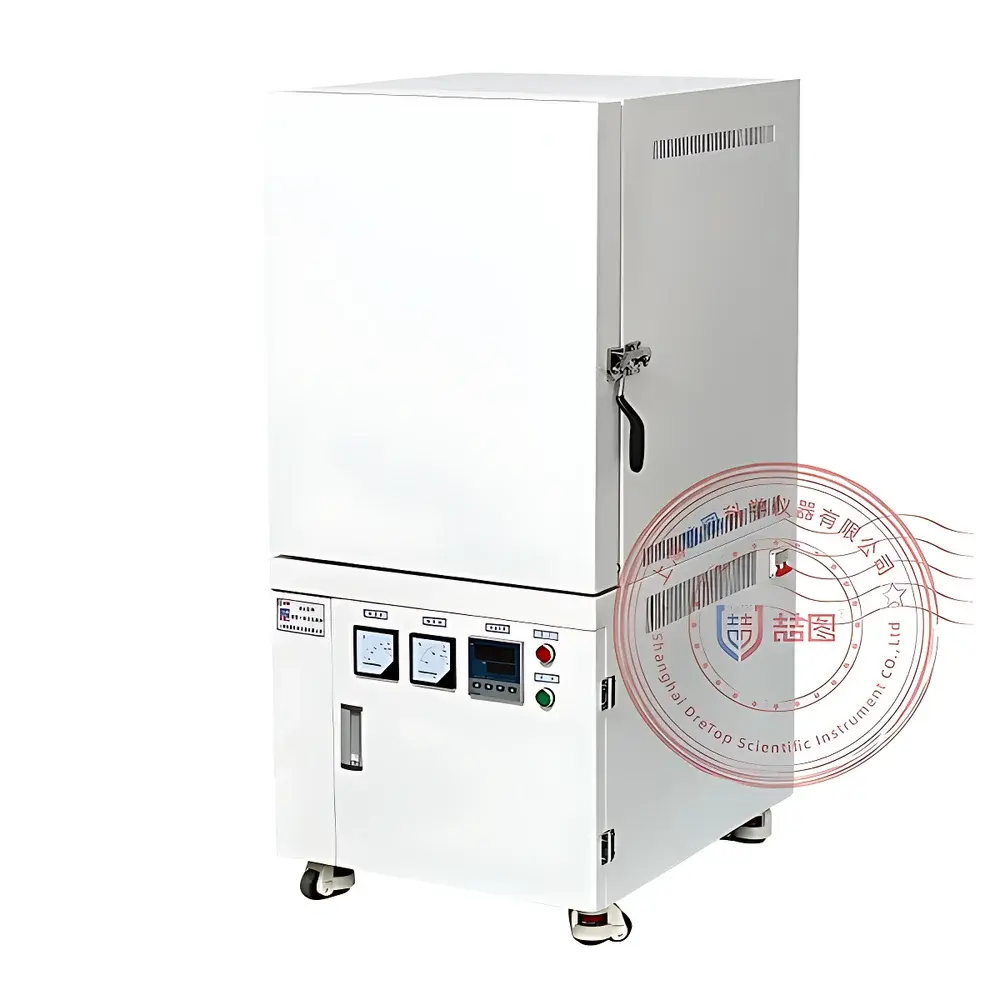
DRETOP MJT18-60A Intelligent Integrated Muffle Furnace
| Brand | DRETOP |
|---|---|
| Origin | Shanghai, China |
| Model | MJT18-60A |
| Type | Vertical Lift-Type Muffle Furnace |
| Max Temperature | 1800 °C |
| Temperature Control Accuracy | ±0.1 °C |
| Rated Power | 18,000 W |
| Heating Element | Silicon-Molybdenum (MoSi₂) Rods |
| Internal Chamber Dimensions | 300 × 400 × 300 mm |
| Nominal Volume | 36 L |
| Heating Configuration | Triple-Wall Radiant Heating |
| Insulation Material | Vacuum-Microporous Ceramic Fiber Board |
| Transformer | 380 V AC, Three-Phase Dry-Type Isolation Transformer |
| Compliance | Designed for GLP-compliant thermal processing environments |
Overview
The DRETOP MJT18-60A Intelligent Integrated Muffle Furnace is a high-temperature vertical lift-type furnace engineered for precision thermal treatment in research laboratories, materials science facilities, and quality control environments. It operates on Joule heating principles, utilizing silicon-molybdenum (MoSi₂) rods as resistive heating elements embedded within a triple-wall radiant configuration. The furnace achieves stable operation up to 1800 °C with exceptional thermal uniformity across its 36 L chamber—enabled by vacuum-microporous ceramic fiber insulation, multi-directional heat radiation, and optimized chamber geometry. Its integrated three-phase dry-type isolation transformer ensures electromagnetic compatibility, minimizes grid interference, and supports uninterrupted power delivery under variable load conditions. Designed for repeatable high-temperature workflows—including sintering, ashing, calcination, annealing, and elemental analysis—the MJT18-60A meets the engineering requirements of ASTM E1113 (Standard Practice for Calibration of High-Temperature Furnaces), ISO/IEC 17025 traceability frameworks, and routine GMP/GLP thermal validation protocols.
Key Features
- Intelligent AI-based temperature controller with self-tuning PID algorithm, supporting programmable ramp-hold-cool profiles with up to 30 segments per program and linear/nonlinear curve fitting.
- 7-inch full-color capacitive touchscreen HMI with real-time temperature trend display, historical data overlay, and dual-mode readout (numerical + graphical bar chart).
- Triple-wall heating architecture with MoSi₂ rods wound helically into side and rear walls—ensuring radial and axial thermal symmetry; measured temperature uniformity ≤ ±3 °C at 1600 °C (per ISO 9001 calibration verification).
- Integrated safety architecture: dual-stage overtemperature cutoff, door-interlocked power interruption, phase-loss detection, thermocouple break alarm, and automatic restart after power recovery with non-volatile memory retention (>10 years data integrity).
- Structural optimization includes front-access lift mechanism, phosphated & high-temp epoxy-coated steel enclosure, stainless-steel inner flange (2 mm thickness), and refractory ceramic fiber挡热 plate at furnace mouth to suppress convection losses.
- Energy-efficient design: low thermal mass insulation reduces standby power consumption by ~40% versus conventional brick-lined furnaces; typical warm-up time from RT to 1600 °C is <65 minutes.
Sample Compatibility & Compliance
The MJT18-60A accommodates standard crucibles (Al₂O₃, ZrO₂, Pt, graphite), ceramic green bodies, metal alloys, geological samples, and pharmaceutical excipients requiring inert or air-atmosphere thermal processing. Its sealed chamber design supports optional inert gas purging (N₂, Ar) via configurable inlet valve (accessory). All electrical components comply with IEC 61000-4 immunity standards; thermal control firmware adheres to FDA 21 CFR Part 11 audit-trail requirements when paired with optional RS485-modbus interface and validated data export (CSV/Excel). The furnace satisfies CE marking prerequisites for Class A industrial equipment and is routinely deployed in ISO/IEC 17025-accredited labs performing USP , ASTM C114, and ISO 562 ash content determinations.
Software & Data Management
The built-in controller logs timestamped temperature, power output, and alarm events internally (≥100,000 records). Data export is supported via USB flash drive in CSV format—with column headers compliant with LIMS ingestion standards (e.g., “Timestamp, Setpoint(°C), PV(°C), Output(%), EventCode”). Optional Ethernet or RS485 Modbus RTU connectivity enables integration with SCADA systems or centralized lab monitoring platforms. Multi-level user authentication (Engineer/Operator/Viewer) restricts parameter modification rights; all setpoint changes and manual overrides are logged with operator ID and UTC timestamp. Firmware supports remote diagnostics via secure SSH tunneling when deployed behind institutional firewalls.
Applications
- High-purity ceramic sintering (e.g., AlN, SiC, YSZ) requiring precise dwell control at 1500–1750 °C.
- Residue-on-ignition (ROI) and loss-on-ignition (LOI) assays in environmental and cement testing per ASTM C114 and EN 196-2.
- Thermal gravimetric pre-treatment of catalyst supports prior to BET surface area analysis.
- Heat treatment of small-dimension tool steels (HSS, M2) with programmable quench-hold cycles.
- Pre-firing of dental porcelain substrates and bioceramic scaffolds under controlled oxidizing atmosphere.
- Calibration reference furnace service for secondary thermocouple verification (Type S, R, B) per ISO/IEC 17025 Clause 6.5.2.
FAQ
What is the maximum continuous operating temperature?
The MJT18-60A is rated for continuous operation at 1750 °C; short-term exposure up to 1800 °C is permissible for ≤30 minutes per cycle.
Does the furnace support inert gas purging?
Yes—when equipped with the optional inert gas inlet valve and flowmeter, it maintains positive pressure purge capability (recommended flow: 0.5–2.0 L/min).
Is temperature uniformity validated across the working zone?
Yes—uniformity mapping per ASTM E220 confirms ≤±3 °C deviation within a 200 × 200 × 200 mm cube centered in the chamber at 1600 °C.
Can historical temperature logs be exported without proprietary software?
Yes—data exports directly to industry-standard CSV format via USB; no vendor-specific drivers or applications are required.
What thermocouple type is used for primary measurement?
Type B (Pt30%Rh–Pt6%Rh) thermocouples are factory-installed and certified to NIST-traceable calibration standards.



