
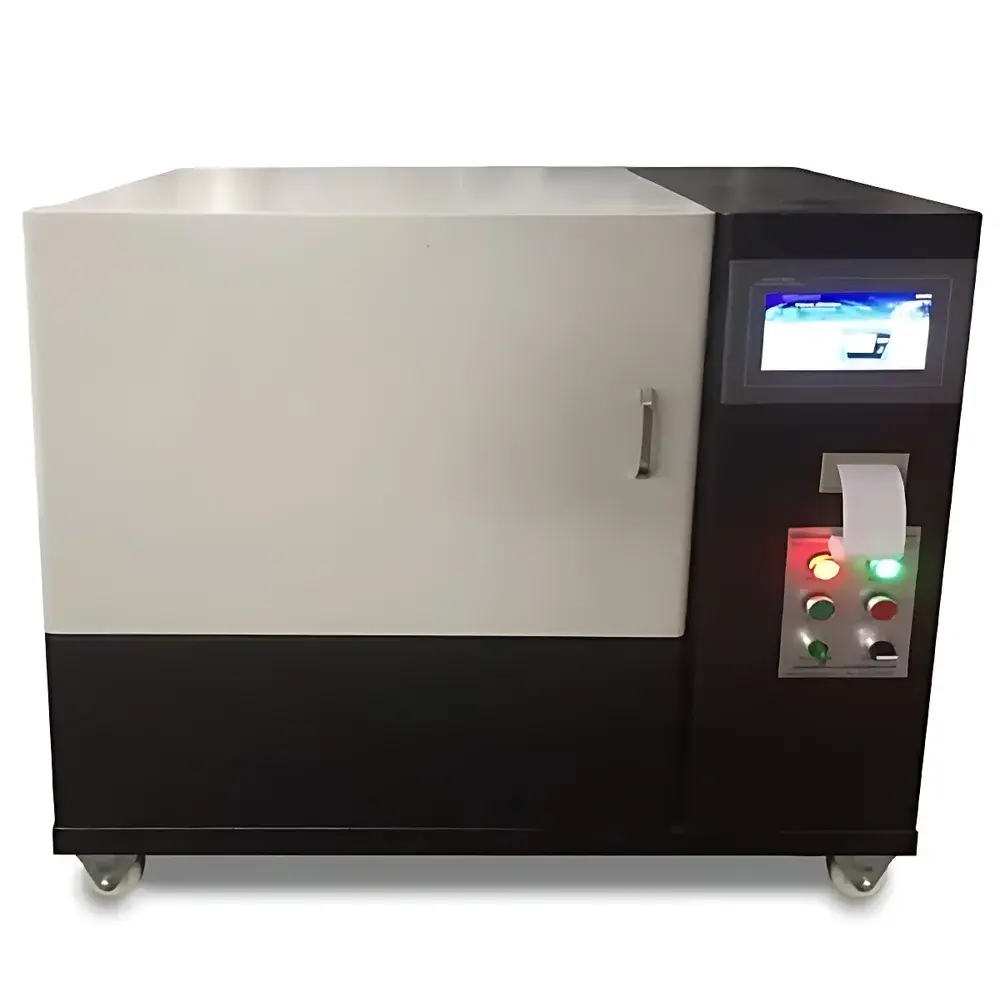
DRH-300 Smart Guarded Hot Plate Thermal Conductivity Analyzer
| Origin | Hunan, China |
|---|---|
| Manufacturer Type | Authorized Distributor |
| Origin Category | Domestic (PRC) |
| Model | DRH-300 |
| Price Range | USD 7,000–14,000 |
| Instrument Type | Guarded Hot Plate Method |
| Dimensions (L×W×H) | 820 × 760 × 950 mm |
| Accuracy | ±2% |
| Thermal Conductivity Range | 0.001–2.20 W/(m·K) |
| Repeatability | ±1% |
| Sample Thickness Range | 5–50 mm |
| Sample Size | 300 × 300 mm |
| Cold Plate Temp. Range | 0–60 °C (0.01 °C resolution) |
| Hot Plate Temp. Range | 10–99.9 °C |
| Temperature Uniformity (Hot/Cold Plates) | ≤0.1 °C |
| Surface Flatness Tolerance | ≤0.5 mm |
| Applied Pressure Range | 0–80 kPa (0.1 kPa resolution) |
| Power Supply | AC 220 V ±5%, 3.0 kW |
Overview
The DRH-300 Smart Guarded Hot Plate Thermal Conductivity Analyzer is an ISO 8302- and GB/T 10294-2008-compliant instrument engineered for precise, steady-state measurement of thermal conductivity in low-to-moderate-conductivity solid materials. It operates on the guarded hot plate principle—a primary standard method defined by ASTM C177 and ISO 8302—where a centrally heated test plate is surrounded by a temperature-controlled guard ring to eliminate lateral heat loss, ensuring one-dimensional vertical heat flow through the specimen. This architecture delivers metrologically traceable results essential for quality control, material certification, and R&D validation in building insulation, aerospace composites, and polymer engineering. The system supports both single- and dual-specimen configurations and integrates active thermal compensation, automatic parallelism adjustment between hot and cold plates, and real-time thermal drift correction—critical for minimizing boundary effects and achieving <±2% accuracy across its full 0.001–2.20 W/(m·K) range.
Key Features
- Single-specimen guarded hot plate design with high-efficiency thermal insulation and active guard-ring temperature tracking via fuzzy PID control
- Triple-layer thermal shielding and environmental isolation to suppress ambient thermal interference
- Motorized, self-aligning hot/cold plate mechanism ensuring ≤0.5 mm specimen surface non-parallelism error
- Dual cooling options: Peltier-based electronic refrigeration or external chiller-compatible water-circulation system (optional)
- Integrated thickness gauge with linear incremental measurement (15–50 mm range, 0.1 mm resolution), compliant with EN 1946-3:1999
- Full-range pressure loading control (0–80 kPa, 0.1 kPa resolution) for standardized specimen compression per ISO 8302 Annex A
- Self-calibration routines for thermal conductivity and heating power, eliminating reliance on reference standards for routine verification
- Embedded temperature compensation algorithms for specimen average temperature, thickness, and edge-loss correction
Sample Compatibility & Compliance
The DRH-300 accommodates rigid, semi-rigid, and flexible low-density solids including mineral wool, glass fiber batts, ceramic fiber boards, vacuum insulation panels (VIPs), extruded/polystyrene (XPS/EPS) and polyurethane (PUR) foams, rubber elastomers, phenolic composites, and laminated insulating panels. Specimens must conform to 300 × 300 mm nominal dimensions and 5–50 mm thickness. The system satisfies mandatory requirements of GB/T 10294-2008 (equivalent to ISO 8302), GB/T 3399-1982 (plastics), GB/T 3139-2005 (fiber-reinforced plastics), and GB/T 17794-2008 (flexible elastomeric foams). All thermal measurements are fully auditable under GLP and GMP frameworks, with timestamped raw data logs, operator ID tagging, and change history tracking—supporting 21 CFR Part 11 readiness when deployed with validated software configuration.
Software & Data Management
The DRH-300 runs on a dedicated Windows-based thermal analysis platform with touchscreen interface and real-time graphical monitoring of temperature gradients, power consumption, and convergence status. The software performs automated test sequencing—including pre-conditioning hold, thermal equilibrium detection (ΔT < 0.02 °C/h), and multi-point steady-state validation—followed by ISO 8302-compliant conductivity calculation using measured heat flux, mean temperature difference, and corrected specimen geometry. All datasets are stored in encrypted binary format with XML metadata (sample ID, operator, date/time, calibration state, environmental conditions). Reporting modules generate PDF/Excel outputs with uncertainty budgets per GUM (JCGM 100:2008), compliance statements against referenced standards, and customizable templates aligned with CNAS, CMA, or third-party accreditation bodies.
Applications
- Quality assurance of thermal insulation products for construction compliance (e.g., China’s GB 50176, EU EPBD)
- R&D characterization of next-generation aerogels, phase-change composites, and nanostructured insulators
- Validation of thermal performance claims for green building certifications (LEED, BREEAM, China 3-Star)
- Batch release testing of fire-rated mineral wool and intumescent coatings per GB/T 10294–2008 Annex B
- Thermal property benchmarking in academic and industrial labs engaged in heat transfer modeling and finite-element simulation
FAQ
What international standards does the DRH-300 comply with?
It conforms to ISO 8302, ASTM C177, GB/T 10294-2008, GB/T 3399-1982, GB/T 3139-2005, and GB/T 17794-2008.
Can the system measure specimens thinner than 5 mm?
No—minimum specimen thickness is 5 mm per ISO 8302 requirements to ensure sufficient thermal resistance for reliable gradient measurement.
Is the software compatible with LIMS integration?
Yes—the system exports structured CSV and XML data with embedded metadata; API documentation is available for HL7 or ASTM E1384-compliant LIMS linkage.
Does the DRH-300 support dual-specimen testing?
Standard configuration is single-specimen; dual-specimen mode requires optional guard-ring expansion kit and firmware upgrade.
What maintenance is required for long-term accuracy?
Annual verification using NIST-traceable reference materials (e.g., SRM 1450c Fibrous Glass) and sensor calibration against platinum RTDs per IEC 60751 is recommended.



