
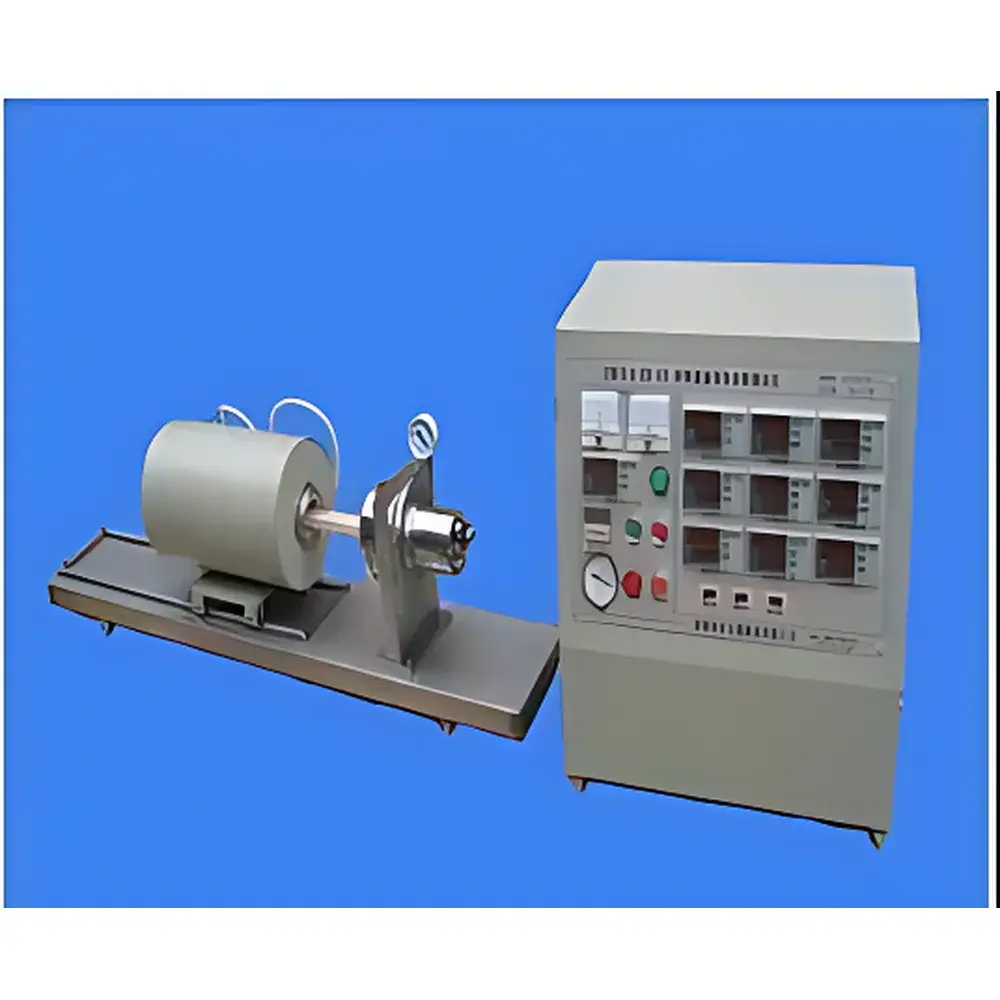
DRX-I-JH High-Temperature Thermal Conductivity Analyzer (Direct Electrical Heating Longitudinal Heat Flow Method)
| Origin | Hunan, China |
|---|---|
| Manufacturer Type | Authorized Distributor |
| Origin Category | Domestic (PRC) |
| Model | DRX-I-JH |
| Pricing | Available Upon Request |
| Max Operating Temperature | RT–600°C / RT–1000°C (configurable) |
| Thermal Conductivity Range | 0.035–40 W/(m·K) and 20–500 W/(m·K) (material-dependent) |
| Sample Geometry | Cylindrical rods (Ø5 × 220 mm for metals |
| Wire Samples | Ø1–3 mm diameter |
| Sample Quantity | ≥2 per test run |
| Measurement Accuracy | ≤5% (typical), down to ±2% under optimized calibration and controlled conditions |
| Vacuum/Atmosphere Control | Customizable (high-vacuum or inert gas purge options) |
| Automation | Fully computer-controlled heating ramping, data acquisition, real-time calculation, and report generation |
| Power Supply | 220 V AC, ≤4 kW total consumption |
Overview
The DRX-I-JH High-Temperature Thermal Conductivity Analyzer is an engineered solution for precise determination of thermal conductivity in electrically conductive solids under elevated temperature conditions. It operates on the direct electrical heating longitudinal heat flow method — a steady-state technique compliant with fundamental heat transfer theory (Fourier’s Law) and standardized for metallic and graphitic materials. In this configuration, the sample serves simultaneously as both resistive heater and thermal conductor: a controlled DC current passes axially through the specimen, generating uniform Joule heating along its length. Two or more calibrated thermocouples embedded at defined axial intervals measure the resulting temperature gradient, while the applied power and geometric cross-section yield thermal conductivity via λ = (Q·L)/(A·ΔT). This method eliminates interfacial contact resistance errors common in guarded-hot-plate or laser-flash systems and is uniquely suited for high-conductivity, electrically active materials where conventional transient or comparative methods suffer from signal-to-noise limitations.
Key Features
- Two configurable high-temperature operating ranges: RT–600°C and RT–1000°C, achieved via dual-zone molybdenum-sheathed heating elements and optimized ceramic insulation.
- Dual-range thermal conductivity measurement capability: 0.035–40 W/(m·K) for low-to-moderate conductivity materials (e.g., doped graphite, ceramics), and 20–500 W/(m·K) for high-conductivity metals (e.g., copper, stainless steel, tungsten alloys).
- Integrated precision thermocouple positioning system supporting ASTM E230/E230M-compliant sensor placement — Ø3 mm × 2 mm blind holes drilled at 50 mm intervals along the sample axis for reproducible thermal gradient mapping.
- Computer-controlled programmable heating rate (0.1–10°C/min), real-time PID regulation, and synchronized acquisition of voltage, current, and thermocouple outputs at 10 Hz sampling frequency.
- Modular atmosphere management: optional vacuum chamber (≤1×10⁻³ Pa) or inert gas purging (Ar/N₂) with mass flow control and pressure monitoring for oxidation-sensitive testing.
- Self-contained power electronics with four-quadrant DC source (0–30 A, 0–20 V), current stability <±0.05% over 24 h, and built-in overcurrent/overtemperature safety interlocks.
Sample Compatibility & Compliance
The DRX-I-JH accommodates cylindrical solid specimens conforming to national and international reference geometries: metallic rods (Ø5 mm × 220 mm), graphite specimens (Ø10 mm × 200 mm), and fine wires (Ø1–3 mm). All samples must exhibit sufficient electrical resistivity to generate measurable thermal gradients without excessive voltage drop or localized melting. The system meets the procedural requirements of GB/T 3651–1983 (“Test Method for Thermal Conductivity of Metals at Elevated Temperatures”) and GB/T 8722–1988 (“Determination of Thermal Conductivity of Graphite Materials at Intermediate Temperatures”). While not certified to ISO 22007-2 or ASTM C1113, its physical implementation aligns with the underlying principles of longitudinal heat flow standards and supports traceable calibration using NIST-traceable reference materials (e.g., SRM 735a nickel alloy).
Software & Data Management
The instrument is operated via Windows-based proprietary software featuring a validated GUI with audit trail functionality compliant with FDA 21 CFR Part 11 requirements (electronic signatures, user role management, immutable data logging). All raw sensor data — including time-stamped voltage, current, and thermocouple readings — are stored in HDF5 format with metadata headers (sample ID, operator, date/time, atmosphere, heating protocol). Thermal conductivity is calculated in real time using least-squares linear regression of ΔT vs. position, with automatic outlier rejection and uncertainty propagation based on instrument calibration certificates. Export options include CSV, PDF test reports (with graphical T-profile overlays), and XML for LIMS integration. Software versioning, backup scheduling, and encrypted local storage ensure GLP/GMP-aligned data integrity.
Applications
- Quality assurance of high-purity copper and aluminum alloys used in semiconductor packaging substrates and high-power electronics cooling interfaces.
- Thermal performance validation of nuclear-grade graphite moderators and reflectors across operational temperature windows (300–900°C).
- R&D of metal-matrix composites (e.g., Cu–SiC, Al–Al₂O₃) where interfacial thermal resistance dominates bulk behavior.
- High-temperature thermophysical property databases for computational materials modeling (e.g., input for ANSYS Mechanical or COMSOL Multiphysics thermal simulations).
- Process development support for sintering, hot isostatic pressing (HIP), and annealing cycles where thermal diffusivity evolution correlates with microstructural change.
FAQ
What standards does the DRX-I-JH comply with?
It implements test procedures aligned with GB/T 3651–1983 and GB/T 8722–1988. Its methodology is physically consistent with ISO 22007-2 Annex B (longitudinal heat flow) and ASTM C1113, though formal certification requires third-party verification.
Can non-conductive samples be tested?
No — the direct electrical heating principle requires measurable electrical resistivity. Insulators (e.g., alumina, quartz) must be evaluated using alternative techniques such as laser flash analysis (LFA) or guarded hot plate.
Is vacuum operation mandatory?
Vacuum or inert atmosphere is recommended above 500°C for oxidation-prone metals and graphite; below this threshold, ambient air operation is permissible for short-duration tests with stable samples.
How is calibration performed?
Calibration uses certified reference materials (CRMs) with known thermal conductivity curves (e.g., NIST SRM 735a) across the target temperature range. System linearity is verified via multi-point current/voltage sweeps and thermocouple drift checks before each qualification run.
What sample preparation support is included?
The delivery package includes dimensional inspection gauges, thermocouple hole drilling jigs (for Ø3 mm × 2 mm depth), and a sample alignment fixture ensuring coaxial insertion into the furnace zone. Detailed SOPs for surface polishing, electrical contact conditioning, and pre-test degassing are provided in the technical manual.



