
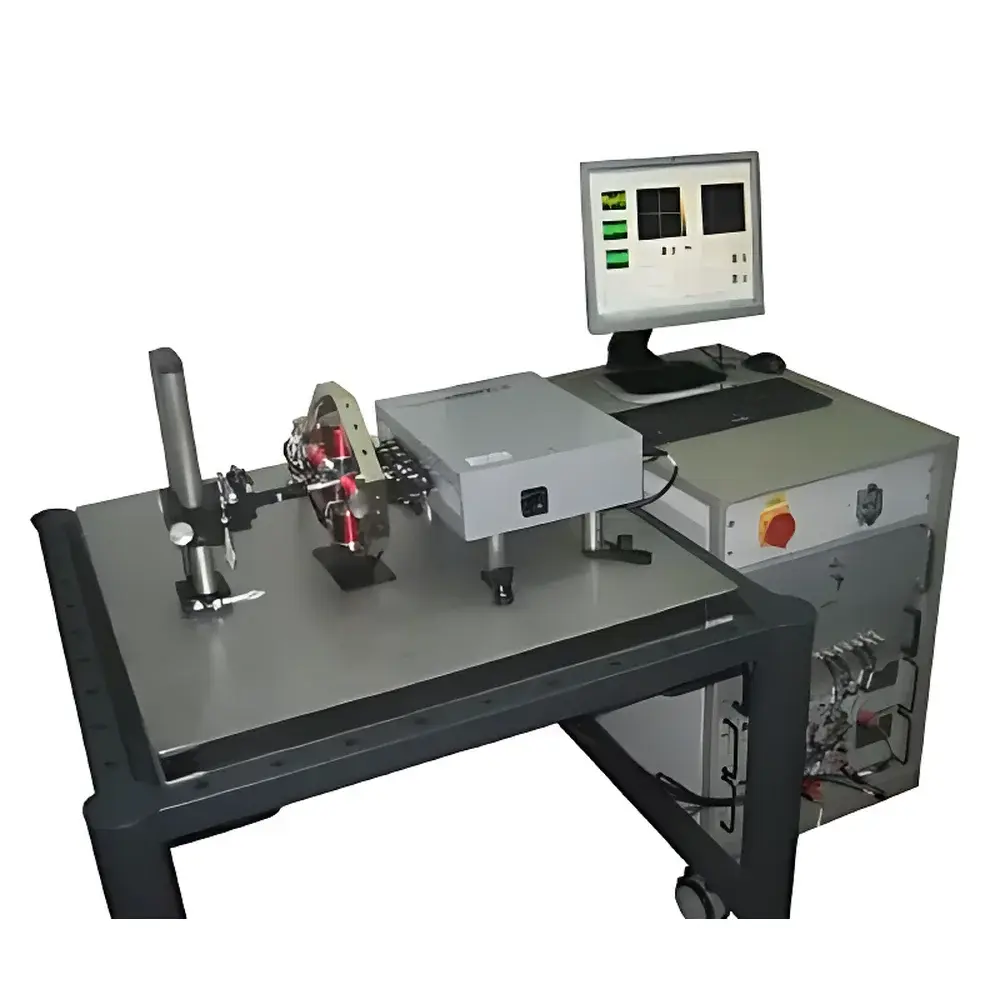
Durham Magneto Optics NanoMOKE3 Magneto-Optic Kerr Effect (MOKE) System
| Brand | Durham Magneto Optics |
|---|---|
| Origin | United Kingdom |
| Model | NanoMOKE3 |
| Temperature Range | 4.2–500 K |
| Maximum Magnetic Field | 5000 Oe |
| Minimum Detectable Kerr Rotation Angle | 0.5 mdeg |
| Minimum Detectable Reflectivity Change | 0.02% |
| Laser Spot Size | ≤2 µm |
| Magnetic Moment Sensitivity | ≤1 × 10⁻¹² emu |
| Sample Size Recommendation | 1–2.5 cm |
| Detection Modes | Longitudinal, Transverse, and Polar MOKE |
Overview
The Durham Magneto Optics NanoMOKE3 is a high-performance, integrated magneto-optic Kerr effect (MOKE) system engineered for quantitative nanoscale magnetometry and dynamic domain imaging. Based on the magneto-optical Faraday–Kerr principle—where polarized light undergoes rotation and ellipticity changes upon reflection from a magnetized surface—the NanoMOKE3 delivers sub-millidegree angular resolution and micro-emu magnetic moment sensitivity. It operates across cryogenic to elevated temperatures (4.2–500 K) under applied magnetic fields up to 5000 Oe, enabling comprehensive hysteresis loop acquisition, vector-domain mapping, and time-resolved magnetization dynamics analysis. Designed in close collaboration with the Department of Physics at Durham University and refined under the technical leadership of Prof. Russell Cowburn FRS, the system bridges fundamental magnetism research with applied spintronics development, offering laboratory-grade reproducibility without requiring ultra-high-vacuum or synchrotron infrastructure.
Key Features
- Sub-millidegree Kerr rotation detection (0.5 mdeg) and 0.02% reflectivity change resolution, enabling quantitative magnetization quantification at the single-microstructure level.
- Diffraction-limited laser spot size ≤2 µm, facilitating spatially resolved measurements on patterned thin films, nanowires, spin valves, and exchange-biased multilayers.
- Integrated optical microscope co-aligned with the MOKE probe path for real-time beam positioning, focus verification, and region-of-interest selection prior to scanning.
- Modular electromagnetic configuration support—including dipole, quadrupole, and solenoid magnets—allowing arbitrary field vector orientation, waveform synthesis (DC, AC, pulsed), and in-plane/out-of-plane field control.
- High-speed CCD-based raster imaging mode (≥30 fps full-frame) for real-time observation of domain wall motion, vortex nucleation/annihilation, and field-driven switching dynamics.
- Open optical architecture mounted on a standard 300 mm × 300 mm breadboard, permitting user-defined optical path modifications, auxiliary excitation integration (e.g., pump-probe, laser heating), and cryostat or electromagnet retrofitting.
Sample Compatibility & Compliance
The NanoMOKE3 is optimized for planar, optically reflective magnetic specimens—including sputtered/perovskite thin films (Co, NiFe, FePt, CoFeB), lithographically defined nanostructures, exchange-spring bilayers, and topological insulator heterostructures. Samples must exhibit surface roughness < λ/10 (typically <5 nm RMS) and minimal oxidation to ensure stable Kerr signal integrity. The system supports ASTM E1976-22 (Standard Guide for Magnetic Domain Imaging) and ISO/IEC 17025-compliant measurement traceability when operated with calibrated photodetectors and NIST-traceable field sensors. Full audit trail logging, electronic signature support, and configurable user access levels in LX Pro software align with FDA 21 CFR Part 11 requirements for regulated R&D environments.
Software & Data Management
LX Pro—a Windows-native, modular control suite—orchestrates hardware synchronization, data acquisition, and post-processing. It provides automated loop acquisition at variable temperature and field sweep rates, pixel-wise hysteresis integration for magnetic property mapping, and FFT-based dynamic mode analysis for resonance frequency extraction. Raw data are stored in HDF5 format with embedded metadata (field history, temperature setpoint, laser power, polarization state), ensuring FAIR (Findable, Accessible, Interoperable, Reusable) compliance. APIs (Python/C++ DLLs) enable third-party integration with LabVIEW, MATLAB, or custom DAQ systems; timestamped triggers support synchronized acquisition with external sources (e.g., RF generators, pulse lasers, dilution refrigerator controllers).
Applications
- Quantitative determination of easy/hard magnetization axes, coercivity, remanence, and domain wall pinning energy in epitaxial and polycrystalline films.
- Spatially resolved anisotropy mapping via vector-loop area integration across user-defined grids (100 × 100 points typical).
- In situ observation of thermally activated domain wall creep, Barkhausen noise, and stochastic switching under sub-critical fields.
- Time-resolved imaging of current-induced domain wall motion in Pt/Co/Pt racetracks and skyrmion lattice deformation under rotating fields.
- Correlative analysis combining Kerr reflectivity contrast (topography proxy) with magnetic contrast to decouple interfacial strain effects from intrinsic magnetic order.
- Validation of micromagnetic simulations (OOMMF, MuMax3) through direct comparison of simulated vs. measured domain configurations under identical field histories.
FAQ
What magnetic configurations does the NanoMOKE3 support?
It supports longitudinal, transverse, and polar MOKE geometries—requiring only optical reconfiguration of the incident beam angle and analyzer orientation.
Can the system operate inside a cryostat or vacuum chamber?
Yes—optical feedthroughs and motorized stage interfaces are compatible with commercial cryostats (e.g., Montana Instruments Cryostation, BlueFors) and UHV chambers equipped with CF-63 viewports.
Is calibration traceable to national standards?
Field calibration uses NIST-traceable Hall probes; angular sensitivity is verified via calibrated waveplate rotation sequences per ISO 10110-5.
How is data integrity ensured during long-duration dynamic imaging?
LX Pro implements checksummed HDF5 writing, automatic backup to network storage, and real-time signal-to-noise monitoring with adaptive exposure adjustment.
Does the system support pump-probe magneto-optical experiments?
Yes—TTL-triggered laser modulation inputs and programmable delay generators allow synchronization with femtosecond laser systems for ultrafast demagnetization studies.



