
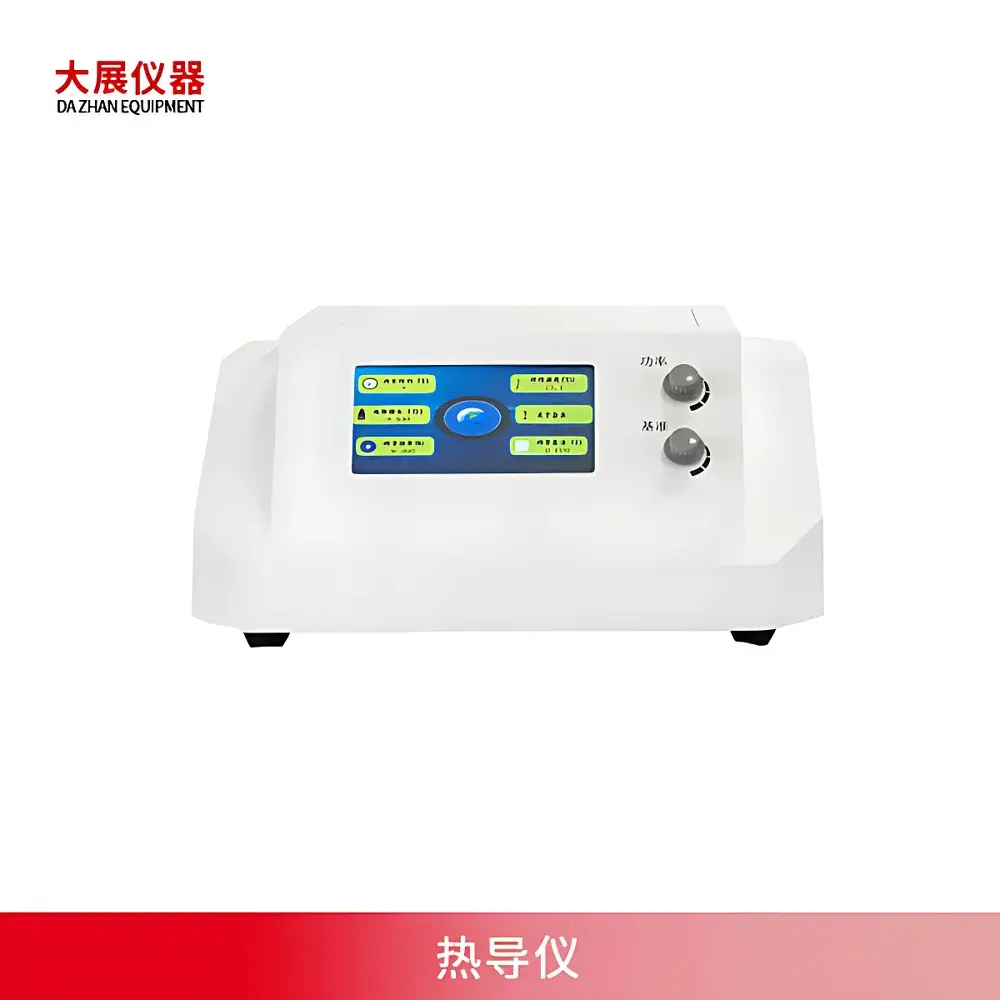
DZDR-S Thermal Conductivity Analyzer by DAZHAN
| Brand | DAZHAN |
|---|---|
| Origin | Jiangsu, China |
| Model | DZDR-S |
| Measurement Principle | Transient Plane Source (TPS) Method |
| Thermal Conductivity Range | 0.0001–300 W/(m·K) |
| Accuracy | ±3% |
| Repeatability | ≤3% |
| Temperature Range | Ambient to 130 °C (extendable to −40 °C to 300 °C) |
| Sample Forms | Solid, Liquid, Gel, Paste, Powder, Film, Granular, Metallic, Insulating Materials |
| Probe Options | 7.5 mm, 15 mm, 50 mm diameter dual-spiral probes |
| Measurement Time | 5–160 s (user-configurable) |
| Dimensions (L×W×H) | 440 × 390 × 220 mm |
| Power Supply | AC 220 V |
| Max. Power Consumption | <500 W |
| Probe Power Limits | ≤1 W (Φ7.5 mm), ≤20 W (Φ15 mm), ≤22 W (Φ50 mm) |
| Minimum Sample Dimensions | ≥15×15×3.75 mm (Φ7.5 mm probe), ≥30×30×7.5 mm (Φ15 mm probe), ≥50×50×15 mm (Φ50 mm probe) |
| Optional Accessories | Custom powder test cell |
Overview
The DZDR-S Thermal Conductivity Analyzer is a precision instrument engineered for rapid, non-destructive determination of thermal conductivity across a broad spectrum of material classes. It employs the internationally standardized Transient Plane Source (TPS) method—defined in ISO 22007-2 and ASTM D7984—where a thin, double-spiral sensor acts simultaneously as both heat source and temperature sensor. Upon electrical pulse excitation, the sensor transiently heats the adjacent sample volume; the resulting temperature rise over time is recorded and analyzed using a robust analytical solution to Fourier’s heat conduction equation. This first-principles approach eliminates reliance on calibration standards for absolute measurement, delivering traceable, physics-based results with high reproducibility. Designed for laboratory environments operating at ambient conditions, the system supports optional temperature-controlled stages for extended testing from −40 °C to 300 °C, enabling characterization under realistic service conditions for polymers, composites, thermal interface materials (TIMs), battery electrolytes, and insulating ceramics.
Key Features
- Direct, absolute thermal conductivity measurement without reference standards or empirical correlations
- Measurement duration configurable between 5 and 160 seconds—optimized for throughput without compromising resolution
- Three interchangeable dual-spiral probes (7.5 mm, 15 mm, 50 mm) for scalable testing—from micro-scale films to bulk insulation panels
- Non-invasive contact measurement: no sample coating, embedding, or destructive sectioning required
- Intuitive 7-inch color touchscreen interface with embedded real-time data visualization and parameter logging
- Modular sample stage accommodates variable thicknesses and geometries; compatible with custom fixtures for powders, pastes, and anisotropic solids
- Low-power probe operation ensures minimal thermal disturbance—critical for low-conductivity materials (<0.1 W/(m·K)) and temperature-sensitive formulations
Sample Compatibility & Compliance
The DZDR-S accepts heterogeneous sample forms—including rigid and flexible solids, viscous liquids, gels, pastes, granular media, and porous insulators—without requiring homogenization or shape conditioning beyond basic surface flatness (≥2× probe diameter in lateral dimension). Powder measurements are supported via an optional, sealed, temperature-stabilized test cell with controlled compaction pressure. All hardware and firmware comply with CE electromagnetic compatibility (EMC) directives and meet general safety requirements per IEC 61010-1. Data acquisition and reporting workflows align with GLP and GMP documentation expectations, supporting audit-ready export of raw voltage-time traces, calculated thermal diffusivity/conductivity values, and metadata (probe ID, timestamp, ambient T, user ID).
Software & Data Management
Bundled PC software provides full control, automated sequence execution, and advanced post-processing capabilities. Raw sensor response curves are stored in HDF5 format for long-term archival integrity. Export options include CSV, Excel, and PDF reports compliant with internal QA protocols. The software enforces user-level access control (administrator/operator modes), maintains immutable audit trails for all parameter changes and result exports, and supports 21 CFR Part 11–compliant electronic signatures when deployed in regulated environments. Calibration history, probe usage logs, and environmental drift compensation factors are tracked automatically.
Applications
- Quality control of thermal interface materials (TIMs) in electronics packaging
- R&D screening of polymer nanocomposites and phase-change materials (PCMs)
- Characterization of aerogels, mineral wools, and vacuum-insulated panels (VIPs)
- Thermal property mapping of battery electrode slurries and solid-state electrolytes
- Validation of computational models (e.g., finite element analysis) requiring experimentally derived k-values
- Regulatory submissions requiring ISO/ASTM-compliant thermal transport data
FAQ
What international standards does the DZDR-S comply with?
It implements the Transient Plane Source method per ISO 22007-2 and ASTM D7984, with traceability to NIST-traceable reference materials used during factory verification.
Can the instrument measure anisotropic materials?
Yes—by orienting the probe normal to principal axes and repeating measurements, directional thermal conductivity components can be resolved with appropriate sample preparation and mounting fixtures.
Is vacuum or inert atmosphere testing possible?
The base configuration operates in air; optional environmental chambers (with gas purge ports and vacuum flanges) enable testing under controlled atmospheres up to 10⁻³ mbar.
How is probe calibration maintained over time?
Each probe carries a unique digital ID storing its factory-calibrated resistance-temperature coefficients and geometric constants; no field recalibration is required unless physical damage occurs.
Does the system support automated batch testing?
Yes—the software supports script-driven multi-sample sequences with auto-loading triggers (via optional robotic stage integration) and pass/fail decision logic based on user-defined tolerance bands.



