
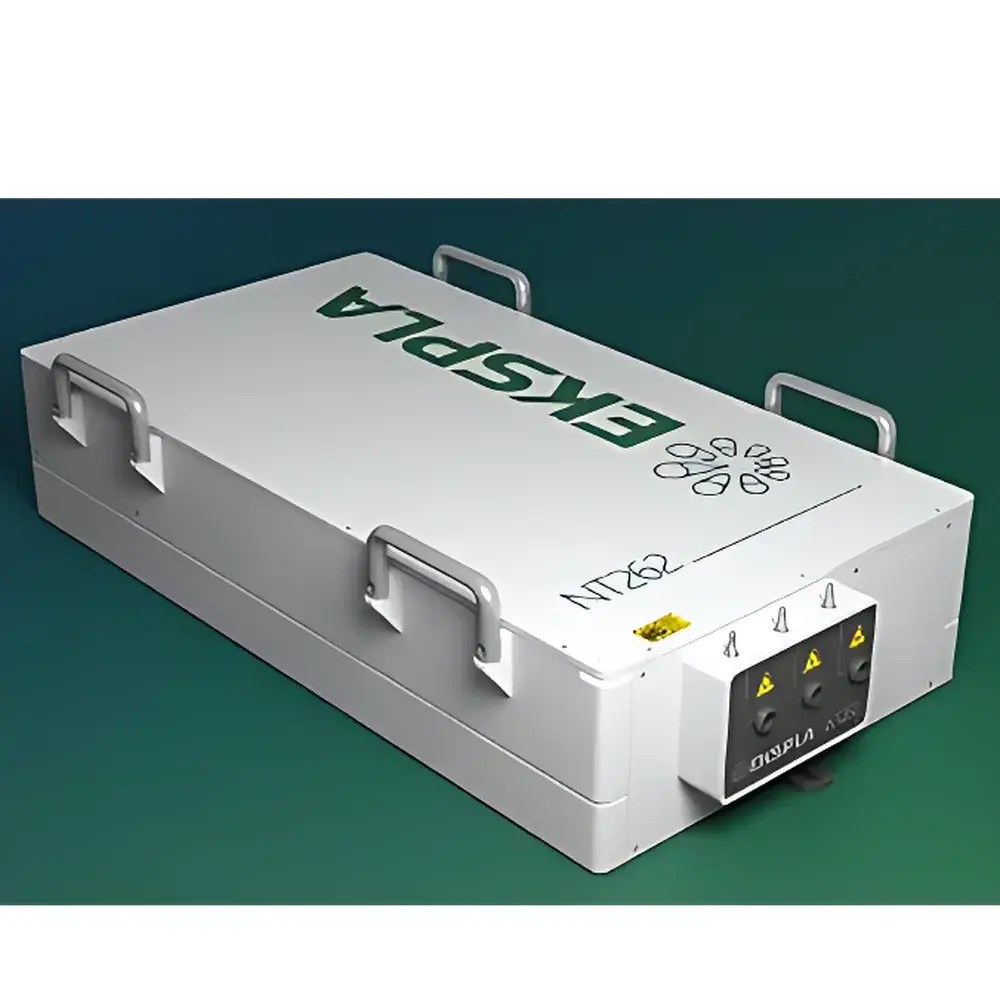
Ekspla NT260 Series Narrow-Linewidth 10 kHz Tunable Optical Parametric Oscillator Laser System
| Brand | Ekspla |
|---|---|
| Origin | Lithuania |
| Manufacturer Type | Original Equipment Manufacturer (OEM) |
| Product Category | Imported Instrument |
| Model | NT260 |
| Core Technology | Solid-State OPO-Based Tunable Laser Source |
| Wavelength Range | 210–2600 nm (gap-free, hands-free tuning) |
| Repetition Rate | 10 kHz |
| Linewidth | < 3 cm⁻¹ (typ. < 2 cm⁻¹) |
| Max. Avg. Output Power | 0.7 W |
| Pulse Energy | up to 70 µJ (OPO), 6 µJ (SH/SF option) |
| Pulse Duration | ~7 ns (FWHM) |
| Beam Quality (M²) | Superior to conventional OPOs |
| Cooling | Integrated air-cooled chiller |
| Compliance | Designed for ISO Class 9 cleanroom operation, GLP/GMP-compatible control architecture |
Overview
The Ekspla NT260 Series is a high-performance, solid-state optical parametric oscillator (OPO)-based tunable laser system engineered for precision spectroscopic applications requiring narrow spectral bandwidth, high pulse-to-pulse stability, and broad, continuous wavelength coverage. Operating at a fixed 10 kHz repetition rate, the NT260 leverages patented monolithic OPO architecture pumped by a Q-switched 355 nm Nd:YAG laser to deliver gap-free, hands-free tuning across an unprecedented 210–2600 nm range — spanning deep UV through visible to mid-IR. Its linewidth specification of < 3 cm⁻¹ (typically < 2 cm⁻¹ across most wavelengths) ensures high spectral brightness and resolution, making it suitable for demanding techniques where laser coherence and spectral fidelity are critical — including calibration-grade metrology, high-resolution gas absorption spectroscopy, and time-resolved pump-probe experiments. The system integrates a robust, vibration-insensitive monolithic frame, internal thermal stabilization, and factory-optimized alignment to minimize drift and maximize long-term operational reliability.
Key Features
- Gap-free, motorized wavelength tuning from 210 nm to 2600 nm without manual realignment or optical reconfiguration
- Stable 10 kHz pulse repetition rate with < 2.5% pulse energy standard deviation (RMS)
- Narrow linewidth output: < 3 cm⁻¹ (FWHM), typically < 2 cm⁻¹ across signal (405–710 nm) and idler (710–2600 nm) bands
- High average power: up to 700 mW in OPO output; optional SH/SF generator extends coverage to 210–405 nm with 60 mW avg. power
- Beam quality optimized for low M² and near-Gaussian spatial profile; beam pointing stability ≤ 50 μrad RMS
- Integrated motorized output shutter and keypad/PCB-based control interface for automated experiment sequencing
- Self-contained air-cooled chiller and built-in clean-air purge system ensure stable thermal management under laboratory conditions
- Designed for >20,000-hour diode pump lifetime and minimal maintenance intervals
Sample Compatibility & Compliance
The NT260 is compatible with standard optical tables, vacuum chambers, and spectroscopic sample cells used in fluorescence, photoacoustic, and absorption measurement setups. Its UV–VIS–NIR–MIR output supports interaction with a wide range of molecular species, thin-film materials, quantum dots, and gas-phase analytes. From a regulatory standpoint, the system’s firmware architecture supports audit-trail logging and user-access-level configuration — enabling compliance with GLP and GMP environments where instrument traceability is required. While not certified as FDA 21 CFR Part 11 compliant out-of-the-box, its control software architecture permits integration into validated workflows via external data acquisition systems adhering to 21 CFR Part 11 electronic record requirements. All optical enclosures meet IEC 60825-1:2014 Class 4 laser safety standards; interlock-ready ports support integration into facility-wide safety interlock networks.
Software & Data Management
Control is implemented via Ekspla’s proprietary Laser Control Suite (LCS), a Windows-based application supporting both local keypad operation and remote PC-driven automation via USB or Ethernet. LCS provides real-time monitoring of pulse energy, repetition rate, temperature diagnostics, and shutter status. Wavelength selection is performed through intuitive graphical sliders or programmable scripting interfaces (LabVIEW, MATLAB, Python SDK available). All parameter changes are timestamped and logged with user ID attribution — facilitating traceable experimental records. Data export supports CSV, HDF5, and ASCII formats, with metadata embedding (wavelength, pulse energy, ambient temperature, system uptime) preserved per acquisition cycle. Optional firmware upgrades maintain backward compatibility with legacy experiment protocols while introducing enhanced spectral calibration routines aligned with NIST-traceable reference lines.
Applications
- Laser-induced fluorescence (LIF) spectroscopy — especially in combustion diagnostics and biological imaging where VIS-range peak power (e.g., 450 nm) enhances signal-to-noise ratio
- Pump-probe transient absorption and photolysis studies requiring precise temporal synchronization and narrow excitation bandwidth
- Photoacoustic microscopy (PAM) leveraging high-repetition-rate NIR output for rapid volumetric scanning
- Metrology-grade calibration of spectroradiometers, monochromators, and detector quantum efficiency curves
- Gas-phase absorption spectroscopy (e.g., CH₄, CO₂, NO₂) in environmental monitoring and industrial process control
- LIDAR transmitter development for differential absorption LIDAR (DIAL) systems operating in atmospheric transmission windows
- Mass spectrometry ionization sources requiring tunable UV/VIS photons for soft ionization of labile biomolecules
FAQ
What is the typical warm-up time before stable operation?
The system requires approximately 15 minutes of thermal stabilization after power-on to achieve specified pulse energy and pointing stability. Continuous mains power is recommended; interruption exceeding one hour necessitates full re-warm-up.
Can the NT260 be integrated into automated production-line QA/QC systems?
Yes — its digital I/O interface, TTL-compatible trigger inputs/outputs, and scriptable control API enable seamless integration with PLC-controlled test benches and inline optical inspection platforms.
Is water cooling available as an alternative to the standard air-cooled chiller?
Water cooling is offered as a factory-configurable option for high-duty-cycle or thermally constrained installations; contact technical support for thermal load specifications and manifold interface requirements.
How is wavelength accuracy verified and maintained over time?
Each unit is calibrated against NIST-traceable atomic line standards (e.g., Hg, Ne, Kr lamps) during final acceptance testing. Internal wavemeter feedback is not included, but external high-resolution spectrometers (e.g., Andor Shamrock + iStar ICCD) can be synchronized for closed-loop calibration validation.
Does the system support dual-wavelength simultaneous output?
No — the NT260 operates in single-wavelength mode per pulse. However, rapid sequential tuning (< 100 ms between adjacent wavelengths) enables quasi-simultaneous multi-wavelength acquisition when paired with gated detection schemes.




