
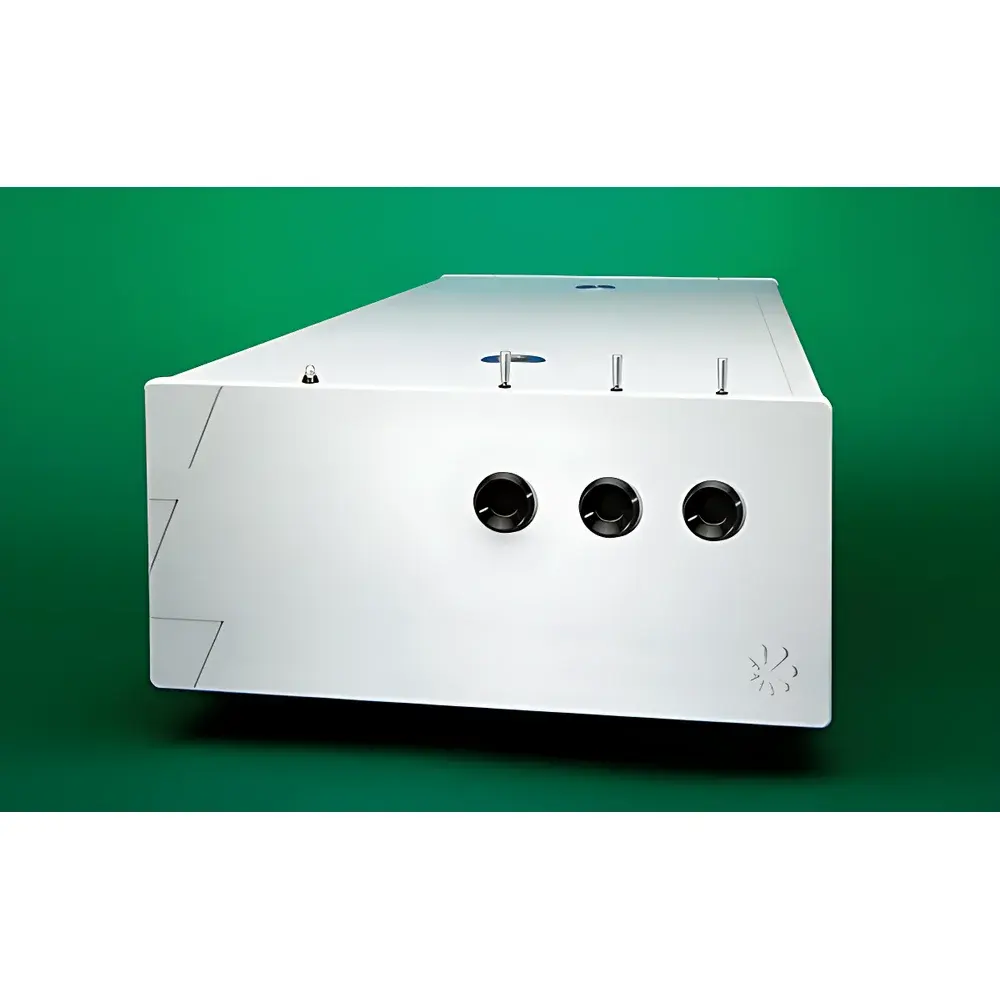
Ekspla NT350 High-Energy Tunable Infrared Laser System
| Brand | Ekspla |
|---|---|
| Origin | Lithuania |
| Model | NT350 |
| Laser Type | Solid-State OPO-Based Tunable Laser |
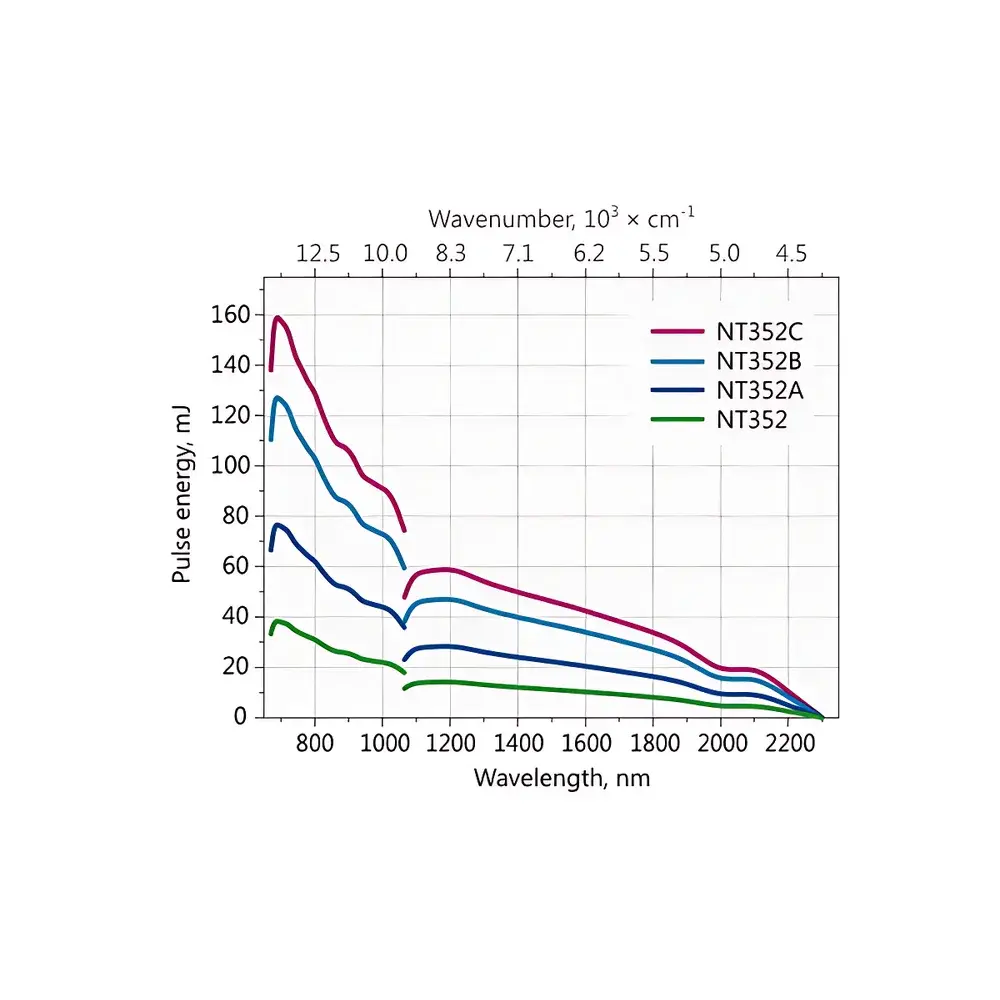
| Tuning Range | 670–2600 nm |
| Max Pulse Energy (IR) | 125 mJ per pulse |
| Linewidth | <5 cm⁻¹ (typ.) |
| Pulse Width | 3–5 ns |
| Repetition Rate | Up to 30 Hz |
| Pump Wavelength | 532 nm (integrated, separable beam) |
| Optional Output | 1064 nm |
| Control Interface | RS232 + LabVIEW™ drivers |
| Remote Operation | Handheld control unit |
| Flashlamp Replacement | Non-disruptive to cavity alignment |
| Resonator Design | Sealed, dust- and moisture-resistant cavity |
Overview
The Ekspla NT350 is a high-energy, solid-state optical parametric oscillator (OPO)-based tunable laser system engineered for demanding spectroscopic and nonlinear optical applications in research laboratories and industrial R&D environments. Operating on the principle of noncritical phase-matched optical parametric generation, the NT350 delivers broadly tunable near-infrared (NIR) output from 670 nm to 2600 nm, pumped by a frequency-doubled Q-switched Nd:YAG laser at 532 nm. Its integrated architecture features a thermally stabilized, hermetically sealed resonator housing that isolates critical nonlinear crystals (e.g., BBO, KTA, or ZnGeP₂ depending on tuning range configuration) from ambient humidity and particulate contamination—ensuring long-term stability and minimizing crystal degradation. Unlike manually tuned systems, the NT350 employs motorized grating and crystal angle positioning with closed-loop feedback, enabling fully automated, repeatable wavelength scanning without user intervention. This design supports high reproducibility across multi-day experiments and facilitates integration into automated measurement platforms requiring precise spectral agility.
Key Features
- Automated wavelength tuning over 670–2600 nm with programmable step resolution down to 0.1 nm (dependent on OPO crystal configuration)
- Single-pulse infrared energy up to 125 mJ, with pulse-to-pulse energy stability better than ±3% RMS (measured over 100 pulses at 10 Hz)
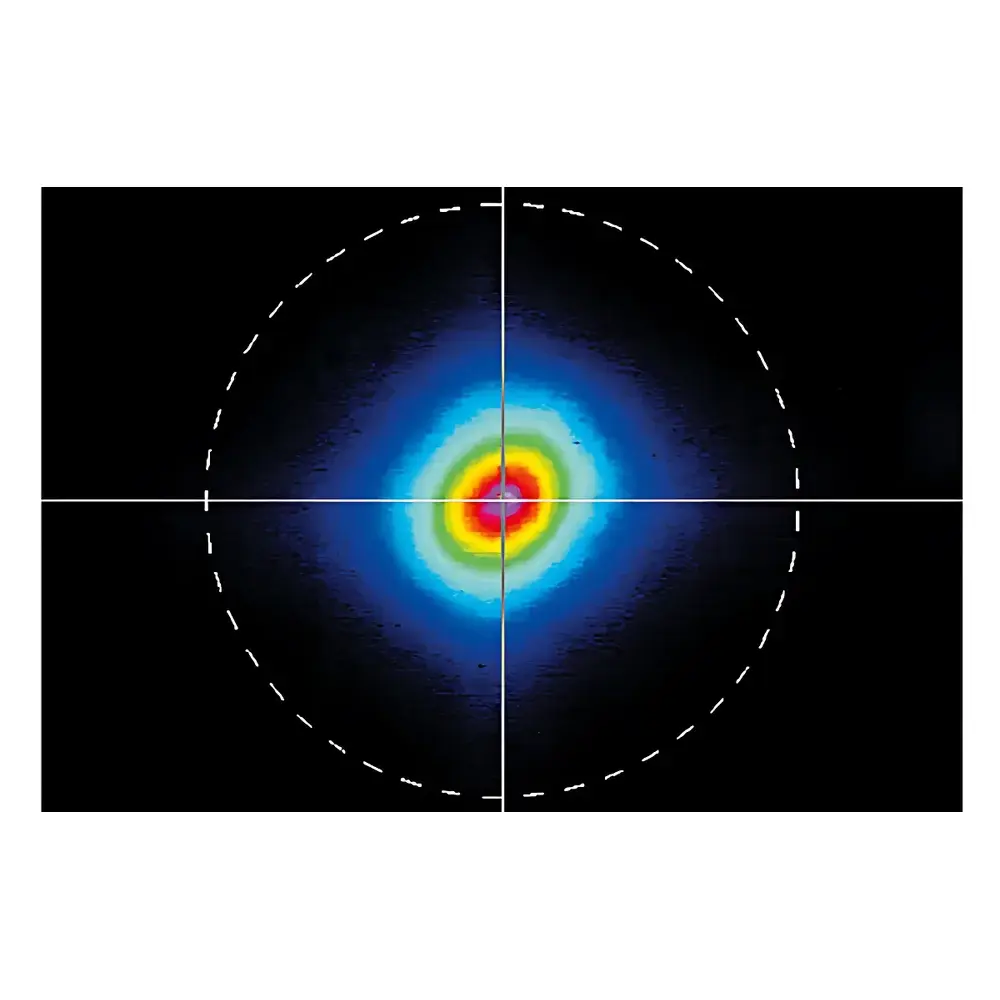
- Narrow spectral linewidth (<5 cm⁻¹ typical), suitable for high-resolution vibrational spectroscopy and selective photoexcitation
- Consistent pulse duration of 3–5 ns (FWHM), optimized for time-resolved pump-probe and transient absorption studies
- Maximum repetition rate of 30 Hz, compatible with gated detection schemes and lock-in amplification protocols
- Dedicated, collimated 532 nm pump beam output (separable from OPO signal/idler), rated at ≥800 mJ/pulse; optional 1064 nm fundamental beam output available
- RS232 serial interface with comprehensive SCPI-compatible command set and native LabVIEW™ drivers for seamless integration into custom data acquisition environments
- Handheld remote control unit enabling real-time parameter adjustment—including wavelength, repetition rate, and pulse energy attenuation—without accessing the main control PC
- Modular flashlamp replacement system: designed to allow lamp exchange without mechanical disturbance to resonator alignment or OPO crystal positioning
Sample Compatibility & Compliance
The NT350 is compatible with standard optical tables, vacuum chambers, gas cells, cryostats, and fiber-coupled sample interfaces commonly used in ultrafast and mid-IR spectroscopy labs. Its sealed resonator meets ISO 10110-7 cleanliness class 5 specifications for internal optical components and complies with IEC 60825-1:2014 Class 4 laser safety requirements when operated with appropriate interlocks and beam enclosures. The system supports GLP-compliant operation through configurable audit trails in host software (when used with validated LabVIEW™ applications), and its deterministic timing architecture enables synchronization with external triggers (TTL/5 V CMOS) for time-of-flight or delay-stage-controlled experiments. While not FDA-cleared as a medical device, its performance characteristics align with ASTM E1421–22 standards for calibration of FTIR spectrometers and USP guidelines for laser-based analytical instrumentation validation.
Software & Data Management
Control and automation are implemented via Ekspla’s proprietary LaserStudio software (Windows 10/11 compatible), which provides graphical wavelength scanning setup, real-time energy monitoring, pulse diagnostics, and script-based sequence execution. All hardware parameters—including OPO crystal angle, grating position, pump energy, and repetition rate—are logged with timestamps and exported in CSV or HDF5 format. The included LabVIEW™ driver package supports NI-DAQmx integration, enabling synchronized acquisition of detector signals (e.g., photodiodes, MCT detectors, or lock-in amplifiers) alongside laser metadata. For regulated environments, users may implement 21 CFR Part 11-compliant electronic signatures and audit logs using third-party LIMS or ELN platforms interfaced via TCP/IP or shared memory buffers.
Applications
- Photoacoustic imaging (PAI) of biological tissues using wavelength-selective absorption contrast in the NIR-II window (1000–1700 nm)
- Time-resolved vibrational spectroscopy, including picosecond IR pump–probe and 2D-IR correlation analysis
- Remote sensing and atmospheric LIDAR employing differential absorption techniques across water vapor and CO₂ absorption bands
- Nonlinear optical characterization: sum-frequency generation (SFG), difference-frequency generation (DFG), and coherent anti-Stokes Raman scattering (CARS)
- Photobiomodulation and optogenetics studies requiring precise NIR wavelength selection for chromophore-specific excitation
- Calibration source for Fourier-transform infrared (FTIR) spectrometers and monochromator-based radiometric systems
FAQ
What is the minimum pulse energy stability achievable across the full tuning range?
Typical pulse energy stability is ±3% RMS over 100 pulses at fixed wavelength and repetition rate; variation increases slightly at spectral extremes due to OPO gain roll-off.
Can the NT350 be integrated into a vacuum-compatible experimental chamber?
Yes—the 532 nm and OPO output beams are accessible via vacuum feedthroughs (CF-63 or KF-40 flanges); optional beam delivery optics include vacuum-rated kinematic mounts and AR-coated CaF₂ windows.
Is firmware update support provided after purchase?
Ekspla offers free firmware updates for registered systems via secure download portal, with version history and release notes compliant with ISO/IEC 17025 traceability requirements.
Does the system include built-in energy monitoring for the OPO output?
Yes—a calibrated pyroelectric sensor is integrated into the OPO beam path, providing real-time energy readout with NIST-traceable calibration certificate.
What maintenance intervals are recommended for flashlamps and nonlinear crystals?
Flashlamps are rated for ≥10⁶ shots at 30 Hz; crystals require no routine maintenance but benefit from annual visual inspection and humidity sensor verification within the sealed cavity.





