
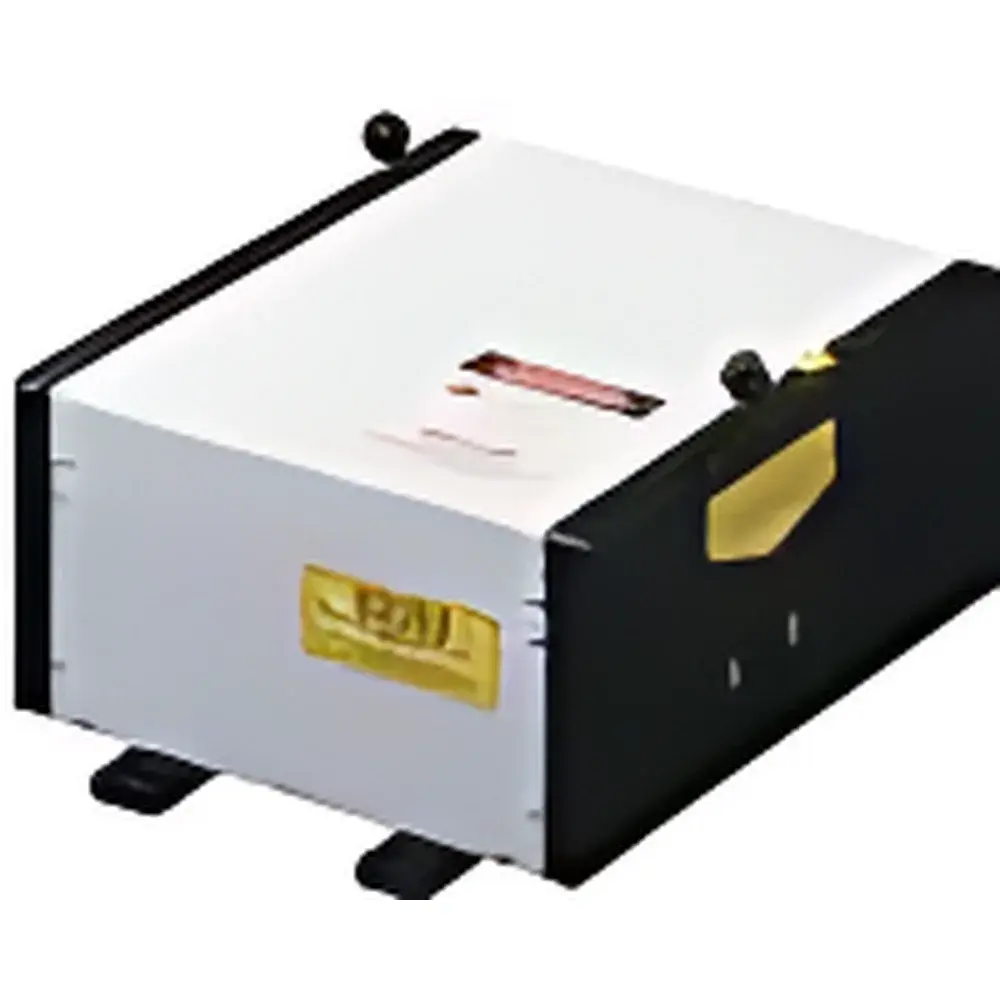
Ekspla PG100 Series Nanosecond Optical Parametric Oscillators
| Brand | Ekspla |
|---|---|
| Model | PG100 |
| Type | Nanosecond Optical Parametric Oscillator (OPO) |
| Pump Source Compatibility | Third-harmonic Nd:YAG Laser (355 nm) |
| Tuning Range | 420–2300 nm |
| Conversion Efficiency | Up to 35% (PG121), 20–30% (PG122) |
| Spectral Bandwidth | ≤5 cm⁻¹ (PG122) |
| Control Interface | LabVIEW-compatible drivers, RS-232/Ethernet remote operation |
| Cavity Design | Sealed, double-pass BBO crystal architecture |
| Nonlinear Crystal | Type I or Type II β-BaB₂O₄ (BBO), oven-stabilized |
| Beam Separation | Dichroic mirrors (PG121) or Glan-type polarizers (PG122) |
| Automation | Microprocessor-controlled motorized crystal rotation and cavity mirror alignment |
Overview
The Ekspla PG100 Series Nanosecond Optical Parametric Oscillators are high-stability, solid-state tunable laser sources engineered for precision spectroscopy, time-resolved fluorescence, photochemistry, and nonlinear optics research. Operating on the principle of optical parametric oscillation in β-barium borate (BBO) crystals, the PG100 family leverages nanosecond-pulsed third-harmonic Nd:YAG (355 nm) pump excitation to generate coherent output across an exceptionally broad spectral range—from 420 nm in the visible to 2300 nm in the near-infrared. Unlike broadband supercontinuum sources, PG100 OPOs deliver narrow-linewidth, high-spectral-purity radiation with deterministic wavelength selection—enabling reproducible calibration-critical experiments. The system’s core architecture employs a double-pass BBO configuration, eliminating the need for intracavity dispersion compensation while maintaining diffraction-limited beam quality and long-term pointing stability. All optical components—including the temperature-stabilized BBO crystal, prism assemblies, and dichroic or polarizing beam separators—are hermetically sealed within a rigid, vibration-damped housing to ensure operational reliability under continuous laboratory or industrial deployment.
Key Features
- Ultra-broad tuning coverage: 420–680 nm and 740–2300 nm (PG121); full 420–2300 nm (PG122)
- High optical-to-optical conversion efficiency: up to 35% (PG121) and ≥20% (PG122) under standard 355 nm pump conditions
- Narrow spectral bandwidth: ≤5 cm⁻¹ (PG122), optimized for high-resolution absorption and Raman spectroscopy
- Sealed, maintenance-free cavity design with oven-controlled BBO crystal (±0.1 °C stability)
- Fully automated wavelength scanning via stepper-motor-driven crystal rotation and cavity mirror positioning
- Integrated microprocessor controller enabling synchronized pump-OPO delay, pulse selection, and real-time diagnostics
- Native LabVIEW driver support and bidirectional RS-232/Ethernet communication for integration into automated test benches
- Glan-type polarizers (PG122) or dielectric dichroic mirrors (PG121) for clean signal/idler beam separation
Sample Compatibility & Compliance
The PG100 series is compatible with standard optical tables, vacuum chambers, and cryogenic sample environments via modular beam delivery interfaces (e.g., SM1-threaded kinematic mounts, Ø1″ or Ø25 mm collimated output). Its sealed cavity and dust-protected internal optics meet ISO 10110-7 cleanliness standards for Class 5 cleanroom operation. While not certified as medical or IEC 61000-4 compliant out-of-the-box, the system adheres to EN 60825-1:2014 safety requirements for Class 4 lasers when used with appropriate interlocks and enclosure integration. For regulated environments—including GLP-compliant analytical labs or FDA-audited pharmaceutical development workflows—the OPO supports audit-trail-capable software logging (via optional Ekspla Control Suite v4.x) and can be configured for 21 CFR Part 11–compliant user access control and electronic signature protocols.
Software & Data Management
Ekspla provides native Windows-based control software with programmable scripting (Tcl/Tk and Python APIs), supporting both manual parameter adjustment and fully automated spectral scans. The software logs timestamped metadata—including pump energy, crystal angle, cavity alignment status, and thermal sensor readings—for traceable experiment reconstruction. Export formats include CSV, HDF5, and MATLAB .mat, facilitating downstream analysis in Igor Pro, OriginLab, or custom Python pipelines. Remote operation is enabled via TCP/IP socket interface, allowing integration into LabVIEW, MATLAB, or EPICS-based facility-wide control systems. Firmware updates are delivered via secure HTTPS channel and verified using SHA-256 checksums to ensure integrity.
Applications
- Time-resolved pump-probe spectroscopy of carrier dynamics in perovskites and 2D materials
- Multi-wavelength photoacoustic imaging calibration across NIR-I and NIR-II biological windows
- Isotope-selective photodissociation studies in molecular physics
- Standards-based calibration of FTIR spectrometers and monochromator linearity verification
- In situ monitoring of catalytic surface reactions using tunable IR absorption
- Development of quantum light sources via SPDC seeding in integrated photonics platforms
FAQ
What pump laser specifications are required for optimal PG100 performance?
The PG100 series is designed for third-harmonic Nd:YAG lasers operating at 355 nm, with pulse durations of 3–8 ns, repetition rates from 10 Hz to 1 kHz, and pulse energies between 10–150 mJ. Minimum beam quality (M²) of ≤1.3 is recommended for efficient OPO threshold crossing.
Can the PG100 be integrated into ultra-high-vacuum (UHV) experimental chambers?
Yes—output beam ports accept ConFlat flanges (CF-35 or CF-63) via optional vacuum feedthrough adapters. Internal optics remain isolated; only the collimated output beam enters the UHV environment.
Is spectral calibration traceable to NIST standards?
Each unit ships with factory-measured wavelength calibration data referenced to atomic emission lines (e.g., Hg/Ne lamp spectra), with uncertainty <±0.2 nm over the visible range and <±2 nm beyond 1500 nm. On-site recalibration services are available through Ekspla’s metrology lab.
Does the system support external triggering and synchronization?
Yes—TTL-compatible trigger inputs accept sync pulses with jitter <1 ns, enabling precise timing relative to pump laser Q-switch or detector gate signals.
What maintenance is required during extended operation?
No routine optical alignment or consumable replacement is needed. Annual verification of crystal oven calibration and firmware update are recommended for GxP-regulated use.




